Getting ‘Mahatma Gandhi’ Calls? Here’s What It Really Means
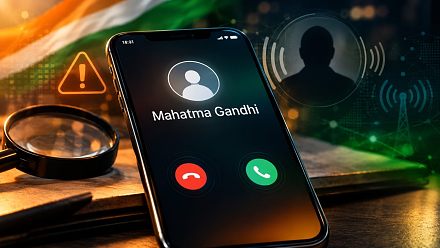
A bizarre caller ID showing “Mahatma Gandhi” has caught the attention of smartphone users ahead of Gandhi Jayanti 2026. The unusual name appearing on an incoming call has sparked curiosity online, but it also raises a mo
By Nibandh Vinod··77K reads
Getting ‘Mahatma Gandhi’ Calls? Here’s What It Really Means
A bizarre caller ID showing “Mahatma Gandhi” has caught the attention of smartphone users ahead of Gandhi Jayanti 2026. The unusual name appearing on an incoming call has sparked curiosity online, but it also raises a more important question: can a caller ID be trusted as proof of who is actually calling?
The answer is no.
Caller identification services use information from different sources, including community contributions, and the information displayed against a number can sometimes be inaccurate or outdated.
Truecaller itself says its community can suggest caller details and report numbers, while multiple user reports can contribute to a number being identified as spam.
That makes unusual caller names something users should treat with caution, not necessarily because every such call is fraudulent, but because curiosity can be used as an entry point for social-engineering scams.
Why Is ‘Mahatma Gandhi’ Appearing on Caller ID?
An unusual caller ID displaying “Mahatma Gandhi” has caught attention ahead of Gandhi Jayanti.
Caller identification services are designed to help users recognise unknown numbers. Truecaller says its caller information can incorporate community suggestions, while its spam detection also uses reports from users.
This means a caller name displayed on your screen should not automatically be considered independently verified information.
A surprising name can also make an unknown call much harder to ignore. Seeing the name of a famous personality, government organisation or well-known company may prompt a person to answer simply because they want to know why they are receiving the call.
That is where curiosity becomes a potential cybersecurity risk.
How the Scam Can Work
The first step in many phone scams is getting the victim to engage with the caller.
A scammer may use an unexpected or attention-grabbing caller identity to make someone answer.
Once the conversation begins, the caller may switch to a more familiar fraud tactic, such as pretending to represent a bank, government department, police agency, courier company or financial service.
The caller may then create urgency by claiming that:
Your bank account needs immediate verification
Your KYC is incomplete
A payment is pending
Your account or SIM will be blocked
A parcel or refund requires confirmation
You are involved in an investigation
You have won a prize or lottery
The objective can then shift towards obtaining sensitive information or persuading the victim to transfer money.
Curiosity Bait: Why People Answer
An ordinary unknown number can easily be ignored. But an unusual caller name can create a completely different reaction.
A person may answer because they are surprised, amused or simply curious about why such a name is appearing on their phone.
This is an example of social engineering, where a scam relies on manipulating a person’s emotions or behaviour rather than directly breaking into a device.
Once a person answers, a fraudster may attempt to establish credibility by using official-sounding language, creating urgency or claiming to have access to personal information.
Vishing: The Phone Scam To Watch Out For
Vishing, or voice phishing, is a type of scam in which criminals use phone calls to obtain information or persuade victims to take an action.
The caller may ask for an OTP, PIN, password, bank details or other personal information. In some cases, victims may also be asked to click a link, install an application or share access to their device.
These are major warning signs.
Never share an OTP, password, PIN, banking credential or other sensitive information simply because a caller appears to know your name or other personal details.
Cybersecurity Alert: Don’t Trust Caller ID Alone
The unusual “Mahatma Gandhi” caller ID is a useful reminder that caller ID is not the same as identity verification.
If an unexpected caller claims to represent a bank, government department or another organisation, do not rely solely on the name displayed on your phone.
Instead:
Pause: Do not allow a caller to pressure you into making an immediate decision.
Verify: End the call and contact the organisation through its official website, app or verified customer-care number.
Protect: Never share OTPs, passwords, PINs, Aadhaar details, card information or banking credentials over an unsolicited call.
Don’t click: Avoid links sent unexpectedly through SMS or messaging apps, particularly if they involve payments, KYC or account verification.
Don’t install: Never install an unknown application because an unexpected caller tells you to do so.
How to Block and Report Suspicious Numbers
If you receive a suspicious call, you can block the number on your phone or through Truecaller. Truecaller says users can search for a number and use the Block and Report Spam options. Its spam identification system also uses community reports to identify numbers associated with unwanted calls.
Reporting a suspicious number can help strengthen community-based spam detection, although a report does not by itself establish that the caller is fraudulent.
For suspected cybercrime in India, the government’s National Cyber Crime Reporting Portal provides reporting facilities, while 1930 is the national helpline for immediate reporting of cyber financial fraud.
What If You Have Already Shared Your Details?
If you have accidentally shared banking information, an OTP or other sensitive details with a suspicious caller, act quickly.
Contact your bank or financial institution through its official channel and explain what happened. If money has been lost through cyber financial fraud, report it immediately through 1930 and the National Cyber Crime Reporting Portal.
The faster a suspected financial fraud is reported, the sooner the appropriate authorities and financial institutions can begin their response.
The appearance of “Mahatma Gandhi” on a caller ID may be surprising, but the name displayed on your screen should not be treated as proof of the caller’s identity.
The bigger lesson is about cybersecurity awareness. Unusual caller names can attract attention, and scammers can use curiosity, urgency and impersonation to keep people engaged.
With Gandhi Jayanti 2026 approaching, the viral claim has attracted attention, but users should focus less on the name displayed on the screen and more on what the caller is asking them to do.
Pause. Verify independently. Never share sensitive information. And report suspected fraud immediately.
Disclaimer: This article is intended for general cybersecurity awareness. An unusual caller ID does not by itself establish that a call is fraudulent. Users should independently verify suspicious communications and report suspected cybercrime through official channels.