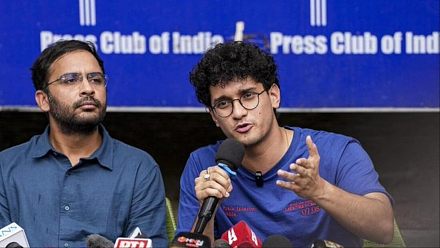
'You Broke Bond Very Next Day': Delhi HC Raps CJP Leaders Das, Ranka While Hearing Plea Challenging Detention
The Delhi High Court on Wednesday questioned Cockroach Janta Party (CJP) leaders Saurav Das and Ashutosh Ranka over their alleged breach of a preventive bond, observing that the authorities could insist on stricter suret
By Vani Mehrotra··73K reads
'You Broke Bond Very Next Day': Delhi HC Raps CJP Leaders Das, Ranka While Hearing Plea Challenging Detention
The Delhi High Court on Wednesday questioned Cockroach Janta Party (CJP) leaders Saurav Das and Ashutosh Ranka over their alleged breach of a preventive bond, observing that the authorities could insist on stricter sureties after a second incident involving a breach of peace. The court made the remarks while hearing their plea challenging the extension of their judicial custody and seeking immediate release.
Justice Subramonium Prasad was hearing the petition filed by Das and Ranka against an October 19 order of the Special Executive Magistrate (SEM), New Delhi district, extending their custody until October 21 in preventive proceedings under Sections 126 and 170 of the Bharatiya Nagarik Suraksha Sanhita (BNSS).
During the hearing, the court questioned the petitioners’ decision to approach it under Article 226 of the Constitution instead of pursuing an alternative legal remedy.
It also examined the circumstances surrounding their arrest following a protest at Jantar Mantar, where the activists allegedly attempted to unfurl the national flag in violation of prohibitory orders.
‘You Gave A Bond And Broke It’
Questioning the petitioners’ conduct, the court referred to the sequence of events involving their bail bonds and subsequent arrest.
“On 11.10 when your bail bonds are accepted, sureties are given, and when a bail bond is broken there is a procedure under BNSS for action to be taken,” the court observed, adding that instead of following that procedure, the authorities had been more lenient by issuing a notice.
The court further questioned whether the authorities could be faulted for insisting on sureties after an alleged second breach of peace.
“Once you have broken peace for the second time, are the authorities not entitled to insist upon everything?” Justice Prasad asked the petitioners’ counsel, Abhik Chimni.
The court also pointed to the sequence in which the activists furnished bonds and subsequently returned to Jantar Mantar after the venue had been denotified.
“You gave a bond, and when you go again, by which time Jantar Mantar is denotified, the challenge to denotification is pending before the Supreme Court. The notification is yet not stayed, you go there and you take a step again,” the court remarked.
The judge said the question of whether the authorities’ action was legally justified would be examined, but questioned the petitioners’ challenge to the insistence on sureties.
“In such a case, insistence on a surety, can it be said to be that illegal or that much against the law? We will hear you on that,” the court said.
Court Warns Of Consequences Of Breaking Barricades
The High Court also expressed concern that actions by the two petitioners could encourage others to violate prohibitory orders, potentially leading to a breach of peace.
“The two petitioners here are at the forefront. When you go and break a barricade, the chances of 10 or 20 more people in violation of 163 are very high,” the court observed, referring to the possibility of others joining the protest.
The court said demonstrations that begin peacefully could escalate, and referred to incidents in other countries while explaining the need for police permission.
“Arson etc. You may have started with something you say is peaceful. For that purpose you take police permission which is to prevent unwanted persons who join your group and spoil your name,” Justice Prasad said.
HC Questions Why Petitioners Approached It Under Article 226
During the hearing, Chimni argued that the October 19 order was fundamentally flawed and that the authorities lacked jurisdiction to extend the petitioners’ custody.
He also contended that the petitioners had repeatedly furnished sureties but were unable to secure their release.
The court, however, questioned why the petitioners had approached it under Article 226 when a revision or appeal could be available against the order.
“Your second incident. You are a person who has actually broken a bond. Your remedy actually lies in revision,” the court told the counsel, distinguishing between the maintainability of a petition and whether it should be entertained.
The judge suggested that the petitioners consider withdrawing the plea, allowing the proceedings before the SEM to take place, and then approaching the appropriate court if they were aggrieved by the outcome.
“Instead of arguing now, why not keep your powder dry for revision court and then this Court,” Justice Prasad said, cautioning that continuing with arguments could have consequences for the petitioners.
The court also distinguished between preventive custody and preventive detention, observing that a challenge to preventive detention could be pursued through a habeas corpus petition.
It further explained that an appellate court could examine facts and their appreciation, whereas a writ court under Article 226 generally examines the decision-making process rather than the decision itself.
Petitioners Withdraw Plea; Contentions Kept Open
The petitioners had challenged the SEM’s October 19 order extending their custody until October 21, arguing that their continued detention since October 13 was illegal and violated their right to personal liberty.
They contended that additional sureties, accompanied by executed bonds and fixed deposit receipts, had been available but were not allowed to be presented.
Their counsel also argued that the order did not adequately explain what material indicated an imminent future threat warranting continued custody.
The hearing also touched upon the petitioners’ ages and the nature of their organisation. After being informed that Das was 27 and Ranka was 32, the judge remarked, “Then you are not Gen Z,” after asking what constituted Gen Z.
The court also questioned the changing causes associated with the organisation and said that, where the apprehension of a breach of peace was involved, the identity, activities and purpose of an organisation could become relevant.
After a brief break, Chimni informed the court that the petitioners would withdraw the plea. The High Court recorded the withdrawal and allowed it, while leaving all contentions of both sides open.
Additional Solicitor General Chetan Sharma, appearing for Delhi Police along with advocate Ashish Dixit, also referred to what he described as the petitioners’ “fissiparous conduct”, saying their bail bonds had been “thrown to the winds” and that four sureties had been revisited.