Why Akhilesh Met Azam After 11 Months: SP’s 2027 UP Poll Strategy, Ticket Distribution & Muslim Representation
Samajwadi Party (SP) president Akhilesh Yadav’s meeting with senior party leader Azam Khan at Rampur district jail on Thursday has brought the veteran leader’s role in the party’s 2027 Uttar Pradesh Assembly election str
By Oliver Fredrick··113K reads
Why Akhilesh Met Azam After 11 Months: SP’s 2027 UP Poll Strategy, Ticket Distribution & Muslim Representation
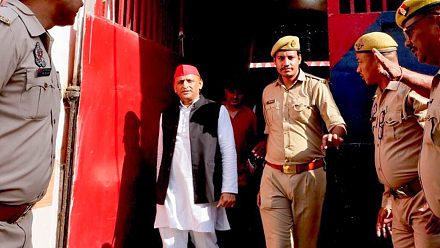
Samajwadi Party (SP) president Akhilesh Yadav’s meeting with senior party leader Azam Khan at Rampur district jail on Thursday has brought the veteran leader’s role in the party’s 2027 Uttar Pradesh Assembly election strategy into sharp focus.
The hour-long interaction comes amid questions over the relationship between the two leaders, Khan’s influence over candidate selection and the SP’s efforts to consolidate its support base in western Uttar Pradesh.
More than a meeting between two senior leaders, the interaction signals the importance of managing regional leadership and internal political equations ahead of the Assembly elections. For Akhilesh, the challenge is to maintain the authority of the central leadership while accommodating a veteran whose political network remains significant in Rampur and neighbouring districts.
THE MEETING WITH AZAM KHAN
Khan, a founding member of the SP and a ten-time MLA from Rampur, has been one of the party’s most prominent Muslim leaders. His prolonged incarceration has restricted his direct participation in politics, but his political standing continues to make his relationship with the party leadership an important issue in the run-up to 2027.
UP’s political observers strongly believe that the SP’s political calculations in western Uttar Pradesh provide an important context for the meeting. “Khan has built a political network over several decades, particularly in Rampur and the wider Moradabad division. His influence extends beyond his personal electoral record to local leaders, party workers and constituency-level political relationships,” a political analyst pointed out.
In the 2022 Assembly elections, the SP won 17 of the Moradabad division’s 27 seats. While the result reflected several political and social factors, it underlined the region’s importance to the party.
Political analyst Shashikant Pandey, head of the Department of Political Science at Dr Bhimrao Ambedkar University, Lucknow, said the meeting needed to be understood in the context of the SP’s preparations for the next Assembly elections.
“The meeting has both organisational and political significance. Azam Khan has a long-standing political network in western Uttar Pradesh, and the SP leadership has to balance the influence of regional leaders with its own electoral strategy. The larger question is whether this engagement translates into a meaningful role for Khan’s network in the party’s preparations for 2027,” Pandey said.
Party insiders said the meeting was also viewed internally as an effort to maintain communication with Khan’s supporters and address concerns over the party’s regional organisation and future ticket distribution.
WHY AZAM KHAN MATTERS
Candidate selection is likely to be one of the key issues shaping the relationship between the two leaders. Khan’s camp has sought consideration for preferred candidates in several constituencies across western Uttar Pradesh, bringing his potential role in the party’s electoral planning into focus.
During the 2024 Lok Sabha elections, the SP fielded Mohibullah Nadvi from Rampur despite reported differences over the choice. The episode highlighted the competing considerations involved in candidate selection: the authority of the central leadership, local political equations and the preferences of influential regional leaders.
So, for 2027 Assembly elections, the question is whether Khan will be consulted on candidates in constituencies where he has maintained a political presence.
Party insiders said some leaders believe Khan’s views could be relevant in constituencies where his network remains active, while the final authority over tickets is expected to remain with the central leadership.
A senior SP leader, Ajay Sagar, has previously cautioned against overlooking Khan’s influence, saying, “We will suffer in the elections if we ignore Azam.”
However, it remains to be seen how much influence he will have over the final selection of candidates.
WHAT IT MEANS FOR SAMAJWADI PARTY
The meeting also comes amid a wider political debate over Muslim representation in Uttar Pradesh. AIMIM chief Asaduddin Owaisi has challenged the SP’s claim to represent Muslim political interests and has criticised its approach towards Muslim leaders.
For Akhilesh, the issue extends beyond Khan personally. The SP has traditionally received considerable support from Muslim voters, but retaining that support requires more than relying on established political loyalties. Local leadership, candidate credibility, representation and constituency-specific issues will also shape the contest.
Khan’s continued association with the SP gives the party an opportunity to underline its relationship with a senior Muslim leader who has been associated with it since its formative years.
However, at the same time, the political observers said, the meeting alone cannot establish whether political concerns among Khan’s supporters have been resolved. The SP will also have to build its wider electoral appeal across caste and community groups while maintaining its organisational strength in western Uttar Pradesh.
Khan’s legal troubles, however, continue to restrict his direct participation in political activities. His incarceration has limited his ability to campaign and engage with party workers, leaving the SP dependent on its local organisation and other leaders to maintain its presence in the region.
Akhilesh, after the meeting, reiterated his support for Khan and alleged that the veteran leader and his family had faced injustice.
Party insiders said that the meeting has reopened communication between two prominent SP figures at a time when the party is preparing for a crucial Assembly election. Whether it leads to a broader political understanding will become clearer through decisions on candidate selection, regional responsibilities and campaign planning.
As the 2027 elections approach, Khan’s place in the party’s strategy will be judged not merely by meetings or public statements, but by the role he and his political network are given in shaping the party’s campaign in western Uttar Pradesh.