Where Is Maa Durga? The Kolkata Poster Turning Dussehra vs Durga Puja Into A Row
A Hindi poster from Kolkata’s Salt Lake has X asking an unlikely question: where is Maa Durga? Billed as ‘Ram ki Ayodhya’, the Durga Puja event ends today with Ravan Dahan. Its blend of Ram and Durga imagery has reopened
By Sumedha Kirti··159K reads
Where Is Maa Durga? The Kolkata Poster Turning Dussehra vs Durga Puja Into A Row
A Hindi poster from Kolkata’s Salt Lake has X asking an unlikely question: where is Maa Durga? Billed as ‘Ram ki Ayodhya’, the Durga Puja event ends today with Ravan Dahan. Its blend of Ram and Durga imagery has reopened an old debate on festivals, language and identity in Bengal.
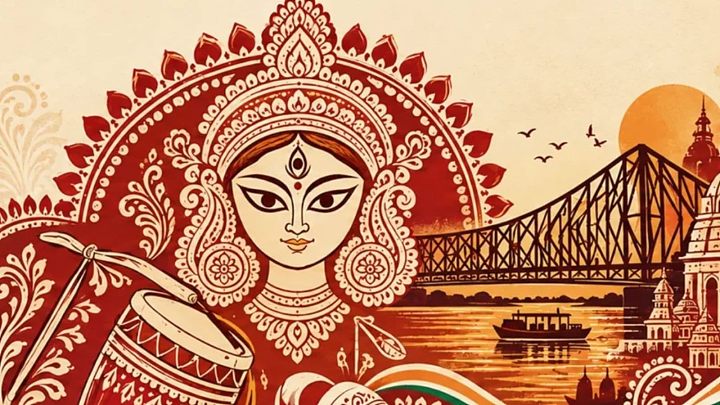
The poster, shared on X at 7:26am on October 20 and viewed over 21,000 times, advertises ‘the grandest Durga Puja celebration in India’ at the Boi Mela Prangan in Karunamayee, Salt Lake, from October 15 to 20.
It promises a Ravan Dahan at 5pm by Chief Minister Suvendu Adhikari, under a ‘Sitaaron se saja Dussehra’ banner featuring Namit Malhotra’s upcoming Ramayana, with Ranbir Kapoor as Ram, Ravi Dubey as Lakshman and Sai Pallavi as Sita against a Ram Mandir backdrop. Nowhere in the text does it mention Durga’s idol, which is what viewers latched on to.
Spot Maa Durga in this poster
Sometimes I wonder whether we are still West Bengal or East UP/Bihar!
Also why is a Bengali CM celebrating Dashami on Nabami? https://t.co/j6UbTlf3Dr
— Agnivo Niyogi (অগ্নিভ নিয়োগী) (@Aagan86) October 20, 2026
Who Is Behind It, And What Do They Say?
The event is organised by the Salt Lake Sanskritik Sansad, which has hosted a Dussehra programme in the township for years, and this is its first Durga Puja. Governor R N Ravi inaugurated it on October 15, reports said.
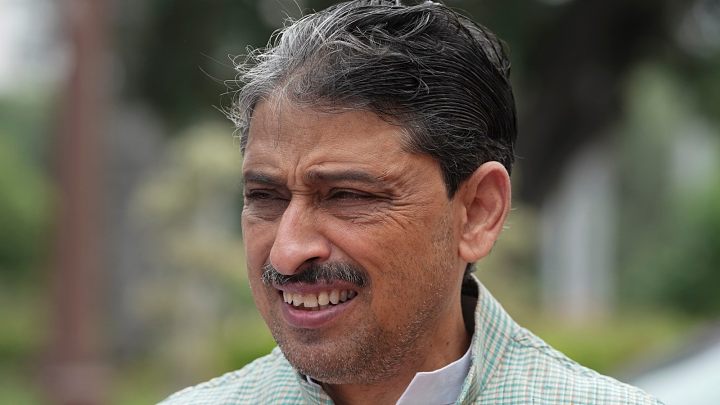
Chairman Lalit Beriwala has described the theme as a celebration of the cultural connection between Durga Puja and Dussehra, and has said the Ramayana cast would attend.
How Do Navratri And Durga Puja Differ?
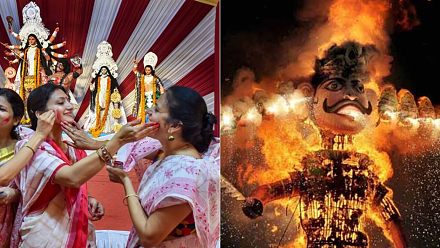
Both honour the Divine Feminine and the triumph of good over evil. In North India, Sharad Navratri runs nine days of fasting, temple visits and Kanya Puja, while nightly Ramlila performances build towards Rama’s victory over Ravana.
In Bengal, the festival peaks over five days from Shashthi to Dashami, and Durga is less a distant deity than a daughter, arriving with Kartikeya, Ganesha, Lakshmi and Saraswati. Clay idols, dhak beats, pushpanjali and pandal-hopping define it.
What Does The Tenth Day Mean In Each Region?
In North India, Dussehra is about a decisive ending. Towering effigies of Ravana, Kumbhakarna and Meghnad go up in flames, marking Rama’s victory and the destruction of ego and evil.
In Bengal, the tenth day is about what follows the battle. In the telling many Bengalis hold, once Durga has slain Mahishasura, she restores life to the gods and goddesses and is reabsorbed into them. The day brings sindoor khela, Bijoya greetings, sandesh and the visarjan, a farewell rather than a victory. In the north, something burns. In Bengal, something dissolves in water.
The calendar adds only a footnote: Bengal’s Dashami falls on October 21 this year, a day after the north’s Dussehra, which is why one viral post asked about Dashami on Navami.
Are The Two Stories Strangers?
Not quite. Bengal’s Krittivasi Ramayana tells of Rama invoking Durga before facing Ravana, an untimely worship known as Akal Bodhan, often cited as the origin of the autumn Durga Puja. Yet the festival’s emotional centre remains Durga and Mahishasura, not Rama and Ravana.
Why The Debate When The Festivities Are The Same Everywhere?
Because this one stitches the two together on Bengal’s turf. Few object to Dussehra itself, and Bengal’s pandals have long borrowed themes, from a Ram Mandir replica in 2023 to this year’s Las Vegas Sphere and Thailand-inspired setups. The friction lies in the packaging.
A Hindi-only poster in a Bengali-majority state and a Ram-centric visual for a Durga Puja are one part of it. The other is the ritual itself: a Ravan Dahan, a festival of fire and conquest, sits inside a pujo whose closing act is about reunion and farewell.
Reactions online reflect that. Some users questioned the missing Durga and the absence of Bengali on the poster. Others saw an attempt to blur two distinct festivals. Defenders called it a scheduled Ravan Dahan programme and urged people not to spread hate.
Perhaps that is why it travelled. A festival that millions celebrate in different ways rarely sits on a single banner. When it does, in a state where Durga Puja is the year’s emotional high point, every choice of language, image and ritual gets read closely.
The poster simply put a familiar autumn question, about what is shared and what is distinctly Bengali, in front of 21,000 viewers by breakfast.