Where Faith Has No Walls: The Muslim Woman At The Heart Of Chikkamagaluru's Ganeshotsava
In a little town tucked away among the green, misty coffee plantations of Chikkamagaluru, there is a woman who knows that Ganesh Chaturthi is more than just a festival. For Jubedha, it is about people, about humanity and
By Rohini Swamy··164K reads
Where Faith Has No Walls: The Muslim Woman At The Heart Of Chikkamagaluru's Ganeshotsava
In a little town tucked away among the green, misty coffee plantations of Chikkamagaluru, there is a woman who knows that Ganesh Chaturthi is more than just a festival. For Jubedha, it is about people, about humanity and love.
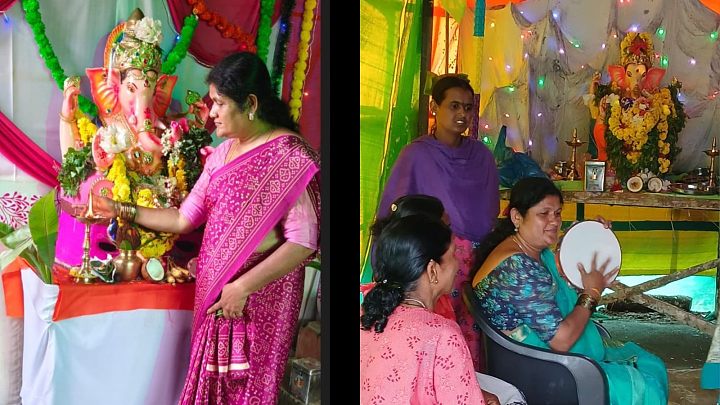
For 18 years, this social worker and former president of the Narasimharajapura Town Panchayat has been the president of the Rajivnagar Sri Vinayaka Seva Samiti, leading the town’s Ganeshotsava celebrations year after year.
She is a Muslim woman at the helm of a committee that brings together people to install a Ganesha idol, conducts special poojas and ensures smooth conduct of the celebration for three days. And she does it with the ease as she is someone who has long stopped seeing religion as a boundary.
“When I see youngsters today fighting in the name of religion and caste, I feel that from a very young age itself, we should teach them love, affection and tolerance towards all religions,” Jubedha told News18 as she continued to get ready to attend a Ganesha Pooja in her area.
That belief is at the heart of what she has been doing for nearly two decades.
Every Ganeshotsava, the Rajivnagar Sri Vinayaka Seva Samiti installs the idol at the pandal. Jubedha oversees the celebrations, including the Ganapathi Homa, Satyanarayana Puja and other rituals, before the idol is taken out for immersion.
“When we have a Ganesha festival, people of all ages come there. In that way, we are also able to send a message of peace and unity. It has been 18 years. We are all human beings. It doesn’t matter what religion, caste or colour you belong to. You may follow your own religion, that’s within your home, but you should also respect other religions as well,” she told News18.
For Jubedha, that respect is not something that should remain confined to words. “When you involve yourself in somebody else’s celebrations, you realise the importance of each other. In my area, all kinds of people from different religions live together and they decided to nominate me and I take that responsibility very seriously.”
It was this very spirit of togetherness that, she says, led to her being chosen to head the Ganeshotsava committee.
“When the decision was being made about who could lead the Vinayaka Chaturthi committee, one decision was made: let’s do something different. And that is how the people decided to nominate me.”
For 18 years, Jubedha says she has never faced a serious hurdle because she is a Muslim woman leading the celebrations. But questions have come.
“I’ve never had such an issue. It has never come to that stage. But there are some people who ask me, ‘You’re a Muslim lady, you may be following Islam. How can you do this? What will your religion say? Or what will your community think that you’re doing this?’”
Her answer is simple. “I tell them I am an Indian first. I believe all the gods are one. My dharma is for me, but I will also respect other people’s dharma. Whatever I practise will be within my home. Anything else follows later.”
And she does not stop at Ganeshotsava. Jubedha is also the secretary of the Karthik Deepotsava Committee, helping organise celebrations around Deepavali.
So when the lights of Deepavali come on, Jubedha is there too.
‘We Shouldn’t Play Politics In The Name Of Ganesha’
When asked about what she feels when she sees tension in the state and several incidents reported of clashes between communities when Ganesha processions are taken out, she says these incidents leave her deeply disturbed.
“I feel extremely hurt when I see such incidents. See, Ganesha is Vighna Vinashaka, the destroyer of obstacles. We should not play politics in the name of Ganesha, you must destroy all obstacles that come to mind and propagate peace.”
“When we look at God, we should look at God with devotion, whichever God it may be. You should not bring your issues related to religion to the streets. We should not disrespect any of the deities or anyone.”
A Daughter Her Father Raised Differently
There is another thread to Jubedha’s story – one that perhaps explains why she has never been afraid of crossing conventional lines.
She is one of five sisters, and grew up with a father who refused to raise his daughters as though the world belonged only to boys. “My father ensured that I was brought up just like the boy of the house. He decided that all of us should be well trained.”
“I learned to ride a cycle. He taught me. I even drive an ambulance. I feel so proud, and so does my father. There have been times when my father was asked, ‘How can you teach a girl child to ride a cycle?’ And later, even to drive an ambulance. He would counter question them – ‘What is wrong in it?’ That’s the spirit that has been embedded in me.”
During the Covid pandemic, she attended to people in need and drove an ambulance to help them. Even now, she works with destitutes, helping relocate those who have nowhere to go. It is simply what she was taught. “It is this kind of family value – that one should stand tall and stand for humanity. That makes me what I am today.” And perhaps that is the simplest way to understand Jubedha.
And in a world that increasingly insists on asking people which side of a religious line they belong to, Jubedha has chosen a different answer – stand tall. Respect everyone. And make room for another person’s faith alongside your own, let there be no obstacles – just as Ganesha says.