Vande Mataram, Ramayana And More: Bengaluru Man's Golu Dolls Are Bringing History Alive
At a time when Vande Mataram is at the centre of annual conversations and controversy, a young artist in Bengaluru is finding a rather distinctive way to bring its story, significance and meaning closer to people. Throug
By Rohini Swamy··149K reads
Vande Mataram, Ramayana And More: Bengaluru Man's Golu Dolls Are Bringing History Alive
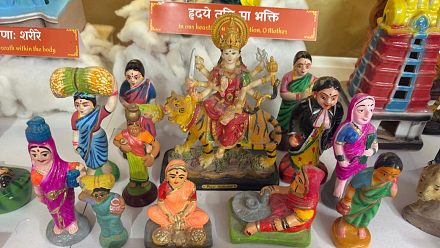
At a time when Vande Mataram is at the centre of annual conversations and controversy, a young artist in Bengaluru is finding a rather distinctive way to bring its story, significance and meaning closer to people. Through Golu, or Gombe Habba as it is known in Karnataka, Prithvi Prabhu is using dolls to tell stories that connect India’s cultural heritage, mythology and history. What unfolds inside his home is far more than a traditional Navaratri display. It is a carefully assembled world of gods and sages, royal families, temple traditions and historical artefacts, where every doll and exhibit has a story to tell.
For Prithvi, what began with just two dolls 21 years ago has grown into an elaborate collection that brings together devotion, history, craftsmanship and the cultural traditions of South India. Prithvi’s association with Golu began when he would help his aunt arrange the dolls during his younger days. Years later, his keen interest in collecting dolls brought the tradition back into focus.
Encouraged by his aunt, who also sparked Prithvi’s mother’s interest in the tradition, the family decided to start its own collection. His mother, too, was an artist who made her own dolls. They began with two dolls gifted to him. Since then, the collection has grown year after year, with handmade creations and ready-made dolls finding their place alongside one another.
For Prithvi, Golu is not simply about arranging dolls on stepped platforms. It is about giving stories a home, allowing traditions to pass from one generation to another through colour, craft and imagination. There is also a belief he follows: one should not count the dolls, just as one should not count friends, money or other blessings. And so, the collection continues to grow without a tally, each addition becoming part of a larger cultural narrative.
“I did my research on Vande Mataram, line by line, translating the verses, understanding its meanings as it was in Sanskrit and Bengali. I then used my research to represent it in the sequence that you see,” he proudly told News18.
A step into the Prabhu home takes visitors into the world of the Ramayana, tracing its many episodes and its deep connections with South India. The journey begins with Rishi Shringa, after whom Sringeri is named, performing the Putrakameshti Yagna that leads to the birth of Rama, Lakshmana, Bharata and Shatrughna. From Ahalya and Shabari to the Kalyana and the vanvaas, familiar episodes from the epic unfold through carefully arranged dolls.
One particularly striking scene depicts Ravana abducting Sita. As she is carried away, Sita drops her jewellery, which later helps Sugriva identify her whereabouts. The display also brings out the detail of Lakshmana recognising Sita’s anklets. Whenever he bowed before her, he would look at her feet, and it is through this familiar detail that he recognises the jewellery.
Prithvi points to another distinctive aspect of the depiction of Sita. Rather than being dressed like a sanyasini, she is shown in her finest silks and jewellery.
“An interesting aspect of this depiction is that Sita is shown wearing all her finery rather than being dressed like a sanyasini, unlike what is commonly believed. This reflects the belief that a kula vadhu should leave home dressed in her finest silks and jewellery. This is also reflected in the episode in which Sita gives Hanuman her chudamani as a token of recognition. These details are brought out through the dolls,” Prithvi explains.
Such details turn the display into more than a visual retelling of the Ramayana. They offer visitors an opportunity to look closely at the stories, the beliefs behind them and the cultural interpretations that have travelled through generations.
The collection extends beyond the epic. Tirupati Venkateshwara Seva and a representation of Mysore Dasara bring temple traditions and royal history into the display. Among the most treasured exhibits are original letters written by Nalwadi Krishnaraja Wadiyar in 1927 to mark 25 years of his reign. The 99-year-old letter, written in English, Kannada and Urdu, bears his original signature. Photographs of Nalwadi Krishnaraja Wadiyar, Jayachamarajendra Wadiyar and members of the present royal family add to the historical collection.
The display also turns the spotlight on Chamundi Hill and the Mahabaleshwara Temple, which predates the Chamundi Temple. The hill takes its name from Mahabaleshwara, while Chamundi is known as Mahabaladri Vasini. The Hoysala-built temple and its historical significance are represented through handmade dolls, including clay dolls of Jayachamarajendra Wadiyar.
A lovely tribute to iconic singer to S Janaki also finds a place in the collection.
Prithvi’s parents are involved in the tradition as well, even though Golu was not originally part of their family’s customs. As the collection has expanded, it has come to include miniatures, paintings, historical letters bearing original signatures and other treasured artefacts. For the family, the display is as much a learning experience as it is a celebration of culture and heritage. Each exhibit offers a chance to discover something new, understand its significance and share that knowledge with visitors who come home to see the Gombe Habba.
“We understand what each doll represents, the stories from our epics and its, later we explain its significance to those who come to our house to see the Gombe Habba. My sister told us that this was a tradition that could be cherished. We found it fascinating, and for the past 21 years, we have continued this tradition,” Prithvi’s mother told News18.
“The belief is that one must not count the number of dolls in the Golu, just like money, regard or books it anything else. We must just keep adding more to the collection, and those are like blessings bestowed,” she explains.
Beyond One Home: Bengaluru’s Gombe Habba Tradition
Prithvi’s collection is part of a larger Navaratri tradition that continues to find expression in homes across Bengaluru. From the stepped doll displays of traditional households to the bustling flower markets and centuries-old temples of neighbourhoods such as Malleswaram and Basavanagudi, Dasara in the city is as much about living heritage as it is about the festivities.
During Navaratri, homes open their doors to visitors, dolls narrate stories from mythology, temples take on a festive appearance and guests are welcomed with sweets. Heritage walks through Bengaluru’s older neighbourhoods offer a glimpse into these customs, taking participants beyond the city’s busy streets and into the communities that preserve them.
The city’s doll shops, meanwhile, offer collections ranging from traditional religious figures to more unusual contemporary themes. This year, displays include dolls representing eight traditional dance forms of India, alongside familiar scenes from the Ramayana, the Mahabharata and the Dashavatara of Lord Vishnu. Girija Kalyana, Krishna Leela depicted through 12 scenes, and deities such as Hayagriva, Ardhanarishwara, Andal and Meenakshi are among the many choices available to collectors.
Traditional wedding sets, temple festivals and scenes from everyday life sit alongside gods and goddesses. Some displays follow established customs, while others introduce new themes and interpretations, allowing families to make the tradition their own.
For some, the collection begins with a handful of dolls depicting Krishna’s Leelas, Tirupati Brahmotsavam or a South Indian wedding. Over the years, these can grow into displays of hundreds of figures, each carrying a memory or telling a story. One does not necessarily have to inherit the custom to participate; sometimes, the sheer pleasure of collecting, arranging and creating something beautiful is reason enough.
Dolls have always held a special place in people’s lives. A child may grow attached to a favourite doll and carry that affection into adulthood. In Gombe Habba, however, the dolls take on another role: they become storytellers, introducing children and adults alike to mythology, regional customs, temple traditions and the lives of historical figures.
Across South India, the tradition ranges from modest displays in homes to elaborate arrangements and themed competitions. The themes may change, the collections may expand and new ideas may find their way onto the stepped platforms, but the essence of Gombe Habba remains unchanged. Every doll has a story, every display opens a window into the past, and every Navaratri offers another opportunity to bring those stories alive.
In Madurai, Tamil Nadu, a devoted Rajinikanth fan named Karthik has created a Navaratri Golu dedicated to the superstar at the Azhagumigu Sri Rajini Temple, a shrine he built himself.
The 15-step display features more than 230 figurines and photographs representing Rajinikanth’s iconic screen characters, tracing his cinematic journey from his debut film, Apoorva Raagangal, to his more recent projects. Alongside dolls inspired by his famous film roles are depictions drawing on divine figures such as Lord Shiva and Lord Krishna.
Karthik, a long-time fan from Thirumangalam in Madurai, has organised the Rajinikanth-themed Golu at the shrine for the third consecutive year. While the display departs from the conventional arrangement of gods and goddesses, it reflects how the tradition can accommodate personal devotion, popular culture and changing forms of storytelling.
Gombe Habba or Golu has become a way to preserve and share that heritage — one story, one artefact and one doll at a time.