Seven Years On, BJP’s Goa Gamble Has A Familiar Face — Manohar Parrikar
As Goa heads towards another assembly election, the Bharatiya Janata Party (BJP) is looking back at the political legacy of its most recognisable Goan leader to reconnect with voters, repair organisational fissures and r
By Anindya Banerjee··69K reads
Seven Years On, BJP’s Goa Gamble Has A Familiar Face — Manohar Parrikar
As Goa heads towards another assembly election, the Bharatiya Janata Party (BJP) is looking back at the political legacy of its most recognisable Goan leader to reconnect with voters, repair organisational fissures and revive a brand of politics that was once central to its success in the coastal state.
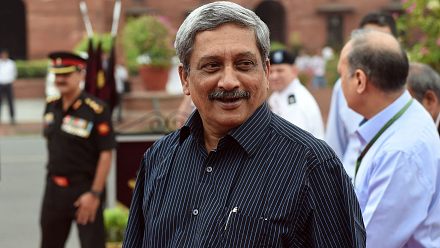
There is a certain irony in the BJP’s political calculations in Goa. Seven years after Manohar Parrikar’s death, the party appears to be rediscovering the political value of the man whose personal connect, administrative style and distinctly Goan identity once helped it overcome some of its biggest electoral challenges in the state while going on to become the highest-ranking Goan ever in BJP.
As the party prepares for the next assembly election, Parrikar is once again becoming an important part of its political discussion. This is not merely nostalgia for a popular former chief minister that even the Opposition still holds in high regard in the state. It is also an acknowledgement that the party’s relationship with Goa’s electorate cannot be sustained entirely through its national political machinery, central leadership or the organisational strength it has built over the years.
The outreach to former party functionaries, efforts to bring back leaders who drifted away and renewed attention to the Parrikar legacy point towards a larger political exercise—reconnecting the BJP with a political identity that was unmistakably Goan.
In October, BJP state president Damodar Naik confirmed that the party had held discussions with Laxmikant Parsekar, a former chief minister who left the BJP after being denied a ticket in 2022. The party also held two meetings with Utpal Parrikar, who had contested the 2022 election as an Independent after being denied the Panaji ticket his father had held for years and expressing his disgust publicly that time.
The significance of these conversations goes beyond the possible return of two leaders. Parsekar was part of the political team that helped build the BJP in Goa, while Utpal carries a surname that continues to have considerable political resonance in Panaji. Their possible return is an attempt to bring back not just individuals, but also constituencies of influence that the party could ill afford to leave estranged.
BJP national president Nitin Nabin was in Goa on October 27 and 28 when he stressed on the need to bring back those to the BJP fold who originally were part of Goa BJP. He asked the state unit to reconnect with every former party functionary and worker, including former office-bearers, sarpanches and deputy sarpanches. The instruction to leave no former worker behind is telling for a party that let its ego give Manohar Parrikar’s Panaji ticket in 2022 election to controversial politician Atanasio (Babush) Monserrate, who had moved between the Congress, Goa Forward Party and BJP. Winning by a wafer-thin margin of 716 votes, Monserrate publicly complained after the result that BJP cadres had worked for Utpal rather than him.
BJP doesn’t want a repeat of 2022 and is attempting to repair its political relationships before the election campaign gathers momentum.
Yet, there is a larger question here. Why does the BJP need Parrikar’s political inheritance at a time when it has been in power in Goa for years and has a strong organisational presence?
The answer lies in understanding what Parrikar represented to the party. He was not simply another chief minister or a senior BJP leader. He was, in many ways, the BJP’s most successful experiment in adapting its national political identity to Goa’s distinct social and political character.
An IIT-Bombay graduate, an RSS organiser and a politician who built his political career from the ground up, Parrikar cultivated an image of accessibility and administrative simplicity where he could be spotted wearing flip-flops, walking through the streets of Goa. He was comfortable engaging with ordinary citizens, understood local sensitivities, loved his fish and could navigate Goa’s complicated political relationships. His appeal was not restricted to BJP’s traditional voter base. Even political opponents acknowledged his personal connect.
It was under his leadership that the BJP won 21 of Goa’s 40 assembly seats in 2012, securing its first full majority in the state. Five years later, when the BJP won just 13 seats against the Congress’s 17, it was Parrikar who negotiated with regional parties and Independents to put together a government and return as chief minister.
That ability to combine political organisation with personal relationships was perhaps his most important contribution to the BJP in Goa.
His death on March 17, 2019, left a leadership vacuum that the party had to navigate while retaining power. Pramod Sawant eventually emerged as his successor, and the BJP continued to consolidate its position. But retaining office and reproducing Parrikar’s political connect are two different challenges.
The 2022 assembly election offered an early indication of this distinction. The denial of a BJP ticket to Utpal Parrikar in Panaji and Parsekar in Mandrem led both to contest as Independents. Neither won, but their rebellion exposed the tensions between the party’s organisational decisions and the loyalties of its older political network. In Panaji, the BJP fielded Atanasio Monserrate, who defeated Utpal. In Mandrem, the split in the BJP’s traditional support base contributed to the victory of MGP candidate Jit Arolkar.
The BJP has since expanded its political footprint, brought in leaders from other parties and strengthened its electoral machinery. But expansion has also created competing political ambitions within the organisation.
The signs are visible in the run-up to 2027. In June, BL Santhosh held individual meetings with ministers and MLAs amid concerns over anti-incumbency, weakening grassroots connections and factionalism. In August, reports emerged of competing political ambitions among BJP leaders seeking to expand their influence beyond their own constituencies.
This is where the Parrikar factor becomes relevant again. The BJP is not merely trying to win back a few estranged leaders. It is attempting to restore a political culture in which local leaders, grassroots workers and the organisation functioned around a recognisable Goan leadership figure.
There is, however, a complication. Bringing back old leaders does not automatically resolve the aspirations of those who have occupied political space in their absence. Parsekar’s return, for instance, could reopen questions about the Mandrem ticket. Utpal’s return would inevitably revive discussion around Panaji, where Monserrate remains an established political figure. The BJP state leadership has already made it clear that a return to the party does not guarantee an electoral ticket.
The party will have to balance reconciliation with the interests of its existing leadership and cadre. A political reunion that creates fresh resentments could defeat the very purpose of the exercise.
There is also the question of whether the Parrikar legacy can be transferred through his surname. Utpal may carry his father’s political inheritance, but Manohar Parrikar’s appeal was built over decades through his own political work, personal relationships and public image. That cannot be recreated through an organisational decision or a formal induction.
For the BJP, therefore, the challenge is bigger than bringing back the Parrikar family or a former chief minister. It is about recovering the political instinct that made the party a formidable force in Goa in the first place.
The Opposition’s continuing fragmentation may offer the BJP some political space. But that alone cannot resolve its internal challenges. Goa’s political landscape has its own sensitivities, and national political narratives do not always translate into local electoral loyalty.
Now, seven years after his death, BJP seems to be leaning back to the man known as its most successful Goa CM.
But there was something quintessentially Goan about Manohar Parrikar that the BJP may find difficult to recreate. Here was a man who had risen through the ranks of the RSS, remained deeply committed to its ideology and yet never felt the need to surrender his cultural identity to fit the image of a conventional Hindutva politician. He loved his fish curry, preferred his sandals to the trappings of office and remained attached to the ordinary rhythms of life in Goa. Even when he occupied the defence minister’s office in Delhi, Goa remained home.
Parrikar’s political genius, if one were to identify it, lay partly in this ability to reconcile two identities that are often presented as incompatible—the disciplined RSS organiser and the quintessential Goan. He did not have to choose between the two.