‘Rs 2.7 Crore Embezzled From Ayodhya Ram Temple’: What SIT’s Chargesheet Submitted In SC Says
The Supreme Court of India on Monday cleared the trial of eight accused who were chargesheeted by a court-appointed Special Investigation Team (SIT) for allegedly siphoning off ₹2.7 crore from Ayodhya’s Ram Mandir donati
By Manjiri Joshi··163K reads
‘Rs 2.7 Crore Embezzled From Ayodhya Ram Temple’: What SIT’s Chargesheet Submitted In SC Says
The Supreme Court of India on Monday cleared the trial of eight accused who were chargesheeted by a court-appointed Special Investigation Team (SIT) for allegedly siphoning off ₹2.7 crore from Ayodhya’s Ram Mandir donations.
Following the submission of this chargesheet, a bench led by Chief Justice of India Surya Kant closed all Public Interest Litigations (PILs) that were seeking an independent CBI probe.
WHAT DID SIT CHARGESHEET SAY?
The SIT status report submitted by Solicitor General Tushar Mehta formally declared the embezzled sum to be approximately ₹2.7 crore.
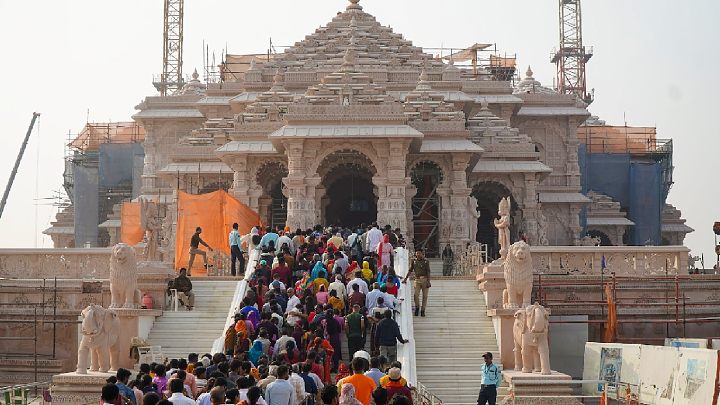
The theft did not involve the temple’s artifacts or offerings (chadhavas), which remain completely intact. Instead, the money was stolen at the counting stage inside the donation-counting room located in the Pilgrim Facilitation Centre (PFC).
CCTV footage analysis revealed 105 instances of unauthorised currency removal or concealment.
The stolen funds were traced to cash deposits, bank accounts, and high-value purchases. The accused allegedly used the siphoned money to acquire movable and immovable assets, including property, construction expenditures, vehicles, and jewellery.
During the hearing, Solicitor General Tushar Mehta, appearing for the UP government, said that the SIT probe found that donations at the temple were embezzled during the counting process. Mehta said some of the accused, who were involved in the counting process of the donations, have embezzled the money and some have invested in properties while others have kept the amount in banks as deposits. He said that investigators have been able to trace back the money in banks and with respect to property transactions in one case, the sale deed showed an amount of Rs 15 lakh was paid while the actual cost of the property was Rs 50 lakh.
The remaining amount was probably paid in cash, which also came from the misappropriation, he said. Mehta added that there was an audit conducted as well and assured the court that all artefacts and other things were found intact during the investigation.
When the CJI expressed concern for the future, Mehta said certain measures have been taken to prevent recurrence of such incidents.
THE SUPREME COURT’S DIRECTIVE
The apex court determined that further judicial monitoring is no longer required now that the chargesheet is filed. However, acknowledging the significant public interest, the court granted the original petitioners (including the Shri Ram Janmbhoomi Case Trust) the status of “victims of crime,” allowing them the legal liberty to assist the local Magistrate during the trial proceedings.
WHAT HAPPENED ON MONDAY?
In a significant development, the Supreme Court on Monday closed the proceedings on a batch of petitions seeking an independent probe into the Ayodhya Ram temple donations embezzlement case, saying that the local court would now proceed with the trial in the case against the accused.
Taking note of the Uttar Pradesh government’s submission that the apex court-appointed Special Investigation Team (SIT) has filed a chargesheet in the case, a bench headed by Chief Justice Surya Kant said that now the state can proceed with the trial in accordance “with the law”.
Taking note of a provision of the Bharatiya Nagrik Suraksha Sanhita (BNSS), the bench, also comprising Justices Joymalya Bagchi and V Mohana, said “since there is an element of public interest” and hence, like a victim of an offence, the writ petitioners before it are granted the liberty to assist the judicial magistrate at Ayodhya in the upcoming trial.
While putting the curtains down on the petitions before it, the bench said that it has not made any observations on the merits of the case.
“The State of Uttar Pradesh has filed a status report, according to which, the chargesheet has now been filed in the matter. Keeping this in view, we dispose of the writ petition and other connected matters with a direction to the judicial magistrate to proceed in the matter in accordance with law.
“Since there is an element of public interest involved, liberty is granted to the writ petitioners to assist the judicial magistrate on the same premise as the law enables a victim of crime to assist the court. It is however clarified that in order to ensure that no prejudice is caused to anyone, this court has not expressed any opinion on merits”, the order stated.
The bench asked advocate Varinder Kumar Sharma, appearing for Akhil Bharat Hindu Mahasabha and other petitioners, to raise their grievances, if any, before the trial court.
The top court also refused to entertain a fresh plea to determine if the Ram temple stands on land adjudicated in the main Ayodhya dispute case.
WHAT NEXT?
Because the SIT filed its final chargesheet ahead of the 90-day default bail deadline, the trial will now proceed before the Local Judicial Magistrate in Ayodhya.
THE AYODHYA RAM MANDIR DONATION THEFT CASE
The Ayodhya Ram Mandir donation theft case centers on the systematic misappropriation of large-scale cash offerings made by devotees. The irregularities were first flagged mid-2026, triggering a high-level investigation and legal battles that reached the Supreme Court.
The theft took place inside the Pilgrim Facilitation Centre (PFC) building within the temple premises. The State’s Special Investigation Team (SIT) revealed that the siphoning did not happen from open collection boxes, but explicitly at the donation-counting stage.
Closed-Circuit Television (CCTV) footage played a critical role in the probe. The SIT identified 105 separate instances of unauthorised currency removal or concealment from the counting room. The State Bank of India (SBI) had reportedly flagged counting and reconciliation discrepancies months prior to the formal registration of the case.
Following public outcry and demands from temple trust officials, the Uttar Pradesh government formed a Special Investigation Team (SIT). On July 27, 2026, the Supreme Court stepped in to monitor the probe and ordered that a forensic auditor be embedded with the SIT to trace the paper trail.
Melting down 944.411 kg of white metal offerings to check for discrepancies (no issues were found with the physical metals; the theft was strictly cash-based).
Investigators mapped out the bank accounts, financial transactions, and movable/immovable properties of the suspects to prove they were acquired using the stolen ₹2.7 crore.
Public interest litigation (PIL) petitions were moved by devotees, legal advocates, and political figures—including RJD MP Sudhakar Singh and the Hindu Dharma Parishad.
The petitioners argued that because offerings constitute sacred trust property belonging to a deity, a Central Bureau of Investigation (CBI) probe and a comprehensive third-party audit of the Shri Ram Janmabhoomi Teerth Kshetra Trust’s entire finances were required.