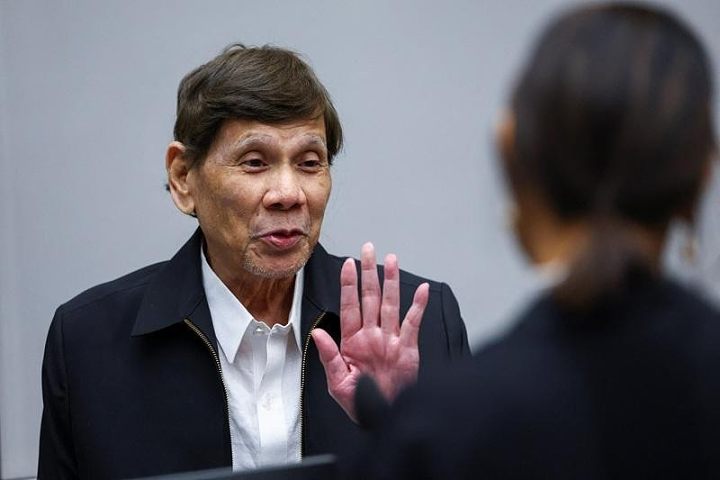
Ahead of the International Criminal Court’s (ICC) trial of Rodrigo Duterte, his lawyers have disclosed a batch of evidence to the Office of the Prosecutor and the Common Legal Representatives of Victims (CLRV).
By JAY-VEE MARASIGAN PANGAN and ANDY PEÑAFUERTE III··181K reads
Ahead of the International Criminal Court’s (ICC) trial of Rodrigo Duterte, his lawyers have disclosed a batch of evidence to the Office of the Prosecutor and the Common Legal Representatives of Victims (CLRV).
The latest filing, dated November 25 but released today, stated that Duterte’s defense submitted 63 items, including a number of press articles, opinion columns, reports, lists of tables and graphics, photographs, ordinances, and legal and court documents.
Legislation signed by Duterte into law
The filing is supported by an annex presenting document types and titles, including 17 laws signed by Duterte during his presidency.
R.A. 10932 — Anti-Hospital Deposit Law amendment
R.A. 11510 — Alternative Learning System Act
R.A. 11054 — Bangsamoro Organic Law
R.A. 10969 — Free Irrigation Service Act
R.A. 11310 — Pantawid Pamilyang Pilipino Program (4Ps) Act
R.A. 11469 — Bayanihan to Heal as One Act
R.A. 11509 — Doktor Para sa Bayan Act
R.A. 11210 — 105-Day Expanded Maternity Leave Law
R.A. 11166 — Philippine HIV and AIDS Policy Act
R.A. 11036 — Mental Health Act
R.A. 11215 — National Integrated Cancer Control Act
R.A. 11346 — law increasing excise taxes on tobacco products
R.A. 11223 — Universal Health Care Act
R.A. 11148 — Kalusugan at Nutrisyon ng Mag-Nanay Act
R.A. 11037 — Masustansyang Pagkain para sa Batang Pilipino Act
R.A. 11463 — Malasakit Centers Act
R.A. 10931 — Universal Access to Quality Tertiary Education Act
All except R.A. 10932 have been cited by lead counsel Peter Haynes in the defense’s pre-trial brief, released on November 25.
The other legislation mentioned in the annex—R.A. 11930 or the Anti-Online Sexual Abuse or Exploitation of Children and Anti-Child Sexual Abuse or Exploitation Materials Act—lapsed into law on July 30, 2022, after Duterte’s term had ended.
The filing does not mention or explain how the defense intends to use each law at trial.
In the pre-trial brief, however, the defense cited Duterte’s initiatives in “free healthcare, education, and extensive drug rehabilitation programs,” which it said contradicted the prosecution’s allegation that he was responsible for a “widespread and systematic attack against the civilian population in the Philippines.”
The annex also lists two administrative orders, a 2018 board regulation and seven executive orders from Duterte’s presidency. These include measures on the government’s anti-illegal drug campaign, the nationwide Emergency 911 system, smoke-free public places, the 8888 Citizens’ Complaint Hotline, the whole-of-nation approach against communist insurgency, disaster rehabilitation, and access to medicines.
The annex does not state the specific evidentiary purpose for each issuance.
Davao ordinances Duterte-era orders
The defense also disclosed eight Davao City ordinances covering women’s and children’s welfare, healthcare, public order, smoking, firecrackers, drug rehabilitation and emergency response. The annex lists the ordinances but does not state the specific evidentiary purpose for each. Several of these ordinances were signed during Rodrigo Duterte’s years as mayor of Davao City:
Ordinance No. 005004-97 — Women’s Development Code of Davao City
Ordinance No. 002491-94 — Davao City Children’s Welfare Code
Ordinance No. 000060-02 — Davao City firecracker ban
Ordinance No. 004-13 — Liquor Ban Ordinance of Davao City
Ordinance No. 000335-10 — ordinance creating the Women Health Care Clinic of Davao City
Ordinance No. 0548-16 — ordinance prescribing the functions of the Davao City Treatment and Rehabilitation Center for Drug Dependents
The annex also lists Ordinance No. 0367-12, or the New Comprehensive Anti-Smoking Ordinance of Davao City, enacted in 2012 when Duterte was vice mayor and serving as acting city mayor.
A more recent measure, Ordinance No. 0100-25, established the Computer-Aided Response and Emergency Dispatch (CARED) System. It was enacted in 2025, when Vice Mayor Sebastian Duterte was serving as acting city mayor.
Drug war police killings EJK reports
The disclosed material also includes reports and data more directly related to Duterte’s anti-drug campaign and alleged extrajudicial killings (EJK).
Among them are a media report titled “8.8M homes covered by TokHang when PNP led drug war,” a report on police use of deadly force in the Philippines, comparative data on police killings, and reports from the United Nations Office on Drugs and Crime.
The defense also disclosed 4 media reports concerning the civilian-led EJK Truth Commission.
Other items include Philippine population and death-rate data and a report titled “The Cost of the Philippine Anti-Drug Campaign.”
The defense also disclosed a report by researcher Peter Kreuzer titled “A Patron-Strongman who delivers. Explaining enduring public support for President Duterte in the Philippines.”
In its introduction, Kreuzer wrote: “Duterte’s core message is one of discipline, iron-fisted assertion of order, and submission to the top strongman’s commands.”
The report, however, focused on explaining Duterte’s “enduring popularity”, asking why “such a national leader has managed to win and keep the hearts of the vast majority of Filipinos and Filipinas irrespective of socio-economic class or gender.”
Another Kreuzer report included in the disclosure is titled “Excessive use of deadly force by police in the Philippines before Duterte.” — BM GMA News
Follow facebook.com/gmanewsonline for real-time news and developments in the Philippines and around the world.