Name Missing From SIR? If Tribunals Take A Decade To Decide Appeals, What Happens To Your Right To Vote
The Special Intensive Revision (SIR) of electoral rolls has raised questions over how quickly voters whose names are excluded can secure a remedy, with a large number of appeals pending before tribunals in West Bengal an
By Shuddhanta Patra··33K reads
Name Missing From SIR? If Tribunals Take A Decade To Decide Appeals, What Happens To Your Right To Vote
The Special Intensive Revision (SIR) of electoral rolls has raised questions over how quickly voters whose names are excluded can secure a remedy, with a large number of appeals pending before tribunals in West Bengal and a significant number of voters facing verification in Karnataka.
In West Bengal, an Election Commission affidavit before the Supreme Court said 1,26,194 appeals had been decided by appellate tribunals in the five months since they began functioning in mid-April. With 37,05,235 appeals pending as of September 16, the present rate of disposal could take around 146 months, or more than 12 years, to clear the backlog.
The issue has brought the focus back to a basic question: if a voter’s name is missing from the electoral roll and the appeal remains pending, can that person vote?
Appeal pending, vote not automatic
The position outlined in the information provided is that the pendency of an appeal does not itself give a voter the right to vote.
If a person’s name is deleted or left out of the electoral roll, they can challenge the decision before the relevant authority or tribunal. If the challenge is rejected, the person may approach a higher court. However, while the case remains pending, the voter’s name remains absent unless a court or election authority grants specific interim relief.
This means the person cannot vote in an election held during the period in which the name remains off the electoral roll.
The Supreme Court has also maintained a distinction between an appeal that has been allowed and one that is still pending. If a tribunal allows a claim before the relevant polling deadline, the Election Commission can include the person’s name in a supplementary electoral roll. A pending appeal, by itself, does not have the same effect. The Court’s orders on the West Bengal SIR process provided for supplementary lists where verification remained incomplete.
Bengal tribunals face massive backlog
The ECI has acknowledged that the existing infrastructure and 24 appellate tribunals in West Bengal are insufficient to handle the volume of cases.
It has asked the Supreme Court to consider increasing the number of tribunals to 42, corresponding to the number of parliamentary constituencies in the state. The Commission has also sought permission for judicial officers to work from home, saying this could reduce time lost in travel and help speed up disposal.
According to the ECI affidavit, 38,31,429 appeals had been filed before the tribunals. Of these, 22,21,118 related to voters seeking restoration of names that had been excluded or deleted, while 16,10,311 challenged the inclusion of names.
Violation of Articles 14 and 21?
If a tribunal or court eventually finds that a deletion was unlawful, the Election Commission must restore the voter’s name in accordance with the order.
The voter can then participate in future elections, subject to the applicable electoral-roll deadlines. But a delayed decision cannot ordinarily restore an electoral opportunity that has already passed. A person who could not vote in an earlier election because their name was absent from the roll cannot normally cast that vote retrospectively.
Speaking to News18, Supreme Court Advocate-on-Record Jatin Bhardwaj said the issue of the voter’s right to vote in this case was particularly important because voters whose appeals ultimately succeed could miss elections while their cases remain pending.
He said that, under the existing system, an excluded voter whose appeal is eventually allowed could still be unable to vote in elections held during the pendency of the case. Bhardwaj argued that any delay resulting in an eligible voter being unable to participate in even one election raises concerns under Articles 14 and 21 of the Constitution.
“If the existing SOP of the Appellate Tribunals is continued, then it would take almost a decade for these appeals to be finally decided. In between many more elections would take place where an excluded voter, whose appeal may ultimately get allowed, would not be able to cast his vote as a result of a SC order of 13th April 2026. In effect, his constitutional right to vote would stand eclipsed during the entire period of pendency of his appeal. Right to vote is the very essence of a democratic polity, which is part of the basic structure of the Indian Constitution. Any curtailment or infringement of this right to vote has to be dealt with utmost seriousness and at the earliest. In my opinion, if any delay in deciding an appeal leads to a situation where an illegally excluded voter is not able to cast his vote in even a single election that would be manifestly arbitrary, violating Articles 14 and 21 of the Constitution of India,” Jatin Bhardwaj said.
Over 1 lakh names restored
The ECI’s figures also show that a substantial number of cases already decided have gone in favour of voters seeking restoration. Of the 1,26,194 appeals decided, 1,13,943 voters had their names restored, while 8,649 appeals were rejected. However, these figures relate only to cases already decided. They cannot be used to conclude that the same proportion of all affected voters will succeed, because more than 37 lakh appeals remain pending.
According to the Election Commission, 1,26,194 appeals have been decided so far, with 1,13,943 voters having their names restored and 8,649 appeals rejected. Meanwhile, 37,05,235 appeals remain pending.
Karnataka faces a different stage
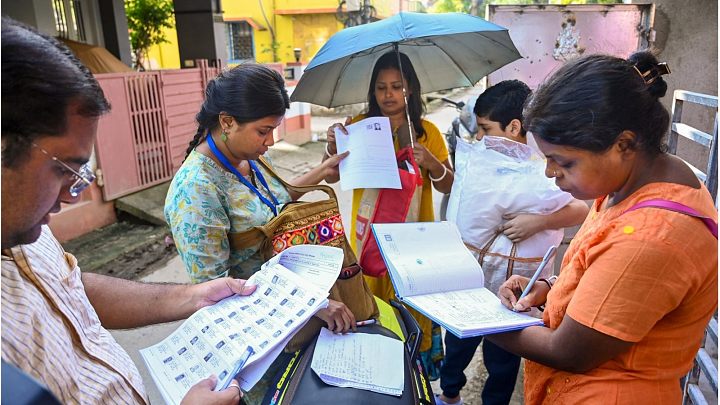
Karnataka is currently going through the SIR process, with the scale of verification creating another set of concerns. The state’s draft electoral roll followed the categorisation of 1.08 crore electors under the ASDDO categories – absent, shifted, dead, duplicate and others. Around 43.8 lakh voters were also expected to receive notices over logical discrepancies or the absence of matching information from the 2002 electoral roll.
Those whose names are excluded have to make a fresh application for inclusion, while voters who receive notices have to provide documents and appear for hearings.
The final electoral roll in Karnataka is scheduled for October 27, while October 12 has been cited as the deadline for voters to clear their names in the process.
The developments in West Bengal and Karnataka therefore highlight different stages of the same question: how quickly can a voter challenge an electoral-roll decision and secure restoration before the next election takes place?