Lucknow Floods: Has Urbanisation Left The Gomti With Too Little Room To Breathe?
LUCKNOW: The latest flooding in Lucknow may have begun with rain falling hundreds of kilometres upstream, but the damage being seen in the city is raising a more difficult question: What happens when a river is denied th
By Parishmita Saikia··174K reads
Lucknow Floods: Has Urbanisation Left The Gomti With Too Little Room To Breathe?
LUCKNOW: The latest flooding in Lucknow may have begun with rain falling hundreds of kilometres upstream, but the damage being seen in the city is raising a more difficult question: What happens when a river is denied the space it needs to spread?
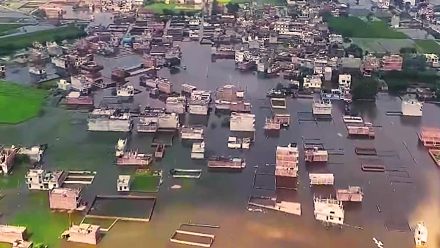
The Gomti rose in Lucknow days after the heaviest rain had passed because runoff from its upper catchment took roughly eight to 10 days to travel downstream. Yet the inundation of low-lying neighbourhoods such as Faizullahganj, Ghaila and Daud Nagar has also put the spotlight on a longer-term transformation of the river’s landscape – the steady urbanisation of areas that once functioned as the Gomti’s floodplain.
The issue is particularly relevant in a city that has invested heavily in turning its riverfront into an urban public space.
The Riverfront Question
Lucknow’s Gomti Riverfront was conceived as a major urban renewal project, with promenades, parks and public spaces along an 8.1-km stretch of the river. But the project also involved straightening the river and constructing reinforced diaphragm walls along both banks.
Studies cited in recent environmental assessments and reporting found that the floodplain along the developed stretch was narrowed from about 450 metres to 240 metres, while the clear waterway was reduced from roughly 250 metres to between 100 and 125 metres. The project reclaimed around 200 hectares of land.
That change matters during extreme flows. A floodplain is not simply unused land beside a river; it is part of the river system’s natural storage space. When water levels rise, the river can spread into these areas, slowing and distributing the flow. Constricting that space with roads, walls and construction can leave less room for the river to accommodate sudden increases in discharge.
A 2019 study also found a significant ecological difference between channelised and relatively undisturbed sections of the Gomti. Researchers identified eight habitat types for fish and other aquatic organisms in undisturbed stretches, compared with just two in the channelised sections.
What About Lucknow’s Marine Drive?
The city’s so-called Marine Drive has become another prominent piece of infrastructure along the Gomti corridor. But the current flooding does not by itself establish that Marine Drive caused the inundation.
What it does show is the vulnerability of infrastructure built close to the river. The Marine Drive underpass was among the stretches severely affected during an earlier spell of heavy rain, with vehicles getting stranded in floodwater.
The larger concern, therefore, is not one road or project in isolation. It is whether a series of roads, embankments, walls and developments along the river has progressively reduced the space available for water to move and disperse during high-flow events.
This Year’s Flood Has Exposed The Contradiction
The contradiction is now visible on the ground. The Gomti Riverfront, built partly to bring the city closer to its river, has itself been inundated as the river swelled. Large low-lying portions of the waterfront were submerged even as local rainfall had eased, with authorities opening barrage gates to manage the rising water.
At the same time, several neighbourhoods located in low-lying areas have remained vulnerable to flooding.
This does not mean that the Riverfront alone explains the current inundation. Officials have attributed the immediate rise in the Gomti to exceptionally heavy rainfall across its upstream basin. Between September 25 and 27, Lakhimpur Kheri recorded 268.3 mm of rain, Shahjahanpur 263.9 mm, Hardoi 147.2 mm, Sitapur 144.1 mm and Pilibhit 119.9 mm. Lucknow itself recorded 180.5 mm during the same three-day period.
The runoff from those districts continued moving towards Lucknow after the skies cleared over the city, producing the delayed flood pulse now being witnessed.
But unusually heavy rain is only one part of the flood equation.
When The Floodplain Becomes Real Estate
Principal secretary of the irrigation and water resources department Anil Garg has pointed to three factors behind the present inundation: exceptional rainfall across the basin, smaller rivers and streams reaching their carrying capacity, and urbanisation and encroachment over the Gomti’s floodplain.
Historically, Garg told TOI, the river could spread across a wider floodplain during high flows. Urban development has reduced that space, meaning water is increasingly confined to a narrower corridor and low-lying settlements can bear the consequences.
The concern is particularly acute because the city’s development has not stopped at the existing riverfront. The Green Corridor project is being constructed along the Gomti, including an embankment intended partly to protect flood-prone areas. The LDA says sections of the embankment have already protected parts of Gomti Nagar Extension and adjoining areas from rising water.
That creates an important policy dilemma: should the response to a river with less floodplain be more embankments and more barriers, or should more of its natural flood-storage capacity be restored?
More Embankments Or More Room For The River?
The answer is already moving towards more flood protection infrastructure. Following inspections of flood-hit areas, Chief Minister Yogi Adityanath has ordered a survey for a proposed embankment system extending from Bakshi Ka Talab in Lucknow towards Naimisharanya in Sitapur. Officials are also examining vulnerable stretches and possible pumping stations.
Separately, the LDA has proposed a Rs 182-crore embankment along the Gomti from IIM Road towards Hardinge Bridge via Khadra to protect areas including Faizullaganj and Daud Nagar.
These measures could protect settlements already exposed to flooding. But they also underline the central challenge facing Lucknow: the city has increasingly built around and along a river whose behaviour depends on having space to expand.
The present flood is therefore not simply a story of rain falling upstream and water arriving late. It is also a reminder that when extreme rainfall sends a delayed surge downstream, the amount of floodplain left open to the river can determine where that water ultimately goes.
For Lucknow, the question is no longer just how high the Gomti will rise. It is how much room the city is still willing to give the river when it does.