'Limits To What US, China Can Agree': EAM Jaishankar Says World Adjusting To 'Very Different America'
External Affairs Minister S Jaishankar has said the rest of the world is making its own arrangements in response to the evolving relationship between the United States and China, arguing that there are limits to what Was
By Vani Mehrotra··145K reads
'Limits To What US, China Can Agree': EAM Jaishankar Says World Adjusting To 'Very Different America'
External Affairs Minister S Jaishankar has said the rest of the world is making its own arrangements in response to the evolving relationship between the United States and China, arguing that there are limits to what Washington and Beijing can agree upon in relation to the rest of the world.
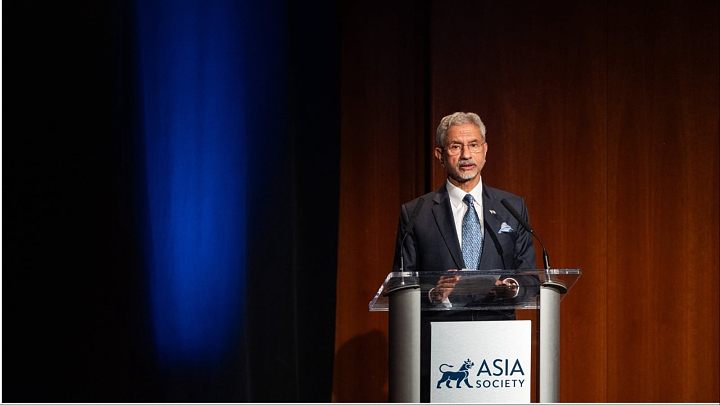
Speaking during a conversation hosted by the Asia Society on Monday, Jaishankar referred to the recent ‘G2’ summit meeting between US President Donald Trump and Chinese President Xi Jinping in Washington and said the two major economies, despite areas of convergence, remained fundamentally competitive.
“When the second most consequential or the weightiest economy joins the first, while they may have their points of convergence, overall they are in a competitive mode,” Jaishankar said.
Jaishankar said the nature of the US-China engagement had implications for other countries, which were now assessing how to respond to the changing global environment.
“There are limits to what the two of them can agree upon vis-à-vis the rest of the world. And that then leaves the rest of us, and the rest of us are coming to terms today with a very different America, with the fact that there is also today a certain conversation taking place between America and China,” he said.
According to Jaishankar, countries across the world are consequently looking at ways to protect their interests amid the changing international environment.
“Each one of us is looking for our optimal solutions. How do we de-risk? How do we diversify? Which are the new partners? Where do we get more value out of an existing partnership?” he said.
Jaishankar described the current global situation as difficult but said countries traditionally respond to such changes by adjusting their policies and finding new arrangements.
“We are really looking today at a difficult global situation. But as always, countries respond, they calculate, they adjust, they find new accommodations, they find new solutions, and that is how the international order develops, and it is that development today that I think the UN is a witness to,” he said.
He added that this evolving global order was reflected in the conversations and meetings held by him and other world leaders during the recently concluded high-level UN General Assembly week.
What Jaishankar Said On A More Multipolar World
In his remarks to an audience comprising prominent members of the Indian-American community, Jaishankar said the world was moving “quite visibly” towards greater multipolarity.
Explaining his assessment, he pointed to changes involving the United States, which he described as the most powerful country in the world and a key shaper of the existing international system.
“In terms of the most powerful country in the world, which has been in many ways the ballast or really the shaper of the system as we know it currently, what we are seeing is really an erosion in alliances, a tendency to do it alone, and that has a huge impact on the thinking of the rest of the world,” he said.
His comments on the US-China relationship came alongside his assessment of India’s own ties with China, which he said had improved compared with the previous two years.
‘Relationship Better Today’ With China
Responding to a question on India-China relations, Jaishankar said ties between the two countries were “better” today compared with where they stood in 2025 and had improved further when compared with 2024.
“If you asked me, compared to where you were in 2025, is the relationship better today? I would say yes. Compared to 2024, even more so,” he said.
Jaishankar said the improvement was not necessarily a “structural change” but followed the stabilisation of a relationship that had gone significantly off-track after the 2020 border standoff.
He said that after the standoff, normal contacts between India and China had come to a halt. While trade continued, official exchanges, visa issuance and flights were affected.
“So once the border standoff was resolved, it was natural that this would start to improve,” he said.
Jaishankar said India had consistently conveyed to China that a prolonged standoff and deterioration in bilateral ties did not benefit either country and could instead provide opportunities to third parties.
“We also maintained consistently a very elementary principle of statecraft – don’t get locked into a problem which benefits others,” he said.
He said the long standoff did not serve the interests of either India or China and that improving relations helped India’s position not only in relation to China but also with the rest of the world.
‘State Of The Border Determines The State Of The Relationship’
Jaishankar said India had approached the relationship with a fundamental principle, the condition of the border determines the broader state of bilateral ties.
“We came down to a very fundamental principle, which is that the state of the border determines the state of the relationship. You can’t have tension on the border and say the relationship should be normal. So what we’ve had is, as the border comes back more towards normalcy, the relationship comes back more towards normalcy, and if the relationship comes back more towards normalcy, it helps both of us,” he said.
He also said India did not want to become excessively focused on one relationship or issue at the expense of its wider interests.
“Because I don’t want to get totally focused to my disadvantage on one particular relationship and issue. If I can find a solution which works for me, I would rather do that,” Jaishankar said.