Kashmir’s First Public-Facing RSS-Affiliated Office: Inside Sangh's Outreach Through A Muslim Leader
Right opposite a hillock in the Barsoo area of Pulwama, an unusual office has come up. Inside the small yet modern office are several national flags and books. As you begin scanning the titles, you come across two books
By Ieshan Wani··112K reads
Kashmir’s First Public-Facing RSS-Affiliated Office: Inside Sangh's Outreach Through A Muslim Leader
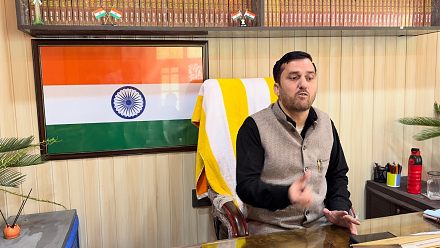
Right opposite a hillock in the Barsoo area of Pulwama, an unusual office has come up. Inside the small yet modern office are several national flags and books. As you begin scanning the titles, you come across two books on the Rashtriya Swayamsevak Sangh (RSS) by its ideologue and author Ratan Sharda. There are other books too, including The Constitution of India by BR Ambedkar and Win Every Argument by Mehdi Hasan. What also catches your eye are the works of Shakespeare, the Bhagavad Gita and Audrey Truschke’s historical reassessment of the sixth Mughal emperor, Aurangzeb Alamgir.
Seated among these books is 35-year-old Sameer Kuchay, the Kashmir in-charge of the Bharatiya Mazdoor Sangh (BMS), a trade union affiliated with the RSS. Sameer has two tablets – a mobile computing device and a CCTV monitor – on his desk, and his gaze constantly shifts between them. In the past, Pulwama district, where Sameer lives, was synonymous with violence, with stone-pelting incidents, encounters and attacks occurring frequently. But times have changed. Today, an RSS-affiliated organisation has opened an office in the same district, with an address accessible to the public.
On a bright autumn morning, Sameer talks about changing times and the influence the RSS had on him from an early age.
“I am a proud Muslim, yes, affiliated with the RSS, affiliated with the BMS. If we talk about Islam itself here, our Prophet Sahib has also talked about ‘Hubbul Watan’, which means, first of all, you have to give preference to the country where you are living,” he told News18.
For Sameer, the journey was not easy. He says he faced social stigma, including from relatives who would not touch the cup from which he drank tea.
“Even my own relatives, after serving me a cup of tea or a glass of water, used to hold that glass with a cloth so that they wouldn’t get a dirty touch from a glass used by a Sanghi,” he says, adding that the situation in the Valley changed after 2019, altering people’s approach towards him.
“People have realised that today our children should have a pen in their hands, should have a book. Today, they don’t prefer their children having a stone in their hands. An ideological change has come; that shift has happened, which somewhere supported us as well in this peaceful environment. So otherwise, pre-2019, things were tough for us,” says Kuchay, who serves as the Kashmir in-charge of the organisation.
His recently inaugurated office, opened by B Sundaram, the national organisation secretary of the Bharatiya Mazdoor Sangh, is guarded by policemen. Sameer says a perception had been created that the Sangh was anti-Muslim, but his own learning and observations led him to a different conclusion.
“I have already experienced this as a Muslim: I was never made to feel inside that I belong to the Muslim community. I was always asked, ‘What can you do to serve humanity, to build the nation, to build the country, to serve society?’ Till today, no senior of mine has ever asked me whether I am a Muslim or belong to the Muslim community. Never,” he says.
He frequently speaks about the welfare of labourers and claims that the BMS has 20 registered affiliated unions in the Valley, representing at least 30,000 labourers and employees. His responsibilities cover 10 districts of the Valley and Ramban district in the Jammu region.
Sameer says he was initially drawn to the RSS through social media. Today, he says, he is dedicated to the cause of uplifting labourers who contribute to nation-building.
“If I talk about the RSS, there is one line from Pujaniya Sarsanghchalak Mohan Bhagwat ji that always inspires me. He says, ‘If you feel RSS is bad, come and join us. If you find out that it is wrong, you are free to leave. You are not bound there.’”
Following the abrogation of Article 370, the RSS and its affiliated organisations have expanded their presence in Kashmir. The Muslim Rashtriya Manch (MRM), described as the Muslim wing of the organisation, has been active in the Valley and has also held gatherings at Srinagar’s Clock Tower on Independence Day and Republic Day. Similarly, the Akhil Bharatiya Vidyarthi Parishad (ABVP), the student wing of the RSS, has organised tricolour marches on similar occasions and held events such as National Students’ Day. The ABVP Kashmir Facebook page shows members participating in debates and sporting events at several colleges.
On Wednesday, the RSS, in collaboration with the Jammu and Kashmir Development Foundation and Al Rahim Trust, organised a conference in Srinagar under the banner of *]Asluk Aalav, meaning the “good call”. The event brought together trade and youth leaders, civil society representatives, intellectuals and prominent personalities on a common platform to promote dialogue and social harmony, according to the BJP.
Ram Lal, Akhil Bharatiya Sampark Pramukh of the RSS, who attended the conference as the chief guest, urged people in Kashmir not to be influenced by the outside world, saying violence could not bring people together.
“I am seeing how easily we are talking. I am an RSS man; see how smoothly the function took place. We heard everyone here. Let anyone make a perception about Kashmir, and people talk about the Sangh like that without experiencing it,” Ram said, adding that the RSS’s credibility was increasing because it worked on truth.
He said Kashmir had a historic culture of togetherness, with Sanatani and Sufi saints living alongside one another.
“There was a difficult patch of terror and violence, but now people have understood that terror and violence wouldn’t lead to peace and prosperity. Kashmiris have understood, and it’s a joyful thing. I want to thank the people of Kashmir, and they shouldn’t get influenced by outsiders,” he told reporters.
Among those who attended the conference were Darakhshan Andrabi, chairperson of the Jammu and Kashmir Waqf Board; Maulana Owais Raza Qadri; and others.
In Pulwama, for Kuchay, however, the office represents an opportunity to reach people through organised labour and an ideology he says he has chosen to embrace.