Jitu Munda Carried Sister’s Skeleton To Bank For ₹20,000: What Has Changed Six Months On?
Do you remember the name Jitu Munda? He was the man who dug up his sister’s grave, took out her skeletal remains and carried them on his shoulders all the way to a bank to prove that his sister was no longer alive.
By Abhay Mohapatra··140K reads
Jitu Munda Carried Sister’s Skeleton To Bank For ₹20,000: What Has Changed Six Months On?
Do you remember the name Jitu Munda? He was the man who dug up his sister’s grave, took out her skeletal remains and carried them on his shoulders all the way to a bank to prove that his sister was no longer alive.
Jitu had visited the bank several times to withdraw the money deposited in his sister’s account. But every time, he returned disappointed. He did not have his sister’s death certificate. When bank officials asked him to provide proof of her death, he was left with no option but to dig up the grave of his sister, Kalara Munda, and bring her skeletal remains to the bank. He placed them on the bank premises to prove that she had died.
Around six months ago, Jitu Munda, a resident of Dianali village under Patna block in Odisha’s Keonjhar district, did something that created a nationwide sensation. Who was this man? Why was he walking along the road carrying human skeletal remains? People were shocked to witness the scene. National media organisations rushed to his village to understand the entire story. The incident was broadcast live, and political leaders, ministers and government officials also reached the village. It seemed as if the entire government had moved from the state capital to Jitu Munda’s village.
But how is Jitu Munda doing now? What is he doing these days? Has his fate really changed? Has the fate of his village, Dianali, changed? Have the hardships he once carried on his shoulders finally disappeared from his life?
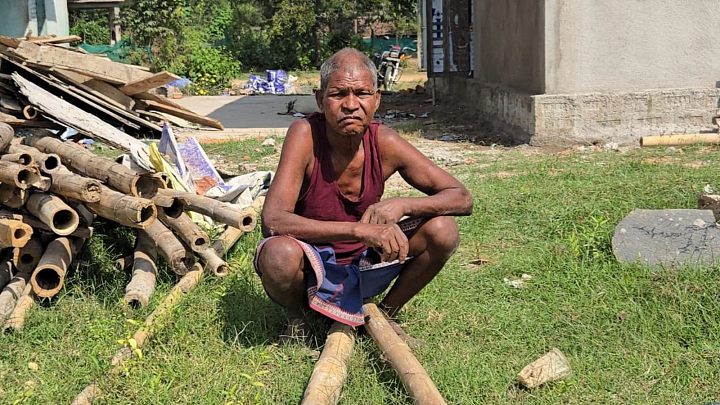
To find answers to these questions, CNN-News18’s Abhaya Mahapatra visited Jitu Munda. He found that Jitu is now constructing a four-room concrete house. He has already spent around ₹5 lakh on the construction. The roof has been completed, electrical wiring has been done, and a steel door has also been installed at the main entrance.
During the conversation, it emerged that Jitu himself does not know exactly where the money deposited into his bank account after the incident came from. Around ₹20 lakh has reportedly been deposited into his account through both government and private sources. He is now using that money to build his house. According to his mason, Kshetra Mohan Mahanta, another ₹5 lakh or so will be required to complete the house.
When a media representative finally visited Jitu after so many months, it was clear from his words that he had begun to understand certain aspects of the situation. He said that many people had come forward to help him when he faced difficulties, but what had really changed?
“I agree that some money came into my bank account. But is this a permanent solution? Where is the road to our village? Where is the drinking water supply to our homes? This ₹20 lakh will get spent sooner or later. What happens after that? Will someone in every village have to carry the skeletal remains of a family member to a bank to get their rightful money? Where will so many skeletons come from?”
These questions raised by tribal man Jitu Munda carry a strong message for the government and its administrative system.
But that is not all. Jitu Munda has now become a different person in the eyes of some villagers. Many believe that he has become rich. They think he has lakhs of rupees in his bank account, is building a house, eating well, wearing good clothes and living a comfortable life. But what about the rest of us? asks Urmila Mahanta, a woman from Jitu Munda’s village.
“His sister died, and he had to carry her skeletal remains. He received ₹20 lakh. But what did Dianali village get? What did the villagers get? We thought our village roads would improve, people without houses would get homes, and we would have access to clean drinking water. We hoped that during summer, we would no longer be forced to drink muddy water. But nothing like that happened. We were poor tribal people earlier, and we remain poor tribal people even today,” she says.
Similarly, another young man from the village, Gayadhar Munda, says that what happened in Jitu Munda’s life remained just an incident. It never became an issue that could bring about changes in the system or improve people’s living conditions.
“Many people came here for a day, two days or a week to show sympathy. But today, everyone has forgotten everything. When summer comes, our people will continue to struggle for water. During floods and cyclones, we will continue to fear that our houses may collapse. But there will be no improvement in our lives,” he says.
From Gayadhar’s words, it was clear that the villagers were neither happy nor satisfied. They were deeply upset.
Although Dianali is a tribal-dominated village, it is located close to National Highway 220. Yet, even the road connecting the village to the national highway has not been properly repaired. To put it simply, the incident of Jitu Munda carrying his sister’s skeletal remains has failed to bring any lasting change to the government system. It remained a news event and could not bring the benefits of development to the village.
Jitu Munda Pays His Respects at His Sister’s Grave
Every day, Jitu Munda visits his sister’s grave, bows before it and spends some time sitting beside it. No one knows what goes through his mind or what he silently says to his sister. But his actions seem to reflect the pain and emotions he carries within him.
Perhaps, deep down, he wishes he could tell her:
“Sister, when you were alive, we had nothing. You were suffering, but I could not do much for you. After you passed away, I had to carry your skeletal remains to the bank just to prove your death and claim the money in your account. That incident brought you into the spotlight, and people from across the country came to know about us. And today, I have money in my bank account. But what was the use of all this if it came only after you were gone? Had I received this support when you were ill, perhaps I could have arranged proper treatment and saved your life. Today, I have money, but I have lost you. What I needed most was to have you by my side.”
Only One Hand Pump in Jitu Munda’s Village
Dianali, Jitu Munda’s village, is not very big. Only around 20 families live here, with a total population of fewer than 500 people. Yet, the village does not have an adequate supply of clean drinking water.
There is only one hand pump in the entire village. People depend on this single hand pump for bathing, washing clothes and utensils, cooking and drinking water. But when summer arrives, villagers have to struggle to get water from it. After repeatedly pumping it, they often find that no water comes out. Eventually, they are forced to depend on a stream flowing deep inside the nearby forest.
Hopes of Jitu Munda’s Villagers
In this picture, two elderly women can be seen sitting on a stone by the village road. When they came to know that a journalist had visited Jitu Munda, they looked towards him and tried to speak. Perhaps they still have some hope that someone will listen to their problems and help them get basic facilities.
“Jitu Munda did something that brought some changes to his life. But what about us? Why has our fate remained the same?”
That is the question still troubling the people of Dianali village.