'Is That An Oxymoron?': Marco Rubio Takes Dig At 'UN Experts' Over India Protest Criticism
US Secretary of State Marco Rubio took a sarcastic swipe at United Nations experts on Wednesday when questioned about their criticism of India’s handling of recent protests, questioning the very term “UN experts” before
By Karishma Jain··132K reads
'Is That An Oxymoron?': Marco Rubio Takes Dig At 'UN Experts' Over India Protest Criticism
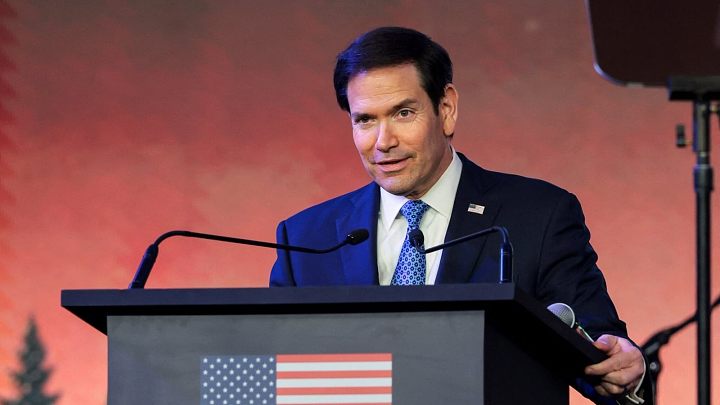
US Secretary of State Marco Rubio took a sarcastic swipe at United Nations experts on Wednesday when questioned about their criticism of India’s handling of recent protests, questioning the very term “UN experts” before declining to take sides in the country’s domestic political affairs.
His remarks came a day after India strongly rejected attempts to use unverified allegations and incomplete statistics to portray the country negatively, amid criticism from UN human rights experts over alleged excessive police force and restrictions on peaceful demonstrations.
‘UN Experts, Or Is That An Oxymoron?’
Responding to a reporter’s question about protests by opposition parties and students in India, and the allegations of a crackdown raised by UN experts, Rubio appeared to mock the international body’s experts.
“Well, the UN experts, yeah. My favourite. The UN experts, or is that an oxymoron?” Rubio remarked.
“UN EXPERTS, THAT’S AN OXYMORON”
U.S. Secretary of State Marco Rubio sarcastically quips as he refuses to be lured by Western Media into opining on “protests in India”.
Rubio even says India is a “democratic country where elections are held”. https://t.co/SVXd7ooyNG
— Rahul Shivshankar (@RShivshankar) October 21, 2026
He then made clear that Washington would not interfere in India’s internal political matters, stressing that the country was a democracy with an electoral process through which its people could make political decisions.
“No, it’s a domestic political matter. I mean, I am not going to get involved in their politics. This is a democracy. They have elections here. So I am not going to align on their domestic political matters,” he said.
Rubio also drew a distinction between peaceful demonstrations, which he described as part of democratic discourse, and riots involving vandalism, arson and destruction of property.
He said the freedom to express differing political opinions was an important feature of democratic societies, contrasting it with countries such as Cuba, where opposition voices risk imprisonment, oppression or exile.
“But we’re not going to comment on internal political matters. That’s for the Indian people to decide and navigate,” Rubio added.
What Did The UN Experts Say About India?
Rubio’s remarks followed criticism from more than 20 independent UN human rights experts, who on Tuesday expressed concern over what they described as a repeatedly heavy-handed police response to peaceful, youth-led demonstrations in India.
The experts alleged that law enforcement agencies had used excessive force against unarmed students, including baton charges, despite the reportedly non-violent nature of the demonstrations.
They also raised concerns about restrictions preventing thousands of people from joining protests, the alleged misuse of digital surveillance, including biometric technologies, and internet disruptions.
“We call on the authorities to immediately cease the use of excessive force, rescind blanket assembly bans, and refrain from the misuse of digital surveillance, including through biometrics, and internet disruptions,” the experts said.
The UN experts also called for an independent investigation into the conduct of law enforcement agencies and accountability for reported injuries and alleged ill-treatment of demonstrators.
Earlier this month, the UN Human Rights Office had expressed concern over reports of mass detentions involving protesters, protest leaders, civil society members, lawyers and journalists before and during large-scale demonstrations in Delhi.
India has maintained that its law enforcement agencies acted in accordance with the law.
India Hits Back At UN, Warns Against Selective Targeting
The criticism prompted a strong response from India at the UN General Assembly’s Third Committee on Tuesday, where New Delhi warned against using human rights as an instrument of political pressure or selectively targeting individual countries.
Ministry of External Affairs Deputy Secretary Barkha Tamrakar said India’s engagement with international human rights mechanisms must be based on dialogue, consultation, cooperation, non-selectivity and transparency.
“India engages with international human rights mechanisms, but such engagement must be based on dialogue, consultation, cooperation with non-selectivity and transparency as guiding principles,” she said.
Tamrakar cautioned against drawing conclusions beyond what UN reports actually established.
“We call on delegations to cite the report faithfully, not to inflate a humanitarian communication into a verdict,” she said.
India also formally opposed attempts to turn unverified allegations, incomplete statistics or reports containing no India-specific observations into a negative characterisation of the world’s largest democracy.
The Indian diplomat stressed that constitutional safeguards, including Article 21, protect fundamental rights and ensure due process.
While reiterating India’s willingness to address specific cases supported by proper documentation through established channels, Tamrakar maintained that human rights concerns should not be used for political pressure or selective country targeting.