Hills On All Four Sides, No AC: Nana Patekar's Simple Life Across Mumbai, Pune And Goa
Nana Patekar, who died at 75 in Goa on Thursday after a cardiac arrest, was reportedly worth around Rs 50-80 crore. Yet he kept a one-bedroom Andheri flat, a Goa home and a Pune farm. Asked on Kaun Banega Crorepati why h
By Sumedha Kirti··51K reads
Hills On All Four Sides, No AC: Nana Patekar's Simple Life Across Mumbai, Pune And Goa
Nana Patekar, who died at 75 in Goa on Thursday after a cardiac arrest, was reportedly worth around Rs 50-80 crore. Yet he kept a one-bedroom Andheri flat, a Goa home and a Pune farm. Asked on Kaun Banega Crorepati why he chose village life, his answer was disarmingly simple.
Doctors at Manipal Hospital said that Patekar was found unconscious at his residence in Dona Paula and could not be revived despite about 45 minutes of CPR. A medico-legal case has been registered and a post-mortem is awaited.
Born Vishwanath Patekar in Murud-Janjira on January 1, 1951, he debuted with Gaman (1978) and spent nearly five decades in Hindi and Marathi cinema, from Parinda and Krantiveer to Welcome and Natsamrat. He won three National Film Awards and the Padma Shri in 2013.
Reports put his earnings at Rs 2-3 crore per film in recent years. His way of living never seemed to follow the money.
Where Did Nana Patekar Actually Live?
For most of his adult life, in a single-bedroom flat in Andheri, Mumbai. The roughly 750 sq ft home was reportedly bought for about Rs 1.1 lakh decades ago and is now estimated to be worth around Rs 3 crore.
He lived there with his mother, Nirmala, until her death in January 2019 at the age of 99. He stayed on alone, and in interviews often said his needs had never outgrown the flat.
What About Goa And Pune?
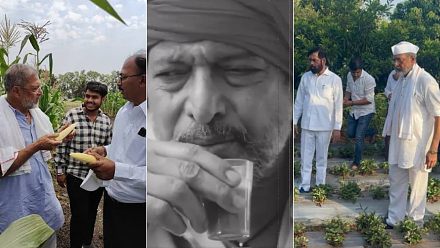
Reports say he also owned a more contemporary house in Goa, where he died, and split his time between Mumbai, Goa and Pune. His largest property was reportedly a 27-acre farmhouse in Khadakwasla, near Pune, with seven rooms and a large hall. Wheat and paddy grown there were reportedly sold across Maharashtra, with earnings shared among farmhands and local farmers. A separate house on Pune’s Law College Road is also reported.
How Rich Was He, Really?
Estimates range from Rs 50 crore to Rs 80 crore, built over five decades. Yet his garage was reportedly a Mahindra Jeep CJ4, an Audi Q7 and a Mahindra Scorpio. There was no supercar collection, and little sign of a star’s usual trappings.
Why Did He Choose Village Life?
He answered this himself, in an exchange with Amitabh Bachchan on Kaun Banega Crorepati. Bachchan asked why, after such fame, he had left it all behind for a village.
“I don’t belong to the industry,” Patekar said, in Hindi. “I come here, work and run back. I’ve never gone to parties here. It never suited me. I’m from the villages and I’ll remain there. That’s where I feel good.”
He said he had received far more than he ever wished for. “When your needs are limited, life becomes very easy,” he said. His village home, he added, has no AC, “but I enjoy it immensely.”
Then came the line that drew applause from the studio. In a city, he said, houses have walls. “Here, we have hills: hills on this side, hills on that side, hills on all sides, and we sit in the middle.”
What Did He Do With His Money?
Reports say he gave much of it away. In 2015, he reportedly handed cheques of Rs 15,000 each to over a hundred drought-hit farming families in Latur and Vidarbha. Friends and colleagues have long cited this as proof that wealth was never the point for him. Wikipedia lists the Naam Foundation as his organisation.
What Did His Years In Uniform Say About Him?
The same discipline showed in his army years. He trained for three years with the Maratha Light Infantry while preparing for Prahaar (1991) and was given an honorary Captain’s rank in the Territorial Army.
In August 1999, during the Kargil War, he obtained special permission from then Defence Minister George Fernandes. He then spent over two weeks near the LoC as part of a Quick Reaction Team, losing about 20 kg, by his own account to The Lallantop.
Where Did The Hardship Come From?
According to reports, Patekar’s family business was taken over by an acquaintance when he was 13, and he began painting movie posters in Chunabhatti for Rs 35 a month. His father died of a heart attack when he was 28. He also lost his elder son, Durvasa, at two and a half. He is survived by his son, Malhar.
Why Is A Film Clip Going Viral Today?
A scene from one of his films has resurfaced on social media. Patekar’s character tells Mahie Gill’s: “You won’t drink, you won’t dance. People will forget you after you die.” Her character asks: “Who stays alive after death?”
“Someone does,” he replies. “The heart for 10 minutes, the brain for 20, and the eyes for four hours. In those four hours, the eyes see how your own people behave. After that, death must feel like a gift to the corpse.”
A tribute to Nana Patekar. Three National Film Awards, four Filmfare Awards, the Padma Shri in 2013 and 23 years of service in the Territorial Army, including during the Kargil War. An actor who lived life with immense passion both on screen and in real life. #NanaPatekar https://t.co/gWOYaUYA4h
— Vijay Kumar (@adv_vkr) October 8, 2026
It was a monologue about how people treat you once you are gone. Patekar lived in a one-bedroom flat and a village among the hills, and he valued people over parties. For those who loved him, and for those who knew him only from the screen, the line lands differently today.