Hashim Moosa Killed: How 3 Years Of Manhunt Decimated LeT’s Key Field Network In J&K
For nearly three years, Mohammad Asif alias Hashim Moosa moved through some of the most difficult terrain in Jammu and Kashmir—from the forests of Poonch and Rajouri to the higher reaches of the Pir Panjal and eventually
By Tejinder Singh Sodhi··187K reads
Hashim Moosa Killed: How 3 Years Of Manhunt Decimated LeT’s Key Field Network In J&K
For nearly three years, Mohammad Asif alias Hashim Moosa moved through some of the most difficult terrain in Jammu and Kashmir—from the forests of Poonch and Rajouri to the higher reaches of the Pir Panjal and eventually the forests of central Kashmir.
On Wednesday, that hunt ended.
Moosa, a Pakistani Lashkar-e-Taiba operative and one of the most wanted terrorists operating in Jammu and Kashmir, was killed in Operation Korag in the Yousmarg area of Budgam. His body was recovered during a follow-up search along with war-like stores, according to the Army.
The significance of Moosa’s killing, however, goes well beyond one more terrorist being eliminated. It potentially marks the dismantling of one of the most important LeT field networks operating across the Pir Panjal and Kashmir Valley.
Who Was Hashim Moosa?
Security agencies had identified Moosa as a Pakistani national with military training. Reports have described him as a former member of Pakistan’s Special Service Group, before he joined the LeT network and infiltrated Jammu and Kashmir in 2023.
His military background was particularly significant because the network he operated with relied heavily on movement through dense forests, long-range mobility and attacks followed by rapid disappearance into difficult terrain.
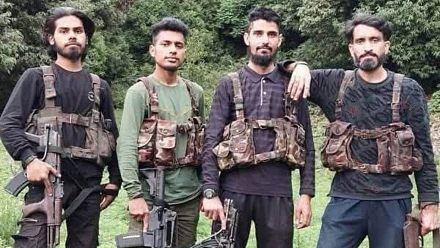
Moosa was not operating in isolation. He was part of a four-member LeT group that included Sulaiman Shah, Junaid Ahmed Bhat and Yasir. Security sources have identified Moosa as the commander of this group.
And one by one, that group has been eliminated. Junaid was killed in December 2024. Sulaiman Shah was killed in July 2025. Yasir was killed in the Yousmarg area earlier this month. Moosa was the last of the four. With his death, the entire four-member group has now been eliminated.
The Trail Of Attacks
The network’s operational footprint stretched across both sides of the Pir Panjal.
Security officials have linked members of the group to a series of attacks on security forces, including the October 2021 attacks in Poonch, the April 2023 Bhatta Durriyan attack, the December 2023 Dera Ki Gali ambush, the May 2024 attack on an IAF convoy, and the October 2024 Buta Pathri attack near Gulmarg.
The attacks demonstrated the advantage the group derived from the terrain.
The militants could operate in the forested areas of the Jammu region, cross the Pir Panjal and disappear into the Kashmir side. For security forces, locating a small group of heavily armed men in thousands of square kilometres of forest was a painstaking intelligence and surveillance challenge.
The Buta Pathri attack in October 2024, for example, killed two soldiers and two civilian porters. Members of the same network were also linked to the Ganderbal tunnel attack of October 2024, in which seven people were killed. Moosa subsequently became a key name in the investigation into the April 2025 Pahalgam terror attack, in which 26 people were killed. J&K Police had listed him among the wanted Pakistan-based LeT terrorists in connection with the case.
Three Years Of Evasion
What made Moosa particularly difficult to catch was not simply his ability to fight. It was his ability to disappear.
After the Buta Pathri attack, Moosa and Yasir remained underground and continued moving through the forests of the Pir Panjal. A prolonged intelligence-led operation eventually put security forces on their trail.
According to officials cited by The Indian Express, human intelligence and technical surveillance were used during a months-long operation in the Poonch-Rajouri forests. The pressure eventually forced the two terrorists towards the Yousmarg side of the Pir Panjal.
Yasir was killed on September 5. Moosa escaped. That made him the principal remaining target.
Less than four weeks later, intelligence inputs led security forces to the Korag-Yousmarg area. The Army, J&K Police and CRPF launched the joint operation. Troops detected suspicious movement, challenged the terrorists and came under fire. In the ensuing encounter, Moosa was killed.
Why Moosa’s Killing Matters
The biggest significance may be organisational.
For years, LeT’s ability to sustain armed operations in parts of Jammu and Kashmir depended on networks of commanders, infiltrators, guides and over-ground support.
Moosa represented the field-command layer of one such network. His death, following the elimination of Sulaiman Shah, Junaid and Yasir, means that the entire publicly identified four-member group has been wiped out.
That creates what can reasonably be described as a major field-level leadership vacuum for this LeT network.
It would, however, be premature to say that Lashkar-e-Taiba itself has become completely leaderless in Jammu and Kashmir. The organisation retains Pakistan-based leadership and networks, and intelligence agencies may possess information about operatives whose identities have not been publicly disclosed.
The more precise assessment is this—Moosa’s killing has eliminated the last publicly identified senior field commander of this particular LeT network operating inside Jammu and Kashmir.
And that distinction matters.
A Major Counter-Terrorism Operation
The operation also demonstrates the changing nature of the hunt for infiltrated militants. This was not simply a conventional encounter in which troops stumbled upon a hideout. The operation came after months of sustained pressure, intelligence gathering, technical surveillance and ground searches across one of the most challenging operational environments in the region.
The security forces first squeezed the network in the Poonch-Rajouri forests. The militants moved towards the Pir Panjal. They were tracked into the Yousmarg sector. Yasir was eliminated. Moosa escaped. The hunt continued. And eventually, the commander himself was found.
That sequence makes the operation significant: the network was not merely attacked; it was systematically dismantled over time.
Moosa’s death does not mean the end of LeT’s presence or Pakistan-based terrorism in Jammu and Kashmir. But it does remove a commander who had survived for years, operated across a difficult geographical corridor and remained a high-value target for security agencies.
For security forces, the challenge now is equally important: preventing another commander from crossing the Line of Control, rebuilding the network and filling the vacuum Moosa has left behind.
For the moment, however, one of the most persistent LeT field networks in Jammu and Kashmir has suffered its most significant setback.