Global Economic Uncertainty Here To Stay, India Must Build Resilience: Nirmala Sitharaman
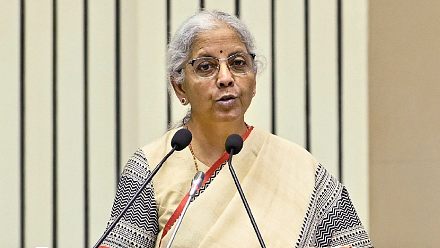
Uncertainty has become a permanent feature of the global economy, and policymaking must be built around it, Union Finance Minister Nirmala Sitharaman said on Saturday.
By Aanchal Sinha··82K reads
Global Economic Uncertainty Here To Stay, India Must Build Resilience: Nirmala Sitharaman
Uncertainty has become a permanent feature of the global economy, and policymaking must be built around it, Union Finance Minister Nirmala Sitharaman said on Saturday.
Speaking at the Kautilya Economic Conclave in New Delhi on the theme “Resilience in an Age of Flux”, Sitharaman said national security depends on achieving structural autonomy in strategic inputs and developing strong, cost-effective supply chains. She said these supply chains must reduce dependence on fragile single-source systems by creating greater domestic operational depth.
India must continue strengthening its resilience because the process cannot be treated as a one-time exercise, she said. Sitharaman cited the National Critical Mineral Mission, Rare Earth Corridors, the India Semiconductor Mission 2.0 and small modular reactors (SMRs) as policy responses to emerging challenges.
“Resilience is the capacity to absorb a shock without losing the growth path, and to retain the policy space to meet the next shock when it arrives. The evidence of resilience lies largely in the counterfactual, in the outcomes that did not materialise, an inflation spiral that did not take hold, queues that did not form at fuel outlets, banking stress that did not surface and a fiscal correction that was never forced.”
Economy Built Resilience Layer By Layer
Sitharaman said the Indian economy has continued to withstand global headwinds as the government deliberately built resilience across different layers from 2014.
She said India remains the fastest-growing major economy in the world, while retail inflation remains range-bound and there has been no deviation from fiscal prudence.
The global economy has faced a series of disruptions since March 2020, including the Covid-19 pandemic, the Russia-Ukraine war, the Israel-Hamas conflict, the US-Iran war that resulted in blockades of key sea routes and continuing trade disruptions caused by the weaponisation of tariffs.
Despite these shocks, the economy remained resilient over the past four years, Sitharaman said.
She highlighted several macroeconomic indicators to underline the resilience of the Indian economy. Real GDP grew 7.8% in the first quarter of 2026-27, while retail inflation was 4.82% in August, remaining below the Reserve Bank of India’s upper limit of 6%.
The current account deficit stood at 0.5% of GDP in the first quarter, while banks’ gross non-performing assets (NPAs) remained at multi-decadal lows. Foreign exchange reserves were around $766 billion, she said.
Oil Imports Remain Key Vulnerability
India continues to face vulnerabilities from both long-standing challenges, such as fluctuations in crude oil prices, and newer pressures, including global trade barriers, Sitharaman said.
The conflicts involving Russia, Ukraine and Iran, along with disruptions around the Strait of Hormuz, created a new form of shock by threatening both the physical movement of oil and gas and their prices, she said.
India imports more than 88% of the crude oil it refines, leaving the country exposed to significant fluctuations in global crude prices.
Benchmark Brent crude was priced at $22.74 a barrel on March 31, 2020, before rising to $104.71 a barrel on March 31, 2022. Since then, prices have fluctuated between $70 and $100 amid geopolitical developments. Brent crude stood at $102.25 a barrel on Friday, October 2.
‘Quantity Shock’ Tests State Capacity
Sitharaman distinguished price shocks and quantity shocks, saying the latter pose a greater test to the state’s ability to respond.
“A price shock can be cushioned with monetary and fiscal tools. But a quantity shock tests buffer stocks and the reach of delivery systems, and therefore the capacity of the state itself,” she said.
The Finance Minister also referred to Kautilya, after whom the conclave is named, saying he authored the world’s earliest treatise on economic policy and statecraft around 2,300 years ago.
Sitharaman said India’s economic fundamentals helped it withstand global headwinds even as global public debt increased to nearly 94% of GDP in 2025.
Citing the IMF’s April report, she said global public debt is projected to reach 100% of GDP by 2029, a level previously seen only after the Second World War.
India, however, came through the period “remarkably well with its fundamentals intact and strengthening”, the minister said.