Filipinos in Japan recount anxious moments after false earthquake alert
TOKYO — An emergency alert warning of a magnitude 9.9 earthquake turned an otherwise ordinary afternoon in Japan into several minutes of anxiety on Friday, as phones rang across the country and people braced for powerful
By JAY-VEE MARASIGAN PANGAN··30K reads
Filipinos in Japan recount anxious moments after false earthquake alert
TOKYO — An emergency alert warning of a magnitude 9.9 earthquake turned an otherwise ordinary afternoon in Japan into several minutes of anxiety on Friday, as phones rang across the country and people braced for powerful shaking that never came.
In Harajuku, about seven kilometers from central Tokyo, phones suddenly blared inside a second-floor shop, prompting staff to tell customers to brace for strong shaking.
Staff instructed customers to move away from shelves lined with drinks and other items that could fall. Inside the shop, customers followed the safety instructions as they waited for possible shaking. Outside, however, people continued walking along the streets as usual.
A screenshot shared by Daisy Whitby to GMA News correspondent Jay-vee Marasigan Pangan shows an emergency earthquake alert indicating an estimated magnitude 9.9 earthquake and warning of strong shaking in Japan on October 16, 2026. Courtesy: Daisy Whitby
Philippine Agriculture Attaché Maria Alilia Maghirang was at Tokyo Big Sight, where the Philippines had a national booth at the Specialty Coffee Association of Japan 2026 exhibition.
The venue, located along Tokyo Bay, was hosting an event that drew an average of about 20,000 visitors daily.
“Medyo disturbing yung experience kasi sabay-sabay na nag-alarm lahat ng phones sa venue, unlike if you're just in the office or at home,” Maghirang said.
(The experience was somewhat disturbing because all the phones in the venue sounded at the same time, unlike if you were just in an office or at home.)
The simultaneous alarms were particularly unsettling given the number of people at the exhibition, she said.
About 120 kilometers from central Tokyo, in Oarai, Ibaraki Prefecture, Filipina permanent resident Michelle Vicencio was at home with her family when a local emergency announcement warned of a strong earthquake.
“Naghintay po kami na magshake, pero walang earthquake na nangyari,” Vicencio said.
(We waited for the shaking, but no earthquake happened.)
Vicencio, who has lived in Japan for more than 10 years, said they later learned that the initial estimate was magnitude 9.9. Even after several minutes passed without shaking, they remained uncertain about whether an earthquake might still occur.
“May kaba pa rin sa dibdib namin kasi baka it’s going to happen pa rin kahit ilang minutes na,” she said.
(We were still nervous because we thought it might still happen even after several minutes.)
Six months pregnant, Vicencio instinctively placed a hand on her belly when she heard the alarm. She said the experience reinforced the importance of being prepared.
“Importante talaga na handa ka… Pero hindi kailangan magpanic,” she said.
(It is really important to be prepared… But there is no need to panic.)
Vicencio added that her family keeps emergency bags in their car.
In Nagoya, about 340 kilometers from Tokyo, Filipino teacher Grace Gutierrez was at work when earthquake alerts sounded on employees’ phones.
Gutierrez, who has lived in Japan for 10 years, immediately went to her students and prepared them for a possible evacuation. Seven children aged one to two were in her class and were taking their afternoon nap at the time.
“Nakakatakot kasi natutulog ibang mga students. Mahirap mag-evacuate,” she said.
(It was frightening because some of the students were asleep. It would have been difficult to evacuate them.)
Some classes had already evacuated when another message arrived saying the alert was false. Gutierrez’s class had not yet left the room.
“Kung di sila tulog, okay lang kasi lagi naman kami may evacuation drill,” she added.
(If they had not been asleep, it would have been okay because we regularly have evacuation drills.)
Further away, in Toyama Prefecture, Mabel Johnson was resting in a tatami room during her lunch break when alarms sounded on employees’ phones.
Johnson, who has lived in Toyama for nine years and works in meat inspection at a food processing company, said earthquakes had become familiar after years of living in Japan. Still, powerful alerts continued to cause concern.
“Parang normal na po sa akin, sa amin mga Filipino, ang lindol dito sa Japan, siguro nakasanayan na. Pero siyempre po nakakatakot pa rin lalo kung sobrang lakas. Mabuti na lang po at false alarm yun,” she said.
(Earthquakes have become somewhat normal for me and for us Filipinos here in Japan, probably because we have gotten used to them. But of course, they are still frightening, especially if they are very strong. It was a good thing that this turned out to be a false alarm.)
Johnson said the alarm sounded twice. She did not notice whether the initial notification indicated magnitude 9.9, but a subsequent message informed them that the warning had been canceled.
A magnitude 9.9 earthquake would exceed the strength of any earthquake ever instrumentally recorded.
The Japan Meteorological Agency (JMA) later said it had significantly overestimated the magnitude of an earthquake near the Kuril Islands, triggering an emergency earthquake warning at around 12:40 p.m. on October 16.
The system initially estimated the earthquake at magnitude 9.9 and issued warnings from Hokkaido to central Japan. The alert was withdrawn about eight minutes later.
The actual earthquake registered magnitude 6.9 and was centered off Russia’s Kamchatka Peninsula. Only weak shaking was observed in Japan, including seismic intensity 1 in Hakodate, Hokkaido. No tsunami warning or advisory was issued. —VBL/MCG GMA News
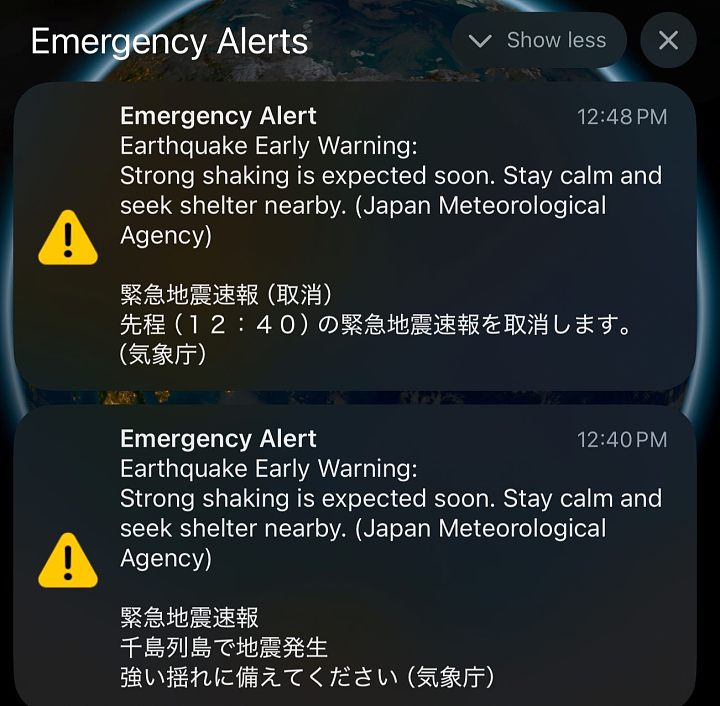
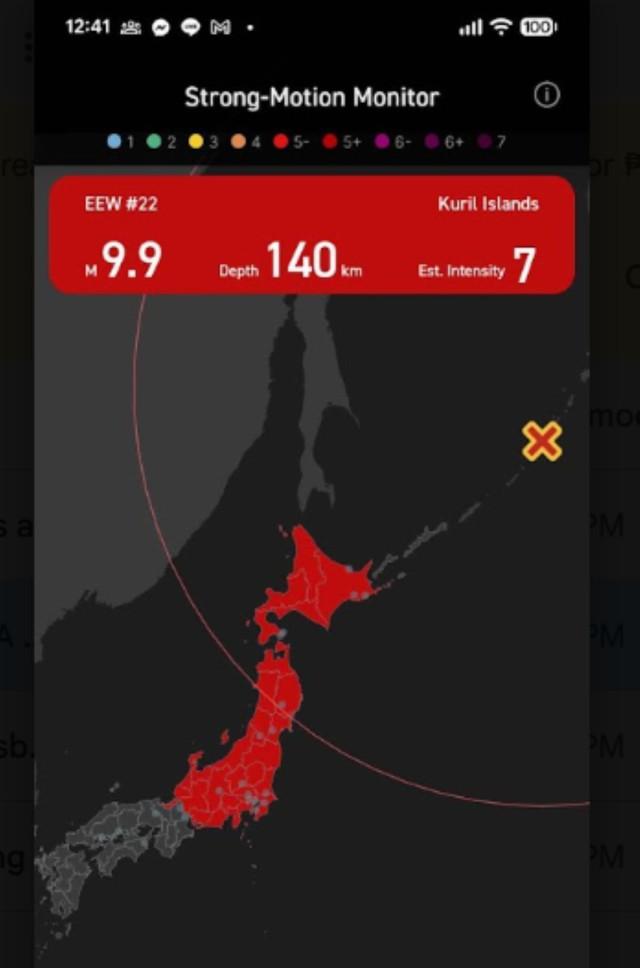 A screenshot shared by Daisy Whitby to GMA News correspondent Jay-vee Marasigan Pangan shows an emergency earthquake alert indicating an estimated magnitude 9.9 earthquake and warning of strong shaking in Japan on October 16, 2026. Courtesy: Daisy Whitby