Dr Ramana Rao’s Sunday Village Clinic: 53 Years Of Free Healthcare, 2.5 Million Lives Touched & Counting
For most people, Sunday is a day to slow down, sleep in or spend time with family. But at Begur, on the outskirts of Bengaluru, Sunday begins much earlier. As the morning sets in, hundreds of people begin arriving at the
By Afreen Hussain··149K reads
Dr Ramana Rao’s Sunday Village Clinic: 53 Years Of Free Healthcare, 2.5 Million Lives Touched & Counting
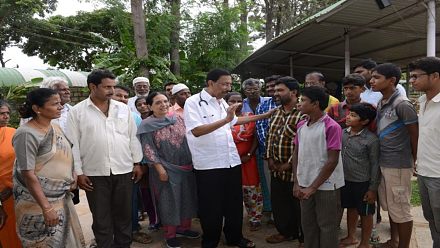
For most people, Sunday is a day to slow down, sleep in or spend time with family. But at Begur, on the outskirts of Bengaluru, Sunday begins much earlier. As the morning sets in, hundreds of people begin arriving at the “Free Village Clinic”, forming a queue that stretches for more than half a kilometre.
They come to see one man, Padma Shri awardee Dr Ramana Rao.
Some arrive from nearby villages, while others travel hundreds of kilometres. Some have been coming to the clinic for decades. And every one of them knows one thing when they arrive: they will not be asked to pay for the consultation, the diagnostic tests, or the medicines they receive.
For 53 years, since August 15, 1973, Dr Rao’s Free Village Clinic has continued this Sunday ritual. Over the decades, the clinic has treated an estimated 2.5 million patients, providing healthcare entirely free of cost.
Images: drramanarao.com
For Dr Rao, the idea began long before the clinic did, with what he saw as a child.
“My father was an engineer working on the Tungabhadra Dam, and we lived there during my childhood. Growing up in a rural area, I saw firsthand how people struggled to access even basic healthcare,” Dr Rao said.
That childhood memory eventually became the foundation for a clinic that has now become a weekly lifeline for thousands of people.
Every Sunday, around 35 doctors work alongside Dr Rao. The team includes specialists in general medicine, cardiology, endocrinology, dermatology, ophthalmology, and dentistry. Patients can consult doctors, undergo diagnostic tests, and receive medicines and medical devices, all under one roof and without having to worry about the cost.
For some, the clinic has become part of their lives.
Gangappa has been consulting Dr Ramana Rao for the past 30 years. For him, the doctor is no longer simply someone he visits for medical treatment.
“We have never seen God, but for my family, Dr Ramana Rao is no less than God. The treatment here is completely free, including consultations, tests and medicines,” Gangappa said.
Another patient, Uday Kumar, came to the clinic after consulting several doctors about his gangrene. He says he was repeatedly told that his condition could not be treated.
“I had consulted several doctors, and they all told me that my gangrene could not be treated. But Dr Ramana Rao has been a miracle for me. I am now recovering,” Uday Kumar said.
For some patients, the journey to the clinic itself is a testament to the faith they place in Dr Rao.
Vishwanath travelled nearly 300 kilometres from Davanagere to Begur after hearing about the doctor. He said he had heard that Dr Ramana Rao could treat anyone and decided to make the journey to get himself examined.
And it is not just the promise of free medical care that has defined the clinic. Dr Rao’s philosophy has always extended beyond treating an illness.
He believes that for a village and its people to grow, healthcare has to go hand in hand with education, sanitation, nutrition and access to other basic necessities.
“The aim is not just to provide healthcare, but to improve the overall well-being of the communities around the clinic,” Dr Rao said.
Over the years, the initiative has expanded into several areas. Dr Rao has built 700 toilets, worked towards eradicating malnutrition in nearby villages, supported around 50 schools, planted 35,000 trees and set up drinking-water units.
The idea is simple: improving the health of a community cannot stop at the doors of a clinic.
But sustaining a free healthcare initiative for 53 years has not been easy. Keeping the clinic running, paying for diagnostic services and medicines and ensuring that patients continue to receive treatment without being charged has brought its own financial challenges.
Dr Rao says the initiative has survived with the support of friends, family and well-wishers.
“The clinic has continued with contributions from friends, family and well-wishers. There were times when finances were stretched, and I would reach out to my friends for help. They have always supported me and have been more than happy to contribute whenever I asked,” Dr Rao said.
There is also another person who has witnessed that commitment closely for decades: his wife, Hema.
She says the Sunday clinic has never been something Dr Rao treats as an obligation that can be skipped when life gets busy. Even family occasions, she says, have not come in the way of his commitment to his patients.
“No matter where he is or how busy his schedule is, he makes sure he is at the clinic for his patients. Even if there is a family function, he makes sure not to miss his Sunday commitment. Many of his patients travel from miles away, with some arriving the previous evening or even a night before just to meet him. That is why, no matter where he is, he makes sure to be at the clinic for them,” Hema said.
For the patients who make those journeys, that consistency matters.
Some arrive the previous evening. Others reach the clinic early in the morning and wait for their turn. For them, Sunday is not simply another day of the week. It is the day they know they will get to see the doctor they have come to trust.
Over the years, Dr Rao has also treated some of Bengaluru’s best-known personalities, including film stars and former Chief Ministers. Among his famous patients was legendary Kannada actor Dr Rajkumar, who remains particularly close to his heart.
There is a small ritual associated with that connection.
Whenever Dr Rao arrives at the clinic, Dr Rajkumar’s songs begin playing. They continue until the doctor leaves. For people living nearby, the music has become a familiar signal. If Rajkumar’s songs are playing, Dr Rao is at the clinic.
Old Hindi classics also play in the background.
“Dr Rajkumar’s songs and old Hindi classics keep me energised and motivated as I work,” Dr Rao said.
Shobha, who has worked alongside Dr Rao and helped run the clinic for the past 35 years, has watched generations of patients come through its doors. She says even the music has become part of the clinic’s Sunday rhythm.
“The moment Dr Rajkumar’s songs begin playing, it is a signal to the patients that the clinic is about to begin,” Shobha said.
And perhaps that is what makes the Sunday Village Clinic different. It is not just the absence of a bill. It is the continuity, the same doctor returning every Sunday, the same promise of free care, and patients continuing to make their way to Begur from near and far.
What began with a six-year-old Dr Ramana Rao witnessing people struggle to access basic healthcare has, over 53 years, grown into an initiative that has touched the lives of around 2.5 million patients.
By the time another Sunday comes to an end, the long queue has disappeared, the consultations are over and the music falls silent.
But the promise remains. The clinic will be there the following Sunday. And so will Dr Ramana Rao.