Delhi Winter Anti-Pollution Plan: Experts Say Measures Aren’t New, Implementation Is The Real Test
Delhi Air Pollution: The Delhi government’s winter action plan has drawn a cautious response from air quality experts, who have welcomed its early announcement but questioned whether it will deliver results. They say mos
By Saurabh Verma··195K reads
Delhi Winter Anti-Pollution Plan: Experts Say Measures Aren’t New, Implementation Is The Real Test
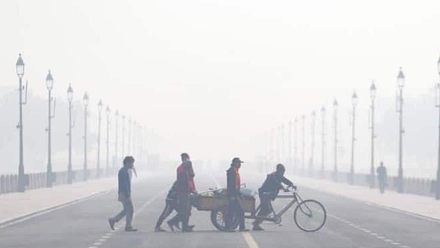
Delhi Air Pollution: The Delhi government’s winter action plan has drawn a cautious response from air quality experts, who have welcomed its early announcement but questioned whether it will deliver results. They say most measures have been announced in previous years, cover only a limited set of pollution sources, and will make a difference only if implemented effectively on the ground.
The plan includes measures such as work from home, stricter Pollution Under Control Certificate (PUCC) checks, and steps to curb construction and road dust. Experts, however, have called for a comprehensive, year-round strategy that addresses emissions from vehicles, industries, power plants, waste and pollution originating beyond Delhi’s borders.
“There’s nothing new. Most of these measures have been announced in the past and have been repackaged,” said Sunil Dahiya, founder and lead analyst at Envirocatalysts.
Dahiya said the key difference this year was the timing of the announcement, which came before the high-pollution season and gave authorities more time to prepare. In previous years, he said, measures were announced at different times rather than as part of a comprehensive plan, while implementation remained a major weakness.
“Whether it will be followed through and actually implemented on the ground remains a question,” he said, adding that enforcement would ultimately determine whether the measures improve air quality.
Also Read | Not Just Choking Lungs, Delhi Air Pollution Is Affecting Your Mental Health Too
Delhi-NCR Needs A Coordinated Approach
Dahiya said the action plan also makes a distinction between pollution sources within Delhi’s control and those originating outside the capital, underlining the need for neighbouring states to take responsibility.
“The Delhi government is saying that it controls about 30 to 40 per cent of the pollution sources in Delhi and that it wants to work on those. But about 60 to 70 per cent of the pollution still comes from outside Delhi, from the larger airshed, NCR and beyond,” he said.
He said neighbouring regions would also need to implement measures to curb emissions if the plan was to deliver meaningful improvements.
Dahiya also raised concerns about the reliability of air quality monitoring data. He said there had been attempts to tamper with readings last year by sprinkling water near monitoring stations, potentially lowering reported pollution levels without reducing pollution across the city.
“That is a big disservice to the public,” he said, adding that such practices should not be repeated this year.
‘Very Few Sources From A Large Pool’
Manoj Kumar, an air quality analyst at the Centre for Research on Energy and Clean Air (CREA), said the measures announced by the government addressed only a limited number of pollution sources.
“These measures address very few sources from a large pool of sources. We need to look at the contribution of each and every source,” Kumar said.
While measures targeting vehicles, road dust and stubble burning are important, he said, other sources also require sustained attention. These include industries, particularly micro, small and medium enterprises (MSMEs), power plants, waste-related activities and pollution originating beyond Delhi-NCR.
Kumar said Delhi’s efforts needed to be complemented by measures across the wider National Capital Region, as pollution cannot be tackled by the capital alone.
He also highlighted the role of secondary particulate matter, which forms in the atmosphere through chemical reactions involving gaseous pollutants. According to Kumar, it can account for around 25 to 30 per cent of Delhi’s PM2.5 pollution, depending on the season.
He said policies focusing primarily on particulate matter risk overlooking the gaseous pollutants that contribute to its formation.
Kumar called for sector-specific emission reduction targets, with clearly defined timelines for industries, transport, power plants and other major sources. The vehicle sector, he said, accounts for around 28 to 30 per cent of Delhi’s pollution, making it important to set measurable targets for reducing emissions from transport.
“Without emissions, there won’t be pollution,” he said, arguing that the response should extend throughout the year rather than intensify only during the winter months.
EV Push Needs Neighbouring States On Board
Kumar welcomed measures that reduce pollution at its source, including the adoption of electric vehicles (EVs), but said a Delhi-only policy would have limitations.
Vehicles registered in Haryana, Uttar Pradesh and Rajasthan also operate in the capital, including those used for app-based cab services. Unless neighbouring states adopt similar measures, petrol and diesel vehicles will continue to contribute to emissions across the region, he said.
Kumar added that increasing the share of EVs would need to be accompanied by efforts to control the growth of the overall petrol and diesel vehicle fleet. Otherwise, the impact of electrification on total transport emissions could remain limited.
Tree Plantation Cannot Replace Emission Cuts
On the government’s emphasis on increasing green cover, Kumar said tree plantation can help reduce heat stress and the urban heat-island effect. However, he said evidence that plantations reduce ambient particulate pollution by a specific amount remains limited.
He also cautioned that trees planted close to roads can, in some circumstances, impede the dispersion of pollutants and trap pollution locally.
For the experts, the central question is no longer whether governments can announce pollution-control measures, but whether they can enforce them consistently, coordinate action across state boundaries and address the full range of emission sources before pollution levels rise during winter.