Dead Fish, Dip In Dirty Yamuna And A Political Face-Off: Why Chhath Puja Is A Flashpoint In Delhi
The sighting of hundreds of dead fish in the Yamuna, concerns over rising ammonia levels and a political row over the river’s cleanliness have brought the BJP and AAP into a fresh confrontation once again amid Chhath Puj
By Shuddhanta Patra··141K reads
Dead Fish, Dip In Dirty Yamuna And A Political Face-Off: Why Chhath Puja Is A Flashpoint In Delhi
The sighting of hundreds of dead fish in the Yamuna, concerns over rising ammonia levels and a political row over the river’s cleanliness have brought the BJP and AAP into a fresh confrontation once again amid Chhath Puja in Delhi.
As the Rekha Gupta-led BJP government showcased its arrangements for the festival, the Opposition AAP has questioned the condition of the ghats and claims of improved water quality. The political spar heated up after dead fish were spotted near Sonia Vihar earlier this week, coinciding with a deterioration in the quality of raw water drawn from the Yamuna and a spike in ammonia levels.
Delhi Water Minister Parvesh Singh Sahib Verma alleged that “some people” had deliberately dumped the fish into the river and said the possible involvement of AAP workers would be investigated.
AAP Delhi chief Saurabh Bharadwaj hit back, saying the government’s claims about cleaning the Yamuna had been “exposed”. He also accused Verma of being “rattled and making baseless statements”.
The BJP has continued to target the previous AAP government over the issue. In a social media post, it said: “Under AAP’s rule, devotees got nothing but dirty water, dilapidated ghats and hollow promises. Under the BJP government, clean ghats, better arrangements and respect for faith.”
The BJP government has announced arrangements at 1,482 Chhath ghats across 996 locations in Delhi. It has also developed an 11-km-long ghat along the Munak Canal, which was inaugurated by BJP national president Nitin Nabin.
North East Delhi MP Manoj Tiwari, one of the BJP’s prominent Purvanchali leaders, took a dip in the Yamuna at Sonia Vihar ahead of the festival. He said the government had made progress in cleaning the river and making it safe for devotees.
The government also launched an electric cruise service between Sonia Vihar and Jagatpur in North East Delhi and organised a light-and-sound show along the Yamuna on the first day of Chhath.
AAP, meanwhile, accused the government of failing to make adequate arrangements. Its Burari MLA Sanjeev Jha, who is also one of the party’s key Purvanchali faces, visited several ghats and raised concerns over the preparations.
Why Chhath has become a political occasion
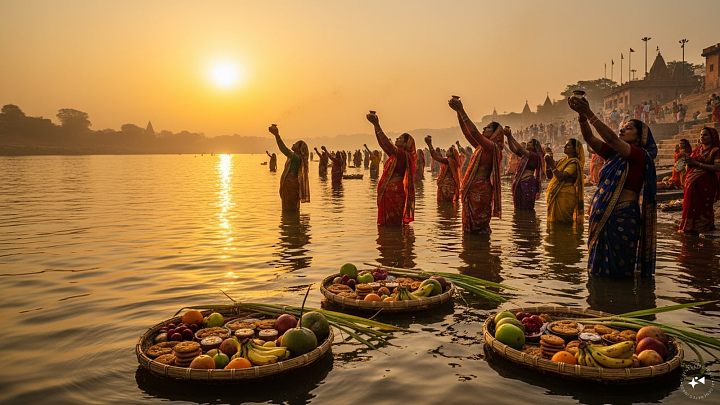
Chhath Puja is a four-day festival dedicated to the Sun and is widely observed in Bihar, parts of eastern Uttar Pradesh and Nepal. In Delhi, it is celebrated by the large Purvanchali community, whose members migrated to the capital from Bihar and eastern Uttar Pradesh in search of work.
Purvanchalis are estimated to account for at least 30% of Delhi’s population, with a significant presence in East and North East Delhi and parts of South Delhi. Their numbers have made the community electorally important, prompting political parties to compete over their outreach and support for the festival.
Chandrachur Singh, who teaches Political Science at Delhi University’s Hindu College, said political parties naturally take population figures into account, but the community’s desire for recognition also plays an important role.
He said migrants wanted their numbers to be valued and publicly recognised. According to Singh, Chhath gives political parties an opportunity to present themselves as inclusive and supportive of the community.
How arrangements and Yamuna rules have changed
Chhath Puja was first declared a public holiday in Delhi in 2014, when the city was under President’s Rule. Before that, it was observed as a restricted holiday. Demands for the change came from the BJP as well as Congress leaders, including former MP and MLA Mahabal Mishra, who joined the AAP in 2022.
Mishra said the setting up of Chhath ghats began during the Sheila Dikshit-led Congress government. “It started with just around 11 ghats. Then under the AAP government, this grew to around 1,100, and this time we are hearing of more than 1,400 ghats,” he said.
Since 2021, the Delhi Disaster Management Authority (DDMA) has prohibited Chhath celebrations on the Yamuna floodplains, citing a 2015 National Green Tribunal order against dumping puja material, food grains and waste into the river. Devotees used artificial ponds across Delhi during the restrictions. The government permitted worship along the Yamuna again last year.
Delhi BJP’s Purvanchal Morcha general secretary Sanjay Tiwari said the large Purvanchali population made proper arrangements necessary. He also credited the BJP with bringing celebrations back to the river.
“I won’t say the Yamuna is 100% clean, but efforts are ongoing and results are coming,” Tiwari said.
The AAP, however, maintains that the restrictions during its tenure were imposed by the Lieutenant Governor-led DDMA, rather than by the state government.