Congress Wants Equal Billing With SP In Uttar Pradesh: Bargaining From Strength Or Fighting For Relevance?
The Congress party wants to be treated as an equal partner in Uttar Pradesh, not as a junior ally expected to accept whatever space the Samajwadi Party is willing to offer. As seat-sharing talks got underway between the
By Parimal Peeyush··188K reads
Congress Wants Equal Billing With SP In Uttar Pradesh: Bargaining From Strength Or Fighting For Relevance?
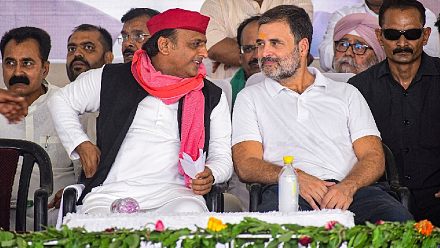
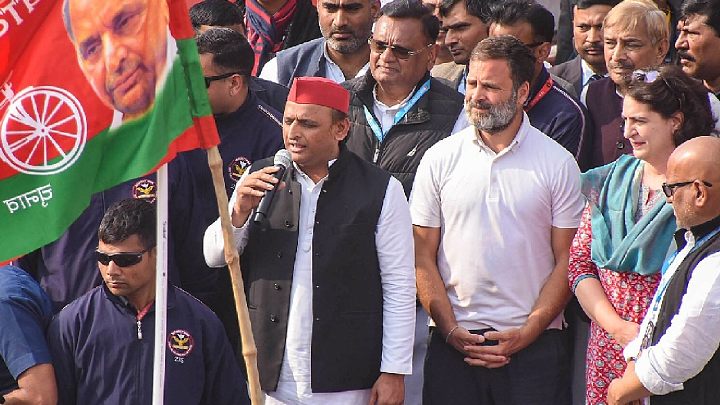
The Congress party wants to be treated as an equal partner in Uttar Pradesh, not as a junior ally expected to accept whatever space the Samajwadi Party is willing to offer. As seat-sharing talks got underway between the two alliance partners ahead of the 2027 Assembly elections, the party on Wednesday said it wants the final word in the choice of seats it contests as well as the number of seats it gets to field its candidates from.
“On the basis of our organisational strength, the confidence people have shown in us and our performance, we have put forward our demand for certain seats. Discussions have begun, and we are confident that the final arrangement will be honourable. The details will be shared once the agreement is finalised,” UP Congress in-charge Rajendra Pal Gautam told mediapersons in Lucknow.
The Congress’s demand for a bigger share of seats in the 2027 Assembly election is based on the party’s understanding that it can turn its recovery in the 2024 Lok Sabha polls into renewed political relevance in India’s most electorally consequential state. But there is a gap between the Congress’s ambitions and its current position on the ground.
The party won six Lok Sabha seats in Uttar Pradesh in 2024, riding an alliance with the Samajwadi Party that delivered 43 of the state’s 80 seats to the INDIA bloc. Yet Congress has only two MLAs in the 403-member Assembly, following its performance in the 2022 election, when it contested independently.
The contrast captures the central tension in the negotiations. While the Congress believes its contribution to the 2024 result gives it a natural claim to a larger role, the SP sees itself as the primary Opposition party in the state — backed by its organisation, social base and electoral record — with no overwhelming reason to cede space to its alliance partner.
The Congress’s UP in-charge, however, has set forth the demand in terms of parity. “There must be equal respect and an equal share,” he said, arguing that the party should not be expected to settle for a marginal role in the alliance. He has also spoken of contesting 150 to 200 seats, while the SP has stressed that the eventual arrangement must be based on winnability.
The UP Arithmetic: Six Lok Sabha Wins, 2 MLAs
Congress has grounds to argue that its position has improved. In the 2024 Lok Sabha election, it won six of the 17 seats it contested in Uttar Pradesh. The SP won 37 of the 62 seats it contested. Together, the two parties dealt a major blow to the BJP, which fell from 62 seats in 2019 to 33 in 2024.
That result gave Congress fresh leverage. It demonstrated that the party could contribute to a winning coalition and that its national campaign, messaging and candidates had a role in the Opposition’s performance. It also strengthened Rahul Gandhi’s position within the INDIA bloc.
But a Lok Sabha result cannot automatically be translated into Assembly-level strength. The 2022 Uttar Pradesh election offers a more difficult benchmark. Congress contested 399 seats and won just two, securing 2.33% of the vote. In 2017, when it allied with the SP, Congress contested 114 seats and won seven, while the SP won 47. The alliance was defeated by the BJP, which won 312 seats.
The experience exposed twin weaknesses of translating an alliance into constituency-level coordination, and Congress’s limited ability to convert its broader political presence into Assembly victories in UP.
The 2024 result offers a more encouraging template. Congress contested fewer seats and won six, while the SP emerged as the largest party in the state. The challenge for 2027 is to replicate that success in an election fought across 403 constituencies, where local organisation, candidates and caste equations matter differently.
In May 2025, senior Congress leader and Saharanpur MP Imran Masood said the party was readying itself to contest all 403 Assembly seats in the state, and that an alliance, if any, would not be acceptable if the SP decided the seats it contests. “They won’t decide our seats now. They offer us seats where we will lose… The Congress is facing harm because of the alliance. See, the BJP eats up its allies. On the other hand, our allies eat us up,” Masood told The Indian Express then.
Cut to 2026, and the Congress now says it has begun identifying seats where it believes it can be competitive. Both parties have conducted surveys, and Congress has emphasised the importance of early negotiations to avoid the late-stage confusion and friendly contests that hurt their 2017 alliance.
The approach makes strategic sense. But it also exposes the limits of the party’s claim to parity. The SP won 111 seats in 2022 and 37 Lok Sabha seats in 2024. Congress won two Assembly seats in 2022 and six Lok Sabha seats in 2024. The two parties are not starting from comparable positions in the state.
The question, therefore, is not whether Congress deserves a voice in the alliance. It is whether the number of seats it seeks corresponds to the constituencies where it can plausibly win.
The Alliance Record
Congress’s bargaining strategy in Uttar Pradesh becomes more telling when placed alongside its performance in other states. The party has often had to negotiate with powerful regional allies, and the outcomes show that seat-sharing demands, vote share and electoral returns do not always move together.
Maharashtra offers a recent warning. In the 2019 Assembly election, Congress contested 147 seats and won 44, with a vote share of around 15.9%. In 2024, it contested 101 seats as part of the Maha Vikas Aghadi, but won only 16, with its vote share falling to 12.42%. Its reduced seat allocation did not prevent a sharp decline in its tally, while the alliance suffered a sweeping defeat.
The lesson is not that contesting fewer seats is inherently a mistake but that an alliance cannot compensate for a loss of support or weak constituency-level prospects. Congress had a substantial share of the opposition contest in Maharashtra, yet its ability to convert that space into victories deteriorated.
Bihar offers a different but equally instructive example. In the 2020 Assembly election, Congress contested 70 seats as part of the Mahagathbandhan and won 19, securing 9.48% of the vote. In 2015, when it contested 41 seats in alliance with the Rashtriya Janata Dal and other parties, it won 27 and received a vote share of around 6.7%. The larger allocation in 2020 did not translate into a larger tally. Congress won fewer seats despite contesting 29 more constituencies.
That result became a point of friction within the alliance. Critics argued that Congress had been given too many seats relative to its strike rate, potentially weakening the coalition’s overall prospects in closely fought constituencies. The broader point for Uttar Pradesh is that a larger seat share can become a liability if the party cannot demonstrate that its candidates are competitive.
Jharkhand provides a more positive counterpoint. In the 2024 Assembly election, Congress contested 30 seats as an ally of the Jharkhand Mukti Morcha and won 16, helping the ruling alliance retain power. Its strike rate was considerably stronger than in Maharashtra or Bihar. The result suggests that a party can perform effectively with a negotiated share when the alliance has a viable electoral base, and its candidates are competitive.
The numbers also caution against treating vote share as a simple proxy for bargaining power. A party’s statewide vote share can be spread thinly across constituencies, while a smaller but concentrated vote can produce more seats. For Congress, the challenge is to demonstrate not just that it has voters, but that it can identify and mobilise them in the constituencies it seeks.
Maharashtra To Bihar: A Recurring Struggle
Congress’s negotiations with regional parties are shaped by a larger political dilemma. It wants to preserve its identity as a national party while accepting that, in several states, regional parties have stronger organisations and more established social coalitions.
That tension can lead to different strategies in different states. Where Congress is the stronger player, it tends to protect its leadership and seat share. Where a regional party is dominant, Congress seeks recognition for its national profile and contribution to a broader anti-BJP coalition. The problem arises when the party’s bargaining position is based more on its national standing than on its state-level electoral prospects.
Uttar Pradesh is particularly sensitive because Congress once dominated the state but has steadily lost ground. Its demand for an equal share is therefore not just about the next election but also about whether the party can prevent its political identity in UP from becoming permanently dependent on the SP.
The party’s record in Maharashtra and Bihar shows the danger of confusing bargaining success with electoral success. Jharkhand demonstrates that alliances can work when seat allocation aligns with competitive candidates and a viable coalition. Uttar Pradesh’s own history shows that even a formal alliance can fail when negotiations are late, and coordination is weak.
Congress is therefore facing a test that goes beyond its relationship with Akhilesh Yadav. It must show that the revival it experienced in the 2024 Lok Sabha election can be converted into a durable state-level organisation. It must also establish that the seats it seeks are backed by local strength rather than the assumption that its national standing should automatically translate into a larger share.