Congress's June Triumph, October Setback: Is Karnataka's Opposition Arithmetic Changing?
In June this year, the Congress had reason to celebrate after winning all five Legislative Council seats it contested in Karnataka, even managing to pull off cross-voting from the BJP-JD(S) camp. Four months later, the t
By Rohini Swamy··133K reads
Congress's June Triumph, October Setback: Is Karnataka's Opposition Arithmetic Changing?
In June this year, the Congress had reason to celebrate after winning all five Legislative Council seats it contested in Karnataka, even managing to pull off cross-voting from the BJP-JD(S) camp. Four months later, the tables have turned. The party has been completely shut out in the latest MLC elections, with the BJP-JD(S) alliance sweeping all four seats.
The contrast between the two results is telling. While the Congress had benefited from a divided Opposition earlier, the BJP and JD(S) have now demonstrated what a united front can achieve. With the 2028 Assembly elections less than two years away, the results have brought the changing political equations in Karnataka into sharp focus.
The MLC results in no way mean that the Congress is headed for defeat in 2028. But the results have exposed a political vulnerability that the party cannot ignore. The road to 2028 is still long. But the electoral arithmetic is already changing, and the Congress may have to start preparing for a very different contest than the one it won three years ago.
The Congress may have won Karnataka comfortably in 2023, but the political arithmetic that delivered that mandate is beginning to look very different. The BJP and JD(S), once bitter rivals who fought separate battles in the state, are increasingly discovering the electoral value of fighting together. And the latest Legislative Council election results have given the ruling Congress a rather uncomfortable glimpse of what that arithmetic could mean in 2028.
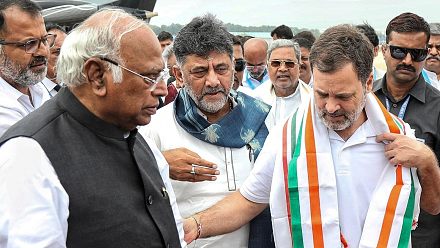
For Chief Minister DK Shivakumar, the results are particularly uncomfortable. He had personally pushed for the use of ballot papers instead of Electronic Voting Machines (EVMs), in keeping with the Congress’s larger national campaign against alleged vote manipulation. The argument was that ballot papers would eliminate doubts surrounding the electoral process. But when the results came in, the Congress had little to celebrate.
Shivakumar admitted that the party had not anticipated the outcome. The Congress was expecting to win at least two seats, particularly Bengaluru Teachers’, which it believed it could retain. While the Deputy Chief Minister said the party respected the voters’ verdict and would study what went wrong, his disappointment was evident.
But the bigger embarrassment for the Congress was the political symbolism of the results.
For the BJP-JD(S) combine, this was an opportunity to send a message beyond the four constituencies.
The BJP retained the North-East Teachers’, South-East Graduates’ and West Graduates’ constituencies, while the JD(S) wrested the Bengaluru Teachers’ constituency from the Congress. The result was a complete sweep for the National Democratic Alliance (NDA), leaving the ruling party without a single victory in the four constituencies.
The BJP was quick to turn the tables on the Congress’s EVM narrative. Its Karnataka unit’s social media post, “DK, it’s done, bro”, was a pointed attempt to suggest that changing the voting mechanism had changed nothing about the voters’ verdict.
The June results: A different story
What makes this defeat particularly interesting is the contrast with another Legislative Council election held earlier in June this year.
In the election to seven Legislative Council seats, the Congress won all five seats it contested, even securing 11 additional votes through cross-voting from the BJP and JD(S). The party managed to secure 151 votes across its five candidates despite claiming a strength of 140 in the 224-member Assembly.
It was seen as a major political victory for the Congress and, in particular, a boost for Shivakumar, who was facing his first electoral test as chief minister after the change in leadership.
The BJP and JD(S), meanwhile, were left dealing with the embarrassment of cross-voting within their own ranks. The BJP acknowledged that at least three of its MLAs had voted against the party line, while the JD(S) was left questioning the loyalty of its legislators.
The Congress had then demonstrated that it could exploit divisions within the Opposition. Several months later, the Opposition has demonstrated that it can do precisely the opposite.
The teachers’ and graduates’ constituencies have a limited electorate and cannot be treated as a direct reflection of the voting preferences of the entire state. But these four constituencies stretch across 19 districts and 133 Assembly segments. They offer a political indication that the Congress cannot afford to dismiss.
More importantly, the BJP has retained three constituencies that have traditionally been its strongholds, while the JD(S) has reclaimed Bengaluru Teachers’ from the Congress.
The Bengaluru Teachers’ result deserves particular attention. JD(S) candidate AP Ranganath defeated Congress’s Puttanna by 908 votes. Puttanna had won the constituency five times since 2002, including four victories as a JD(S) candidate before switching parties. He had joined the BJP after being expelled from the JD(S), and subsequently moved to the Congress in 2023. Ranganath, who had lost to Puttanna in the 2024 bypoll, has now managed to reverse that result.
The BJP’s performance was equally significant. SV Sankanur retained West Graduates’ for the third consecutive time, while Shashil G Namoshi won North-East Teachers’ for the fifth time. In South-East Graduates’, the BJP’s new candidate KM Suresh defeated the Congress by a substantial margin, reinforcing the party’s hold over the constituency.
The results also demonstrate that the BJP’s organisational strength in its traditional pockets remains intact.
The changing BJP-JD(S) equation
For the BJP and JD(S), the bigger victory is that the alliance appears to be working beyond the Lok Sabha elections.
The two parties had come together ahead of the 2024 parliamentary elections and managed to put up a formidable challenge to the Congress. The BJP won 17 seats and the JD(S) two, while the Congress was restricted to nine seats. Their combined vote share stood at 51.66%, compared with 45.43% for the Congress.
That electoral understanding now appears to be extending into other contests.
The 2023 Assembly election had presented a completely different picture. The Congress won 135 seats, while the BJP secured 65 and the JD(S) 19. The Opposition’s divided votes had worked to the Congress’s advantage. With the BJP and JD(S) contesting separately, the Congress had managed to convert anti-incumbency against the Basavaraj Bommai government into a decisive mandate.
But the 2024 Lok Sabha elections changed that equation. The latest MLC results reinforce the possibility that the BJP and JD(S) could continue to work together in the run-up to 2028.
For the BJP, the alliance provides an opportunity to consolidate its traditional vote base while drawing on the JD(S)’s influence in parts of southern Karnataka. For the JD(S), which has been struggling to regain its independent political strength, the partnership offers relevance and bargaining power.
The Congress cannot afford to treat these results as a minor setback simply because they do not affect its majority in the 75-member Legislative Council. The party currently has 38 members in the Upper House and remains in a comfortable position there. The political impact, however, is much larger than the numbers.
The road to 2028
The Greater Bengaluru Authority elections, expected in December, will be the next important test. These elections will be particularly significant because Bengaluru is both the Congress’s political battleground and the BJP’s traditional urban stronghold. Elections to district, taluk and gram panchayats, along with other local bodies, will follow.
For Chief Minister Shivakumar, Bengaluru presents an especially important challenge. His political influence in the region and his ambitions for the state’s top post make the city’s electoral performance crucial. A poor showing could give the Opposition another opportunity to question his political standing.
The BJP, meanwhile, will be looking to build on its recent momentum and establish that its partnership with the JD(S) is not merely a Lok Sabha arrangement.