Beyond Kunda: What Raja Bhaiya’s Meeting With UP BJP Chief Means For 2027 Assembly Polls
The meeting between Uttar Pradesh BJP president Pankaj Chaudhary and Jansatta Dal Loktantrik chief Raghuraj Pratap Singh, popularly known as Raja Bhaiya, on October 18 has brought the Kunda MLA back into focus in the sta
By Oliver Fredrick··177K reads
Beyond Kunda: What Raja Bhaiya’s Meeting With UP BJP Chief Means For 2027 Assembly Polls
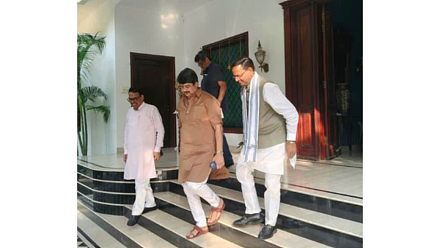
The meeting between Uttar Pradesh BJP president Pankaj Chaudhary and Jansatta Dal Loktantrik chief Raghuraj Pratap Singh, popularly known as Raja Bhaiya, on October 18 has brought the Kunda MLA back into focus in the state’s evolving political landscape. Although the meeting was described as a courtesy visit and no seat-sharing arrangement was announced, its timing has drawn attention amid preparations for the October 23 Legislative Council elections and the 2027 Assembly polls.
For the BJP, which has a well-established organisation across Uttar Pradesh, the meeting raises a broader question: what value does a regional leader with a limited legislative presence bring to a party competing across 403 Assembly constituencies?
The answer lies partly in the politics of Pratapgarh, where Raja Bhaiya has maintained an independent electoral identity for more than three decades, and partly in the importance of local leaders whose influence cannot be measured solely by the number of seats their parties hold.
Kunda presents an interesting case study in Uttar Pradesh politics. Raja Bhaiya has won the Assembly seat in every election since 1993, initially as an Independent and subsequently through his own political outfit. His record has endured changes in government, party alignments and the emergence of competing political forces.
The caste arithmetic, which puts Thakurs at around 6% and Dalits at approximately 26% of Kunda’s population, raises questions about how a leader strongly associated with the Thakur community has sustained his electoral dominance. These percentages should be independently verified before publication, particularly because constituency-level caste estimates are not equivalent to official election data.
The broader point, however, is that Raja Bhaiya’s electoral record cannot be explained by caste identity alone. Personal networks, local influence, relationships with voters and the ability to attract support across community lines may all contribute to his continued success.
The 2022 Assembly election illustrates the scale of his electoral base. Raja Bhaiya won on the Jansatta Dal Loktantrik ticket with 99,612 votes, defeating Samajwadi Party candidate Gulshan Yadav, who received 69,297 votes. The BJP’s Sindhuja Mishra Senani secured 16,455 votes. Raja Bhaiya’s victory margin was 30,315 votes.
The result is significant for two reasons. Raja Bhaiya demonstrated that he could retain Kunda against a strong SP challenge without contesting on a major party’s symbol. At the same time, the BJP’s separate candidate finished a distant third, highlighting the difference between the party’s statewide presence and its electoral position in this particular constituency.
For the BJP, any future understanding with Raja Bhaiya would therefore have to be assessed against a practical question: can his personal electoral influence complement the BJP’s organisation, and can that influence extend beyond Kunda and Babaganj?
The immediate context may be as important as the longer-term Assembly election calculations. The October 23 Legislative Council elections provide a near-term reason for political parties to engage with leaders whose support could matter in closely contested seats. Raja Bhaiya has previously supported candidates from different political parties in Council elections, making his position relevant to the state’s political arithmetic.
A senior BJP leader familiar with the party’s strategy said, “At this stage, the meeting should not be read as a final decision on an alliance. The immediate focus is on political coordination, but every interaction with an influential regional leader is also examined in the context of 2027.”
A Jansatta Dal Loktantrik insider, speaking on condition of anonymity, said, “Raja Bhaiya has never entered politics by surrendering his independent identity. Any understanding will have to respect his party’s position and his relationship with voters in Kunda and Babaganj.”
This history illustrates why the relationship cannot simply be described as an established alliance. Raja Bhaiya has maintained room for independent political decisions, and his support has varied according to the contest.
The meeting may also reflect the BJP’s broader effort to engage influential regional figures ahead of 2027. For a party with statewide ambitions, local relationships can matter in constituencies where candidate selection, community equations and personal networks shape electoral competition.
The attraction of Raja Bhaiya’s politics lies in the possibility that his influence extends beyond his immediate caste base. If his support network includes voters from several communities, it could offer a political advantage in selected constituencies.
Political analyst Shashikant Pandey said, “Raja Bhaiya’s political relevance lies in the fact that his electoral strength has been sustained over several decades despite changes in the larger political environment. His case shows that caste identity alone does not explain electoral success; local networks, personal credibility and the ability to mobilise support also matter.”
Pandey added, “For a national party, engagement with a regional leader can be important, but the real question is whether his personal influence can translate into support beyond his own constituency. That is something only an electoral arrangement and subsequent ground-level campaigning can establish.”
The political equation is not one-sided. Raja Bhaiya has maintained his position without relying exclusively on either the BJP or the SP. Any formal arrangement would therefore involve a calculation about what his party stands to gain without sacrificing its independent identity.
His Jansatta Dal Loktantrik outfit has two MLAs: Raja Bhaiya from Kunda and Vinod Saroj from Babaganj, both in Pratapgarh district. This gives the party a limited but identifiable legislative base.
An understanding with the BJP could provide greater organisational reach, help the party negotiate its position in selected constituencies and reduce the risk of a direct contest with BJP candidates. But the terms would matter. A formal alliance, electoral coordination and issue-based cooperation are different arrangements, each with implications for candidates and local party workers.
A party insider said, “The discussion is not only about seats. It is also about political space, local influence and whether both sides can work together without confusing their own workers and supporters.”
For Raja Bhaiya, the challenge would be to secure any benefits from cooperation without weakening the independent image that has helped sustain his political career.
The SP remains an important part of the Kunda equation. Its candidate, Gulshan Yadav, secured 69,297 votes in 2022, demonstrating that the constituency is not beyond the reach of a major party.
Political analysts say if Raja Bhaiya and the BJP were to develop a formal understanding, the SP would have to reassess its local strategy, including candidate selection and the consolidation of its own support base. But no electoral consequence should be assumed before the terms of any arrangement become clear.
An SP functionary from the region said, “Kunda is not a one-sided contest. Raja Bhaiya has a personal base, but the SP also has a substantial vote share. The outcome will depend on candidate selection, local issues and whether opposition votes remain divided.”
The BJP would also have to account for its own local aspirants and workers. A decision to accommodate a regional ally can create tensions if existing party leaders are asked to step aside or campaign for another outfit’s candidate.