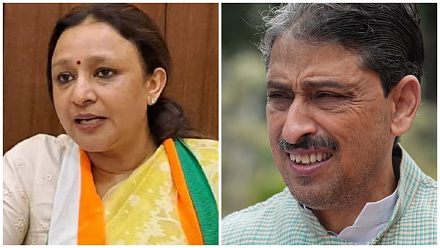
Aradhana Mishra, Imran Masood In: What Congress’ UP Reshuffle Signals Ahead Of 2027 Polls
Can a change of leadership help the Congress reclaim political space in Uttar Pradesh, where it has struggled to emerge as a significant electoral force for years?
By Oliver Fredrick··140K reads
Aradhana Mishra, Imran Masood In: What Congress’ UP Reshuffle Signals Ahead Of 2027 Polls
Can a change of leadership help the Congress reclaim political space in Uttar Pradesh, where it has struggled to emerge as a significant electoral force for years?
With the 2027 Assembly elections approaching, the party has replaced Ajay Rai with three-time Rampur Khas MLA Aradhana Mishra ‘Mona’ as its new state president, while appointing Saharanpur MP Imran Masood as working president.
The organisational reshuffle, announced on Friday, also brings Devendra Nishad and Alok Prasad into the state leadership as senior vice-presidents. Congress MLA Chaudhary Virendra Singh has been appointed Leader of the Congress Legislature Party (CLP), replacing Mishra.
The appointments point to a broader political exercise involving caste representation, regional balance and the Congress’s efforts to strengthen its bargaining position within the INDIA bloc ahead of the next Assembly elections.
Ajay Rai, who took charge of the Uttar Pradesh Congress in August 2023, was among the party’s most visible faces in the state. His tenure included the 2024 Lok Sabha elections, when the Congress contested in alliance with the Samajwadi Party and won six seats in Uttar Pradesh.
A three-time MLA from Rampur Khas in Pratapgarh, Mishra has served as the Congress Legislature Party leader since 2019. She is the daughter of senior Congress leader Pramod Tiwari and has remained an important face of the party in the state legislature.
Her elevation also places a woman at the helm of the state organisation, potentially giving the Congress an opportunity to strengthen its messaging around women’s representation.
Political analyst Dr Shashikant Pandey, Head of the Department of Political Science at Dr Bhimrao Ambedkar University, Lucknow, said: “The appointment of Aradhana Mishra and the restructuring of the Uttar Pradesh Congress leadership should be viewed as an attempt to address multiple political requirements simultaneously. The party is seeking to balance caste representation, regional leadership and organisational consolidation. However, the real challenge will be to convert this leadership restructuring into a functioning grassroots network. Representation can create political visibility, but electoral relevance depends on sustained cadre mobilisation and the ability to connect with voters at the constituency level.”
Congress’s Social Arithmetic: A Response To PDA Politics?
The composition of the new team is significant in the context of Uttar Pradesh’s caste-driven electoral politics.
Mishra represents the Brahmin community, Masood is a prominent Muslim leader, Devendra Nishad represents the Nishad community, while Alok Prasad is a Dalit leader.
The combination indicates an attempt to widen the Congress’s social outreach at a time when the Samajwadi Party has been building its political narrative around PDA — Pichhda, Dalit and Alpsankhyak.
For the Congress, the challenge is to establish an independent political identity among these communities while continuing its alliance with the Samajwadi Party.
Pandey explained the political significance of the appointments: “The Congress appears to be trying to expand its social base without abandoning the broader opposition coalition. The inclusion of leaders from different communities reflects an understanding that Uttar Pradesh’s electoral politics cannot be approached through a single social constituency. But the party will have to demonstrate that these appointments are part of a larger organisational strategy and not merely an exercise in balancing identities.”
Imran Masood’s Elevation And The Western UP Factor
The appointment of Imran Masood as working president is another important element of the reshuffle.
A Lok Sabha MP from Saharanpur, Masood is among the Congress’s prominent Muslim leaders in western Uttar Pradesh. His elevation gives the state organisation a senior face with an established regional political base.
His appointment could help the Congress strengthen its outreach in western UP, where electoral contests are influenced by a complex combination of caste, community and local political equations.
Masood has previously expressed differences with the Samajwadi Party over alliance politics, making his elevation significant as the two parties prepare to negotiate their respective roles in the 2027 Assembly elections.
However, his appointment does not by itself indicate a change in the alliance arrangement.
A Message To The Samajwadi Party?
The reshuffle could also have implications for the Congress’s relationship with the Samajwadi Party.
While the two parties worked together in the 2024 Lok Sabha elections, the Congress has an organisational incentive to expand its independent presence in Uttar Pradesh.
According to Pandey: “The Congress will have to maintain a balance between alliance coordination and its own organisational ambitions. A stronger state unit could provide it with greater negotiating capacity, but the extent of its influence in seat-sharing discussions will depend on its organisational strength and electoral performance. The immediate priority should be building a credible political presence across constituencies rather than focusing exclusively on leadership-level negotiations.”
Despite the political significance of the reshuffle, the Congress faces a substantial organisational challenge in Uttar Pradesh.
The party has only two MLAs in the 403-member Assembly, with Mishra and Virendra Singh now occupying key state-level organisational and legislative positions.
The new leadership will have to strengthen district and block committees, build a wider cadre base, identify local issues and establish a sustained campaign mechanism.
The leadership will also have to determine how to accommodate local aspirations, coordinate with alliance partners and create a distinct narrative in a state where the Congress has been competing for space against established regional and national parties.
The 2027 Test
For the Congress, the leadership change is more than a routine organisational reshuffle. It represents an attempt to recalibrate its strategy in India’s most electorally significant state.
But symbolism will not be enough. The new team must now build functioning party structures, expand beyond the Congress’s limited legislative footprint and prove that its social arithmetic can translate into votes.
The 2027 Assembly elections will therefore be a test not only of Aradhana Mishra’s leadership, but of whether the Congress can turn representation into organisation, alliances into leverage and visibility into a durable political presence.