Amit Shah In Jalandhar: Punjab's Decade-Long Drug Crisis Gets A Fresh Political Push
As Union Home Minister Amit Shah prepares to address the concluding rally of the BJP’s Nasha Mukt Punjab Abhiyan in Jalandhar on September 30, the spotlight is once again on Punjab’s deepening drug crisis, an issue that
By BrajMohan Singh··74K reads
Amit Shah In Jalandhar: Punjab's Decade-Long Drug Crisis Gets A Fresh Political Push
As Union Home Minister Amit Shah prepares to address the concluding rally of the BJP’s Nasha Mukt Punjab Abhiyan in Jalandhar on September 30, the spotlight is once again on Punjab’s deepening drug crisis, an issue that has remained at the heart of the state’s politics for more than a decade.
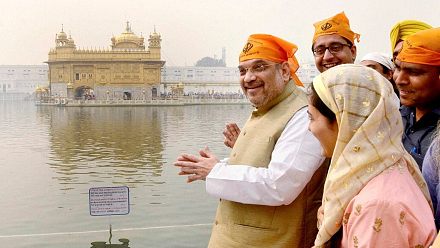
The BJP’s anti-drug campaign enters its final leg in Jalandhar, with Shah taking centre stage. The campaign matters not only because of the size of the concluding rally, but also because of its statewide reach. Four anti-drug yatras have travelled nearly 4,000 km across all 117 Assembly constituencies, beginning from four different directions and converging in Jalandhar. The BJP is expecting a large mobilisation.
Jalandhar is an interesting choice for the finale. Before Partition, it was an important administrative and commercial centre of undivided Punjab and subsequently played a major administrative role in post-Partition East Punjab. Today, Jalandhar is at the centre of Doaba politics, a region that is also home to a large NRI population and has traditionally played an important role in shaping Punjab’s political discourse.
Drugs Return To The Centre Of Punjab Politics
The drug issue has once again moved to the centre of Punjab’s political discourse ahead of the 2027 Assembly elections.
That is hardly surprising. Punjab has lived with the drug crisis for more than a decade, and the issue played a particularly prominent role in the 2017 Assembly election. Contemporary election coverage described drugs, along with corruption, unemployment, farmers’ issues and sacrilege, as among the issues dominating the campaign.
Former Chief Minister Captain Amarinder Singh made the drug menace a major electoral promise, famously pledging to wipe it out within four weeks of taking office. After forming the government, his administration launched a crackdown and constituted a Special Task Force.
The promise became a political benchmark, but the drug issue survived successive governments. The Shiromani Akali Dal continues to face political attacks over allegations surrounding the growth of the “chitta” culture during its 2012–17 tenure. The AAP government, meanwhile, is now facing opposition attacks over its own record.
And the BJP has chosen to make the drug crisis one of its principal political mobilisation themes ahead of 2027.
AAP’s Counter-Offensive
The Aam Aadmi Party has responded by shifting the argument from Punjab’s internal drug network to the larger national supply chain and the political portrayal of Punjab as a “drug state”. The political contest is therefore becoming familiar: every party has a different explanation for the crisis and a different set of people to blame.
But Punjab’s families need something more than competing narratives.
Scale Of Problem Bigger Than Any Rally
There is little doubt that Punjab faces a serious substance-use problem. A 2025 peer-reviewed review covering data from 2015–24 found more than 51,000 NDPS cases and over 4,600 kg of heroin seizures during that period. It also identified unemployment, inadequate mental-health infrastructure and Punjab’s proximity to international trafficking routes among factors associated with the crisis.
The problem is not restricted to heroin. In August 2026, the Central Bureau of Narcotics seized nearly 66.8 lakh psychotropic tablets, including Alprazolam, Tramadol, Nitrazepam and Clonazepam, in an interstate trafficking case involving the Punjab-Himachal corridor.
The Golden Crescent Factor
Punjab’s geographical location makes the challenge particularly difficult. The state lies close to the traditional Golden Crescent – Afghanistan, Pakistan and Iran – which has long been associated with the production and trafficking of heroin and other opioids. Academic research identifies Punjab’s location and its international border as important factors in the state’s exposure to trafficking networks.
The nature of smuggling has also changed. Traditional methods have increasingly been supplemented by drones and other technologies. Recent investigations in Punjab have documented drone-assisted cross-border consignments, including a September 2026 case involving 47.3 kg of heroin.
Security agencies have undoubtedly strengthened surveillance and counter-drone capabilities. But the continuing recovery of narcotics delivered through drones demonstrates that the supply chain has not been eliminated.
Drugs Are Supplied Because There Is Demand
Punjab’s drug crisis cannot be explained exclusively through Pakistan, smugglers, peddlers or political patronage. You can arrest a supplier. You can seize a consignment. You can destroy a laboratory. But if demand remains, the market adapts.
This is where the politics of the drug war becomes complicated. Punjab’s governments have repeatedly highlighted arrests, seizures, raids and special operations.
The current Yudh Nashian Virudh campaign has produced substantial enforcement numbers. In a December 2025 reply, the Union Home Ministry cited Punjab government figures showing more than 26,000 cases and 38,000 accused under the campaign, along with large quantities of heroin, opium, poppy husk and pharmaceutical pills seized.
Those numbers demonstrate enforcement activity. They do not, by themselves, demonstrate that the drug economy has been dismantled.
Complete eradication of illicit drugs is an extraordinarily difficult objective for any government.
The International Narcotics Control Board estimates that 20.7 million people in South Asia used opioids in 2023, making the region the world’s largest opioid consumer market. It also describes South Asia as a major transit region for illicit opiates and methamphetamine.
Punjab is therefore dealing with a problem that is simultaneously local, national and global.
Punjab Needs Fewer Narratives, More Results
For more than a decade, Punjab has heard promises to eradicate drugs. Governments have changed. Political alliances have changed. Chief ministers have changed. Campaign slogans have changed. But the drug market has repeatedly adapted.
The BJP has now made Nasha Mukt Punjab a major political rallying point. The question is whether this enormous political mobilisation can translate into an equally determined institutional response.
The rally may last a few hours. The drug war will take years. That is the real test for Jalandhar, and for Punjab.