Akhilesh Yadav Has A '27,000 Votes' Plan For UP Polls, But Can SP Keep Its Own House In Order?
Samajwadi Party chief Akhilesh Yadav has a very specific number in mind for the 2027 Uttar Pradesh assembly election—27,000.
By Apoorva Misra··122K reads
Akhilesh Yadav Has A '27,000 Votes' Plan For UP Polls, But Can SP Keep Its Own House In Order?
Samajwadi Party chief Akhilesh Yadav has a very specific number in mind for the 2027 Uttar Pradesh assembly election—27,000.
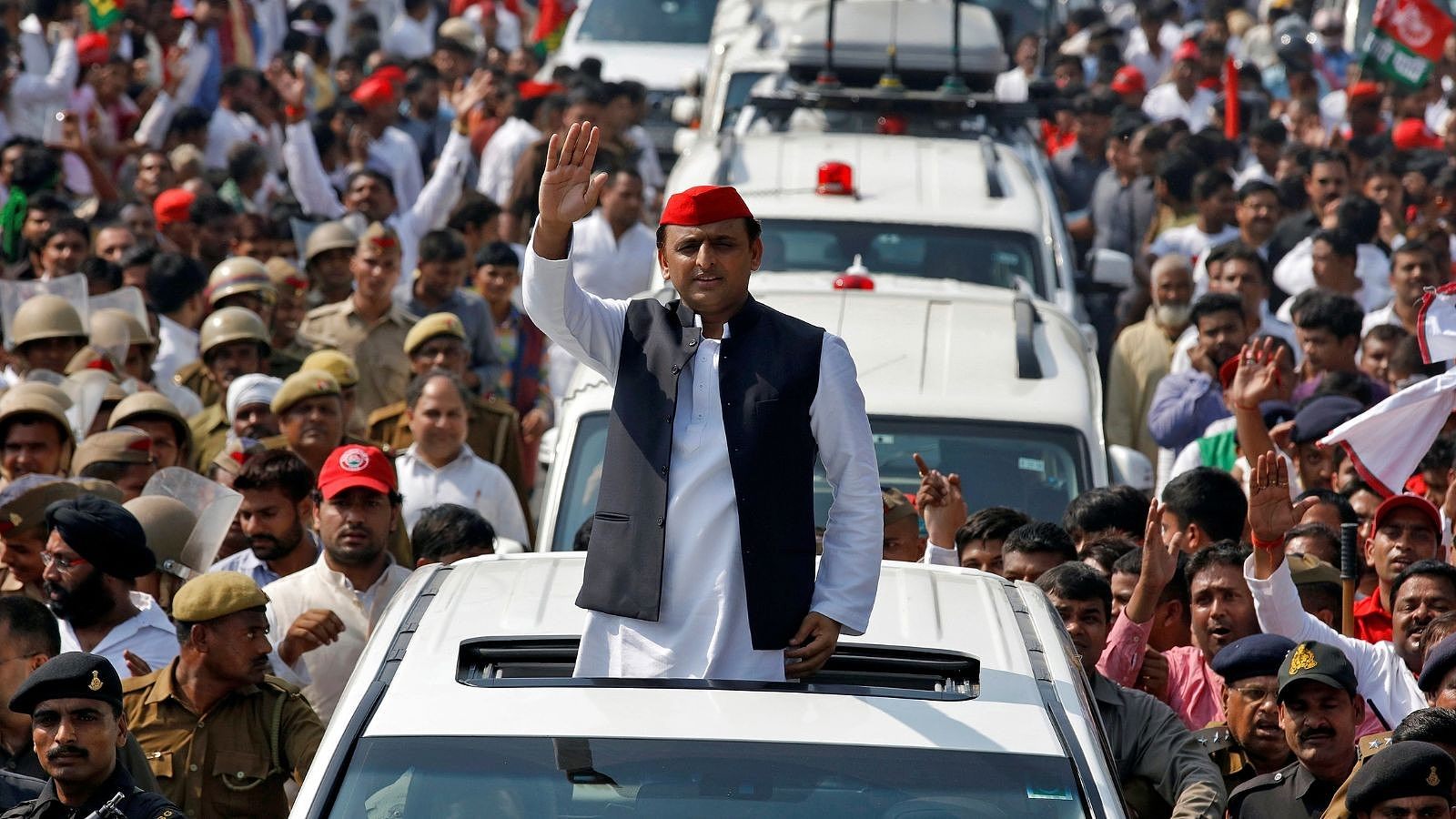
The plan is to increase the party’s vote tally by 27,000 in each of 27 identified assembly constituencies, with SP workers tasked with reaching voters directly, understanding their concerns and attempting to eat into the BJP’s support base. The strategy was outlined by Yadav at a meeting of the SP’s state executive and office-bearers in Lucknow over the weekend.
But as the SP prepares for what could be another major contest with the BJP in Uttar Pradesh, the party is facing another number that cannot be reduced to a campaign slogan—the number of internal battles its leadership has to manage.
On the very day Yadav was discussing election preparations and organisational mobilisation, a meeting of SP leaders from Etah and Kasganj descended into a public clash between rival functionaries. The party subsequently dissolved the organisational units in both districts, along with their frontal organisations, citing indiscipline.
The episode is not, by itself, evidence of an imminent split in the SP. But it adds to a series of recent organisational disputes that underline the challenge before Yadav—Can the party expand its social coalition and take the BJP head-on while keeping its own local leadership structures under control?
The 27,000-Vote Strategy: What Is Akhilesh Yadav Planning?
Yadav’s latest strategy is built around a targeted rather than blanket approach.
The SP has identified 27 assembly constituencies where it wants to add 27,000 votes to its tally. Yadav has asked workers to go to voters’ homes, listen to their problems and engage directly with them. The stated objective is not merely to increase the SP’s vote count but to reduce the BJP’s advantage in these constituencies.
The strategy also fits into a larger attempt to strengthen the party at the booth level.
The SP has been talking about expanding its PDA—Pichhda, Dalit, Alpsankhyak—coalition, which became a central part of its political strategy during the 2024 Lok Sabha election. The party is now attempting to take that formula into areas where the BJP has traditionally been strong.
A recent Hindustan Times report said the SP is planning a Dalit conference in Agra and a training programme in Gorakhpur. The choice of locations is significant: the BJP won all nine assembly seats in Agra district in 2022, while the BJP and its allies won 27 of 28 seats in the Gorakhpur division. The SP is also looking to reach communities such as Nishads, Kurmis and Brahmins in eastern Uttar Pradesh.
In other words, the strategy has two parts: retain and consolidate the PDA base, while trying to make inroads into sections of the BJP’s social and geographical strongholds.
The 2024 Lok Sabha Election Push
The SP enters this phase of preparation with a substantially stronger electoral position than it had a few years ago.
In the 2024 Lok Sabha election, the SP won 37 of Uttar Pradesh’s 80 seats, emerging as the single-largest party in the state. The Congress won six, taking the INDIA bloc’s tally to 43 seats in Uttar Pradesh. The BJP won 33 seats. The result was a major improvement for the SP compared with 2019, when it had won five seats.
The party and its supporters have attributed the turnaround to several factors, including the PDA outreach, candidate selection and the SP-Congress alliance.
But translating a successful Lok Sabha campaign into a winning assembly organisation is a different exercise. There are 403 assembly constituencies in Uttar Pradesh, each with its own local equations, factions, ticket aspirants and caste combinations.
And that is where the SP’s organisational problems become relevant.
Etah-Kasganj: A Factional Flashpoint
The latest example came at the SP headquarters in Lucknow. The meeting, attended by district presidents and executive committee members from Etah and Kasganj, was convened to discuss preparations for the 2027 polls. Instead, two groups associated with local leaders clashed in front of Yadav.
The dispute reportedly involved former Etah district panchayat chairman Jogendra Singh Yadav and Manjit Yadav, nephew of former Uttar Pradesh Legislative Council chairman Ramesh Yadav. The argument escalated into an exchange of accusations and verbal abuse.
Yadav intervened and subsequently dissolved the Etah and Kasganj district units and their associated frontal organisations.
The timing is particularly significant. Etah currently has four assembly constituencies, all held by the BJP. In Kasganj, the BJP holds three of the four seats and the SP holds one. These are therefore precisely the kinds of areas where the SP’s stated strategy requires a disciplined and coordinated organisation capable of expanding its vote base. Instead, the leadership has had to step in to resolve a dispute within its own ranks.
Moradabad Showed A Similar Problem Earlier
The Etah-Kasganj episode is not the first recent instance of Yadav having to personally intervene in a local power struggle.
In June, a dispute in Moradabad involving SP MLA Kamal Akhtar and party MP Ruchi Veera reached the party leadership. According to The New Indian Express, the dispute was linked to competing claims over political and organisational influence in the district. Yadav intervened and Akhtar subsequently resigned as the SP’s chief whip in the Uttar Pradesh Assembly. He remained an MLA.
The episode showed another organisational challenge: disagreements are not necessarily between the SP and its opponents. They can also emerge between elected representatives and local organisational networks competing for influence.
For a party preparing for a 403-seat election, these local equations can become particularly important when tickets, alliances and campaign responsibilities are eventually decided.
The Congress Question
The SP also has to navigate its relationship with the Congress. The two parties fought the 2024 Lok Sabha election together in Uttar Pradesh, but their arrangement for the 2027 assembly election remains unsettled.
The Times of India recently reported that Congress had not yet held formal discussions with the SP on alliance and seat-sharing, while the SP had begun preparing for all 403 assembly seats. Party sources told TOI that names had already been finalised for more than 100 seats, although the party had not formally announced candidates.
That creates a delicate situation.
An alliance can require parties to surrender seats where their own local leaders expect tickets. Conversely, preparing for all 403 seats gives the SP room to build its organisation but could complicate eventual seat-sharing negotiations if both parties develop competing claims.
For Yadav, therefore, the challenge is not simply deciding how many seats the SP wants to contest. It is also managing expectations among local leaders while keeping the larger alliance strategy open.
Can PDA Move Beyond SP’s Traditional Base?
The SP’s 2027 strategy depends heavily on whether the PDA formula can be broadened. The party’s 2024 performance demonstrated that an SP-Congress combination could build a broad coalition. But the assembly election will test whether the party can reproduce that coalition constituency by constituency.
That is why Agra and Gorakhpur matter.
The proposed Agra programme is aimed at Dalit outreach, particularly among Jatavs, while the Gorakhpur programme is intended to expand the party’s organisation and PDA appeal in eastern Uttar Pradesh. The SP is also looking at Nishads, Kurmis and Brahmins in the region.
The party has to persuade voters who may have traditionally supported the BJP, BSP or other parties while simultaneously ensuring that its existing supporters remain consolidated. And that requires an organisation that can operate effectively at the booth and constituency levels.
The BJP Is Also Preparing
The SP is not operating in an electoral vacuum.
The BJP has already begun its own preparations for 2027 with a focus on strengthening booth-level structures and appointing district-level in-charges across Uttar Pradesh. The BJP has also indicated that its campaign will emphasise the performance of the state government over the past decade, with law and order and women’s safety among the issues highlighted by party leaders.
That makes the SP’s organisational consolidation even more important to its strategy.
Is SP Really Facing An ‘Implosion’?
There have been visible factional disputes, interventions by Yadav and dissolution of organisational units in Etah and Kasganj. But those developments do not establish that the SP is breaking apart.
The Etah-Kasganj action can also be read differently: rather than evidence of organisational collapse, the dissolution of the two units represents an attempt by the central leadership to impose discipline and reset local structures ahead of the election. Similarly, the Moradabad dispute ended with the removal of one organisational responsibility rather than an exit from the party by the MLA.
So, the question of the hour is if Yadav can convert his centralised control into a disciplined, functioning election machine across 403 constituencies while managing competing local power centres.
For the SP chief, the immediate task is therefore twofold: take the fight to the BJP while ensuring that the fight within the party’s own organisational structures does not consume the energy needed for the 2027 campaign.