Akhilesh Faces Tough Bargain From Congress As 2027 UP Poll Talks Begin: What Previous Elections Tell Us
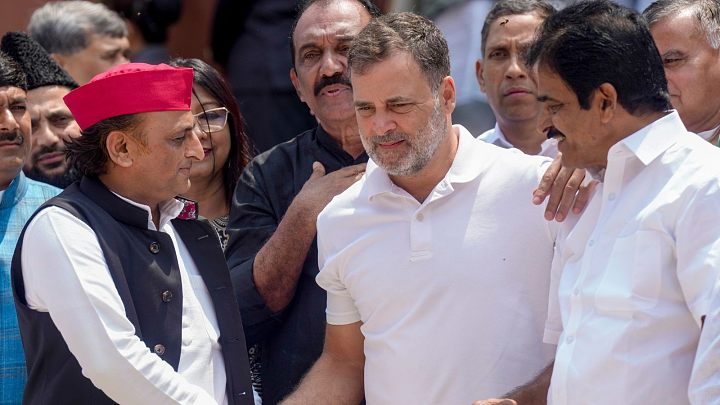
The battle over seat-sharing has emerged as the first major test of the proposed Samajwadi Party-Congress alliance ahead of the 2027 Uttar Pradesh Assembly elections.
By Oliver Fredrick··112K reads
Akhilesh Faces Tough Bargain From Congress As 2027 UP Poll Talks Begin: What Previous Elections Tell Us
The battle over seat-sharing has emerged as the first major test of the proposed Samajwadi Party-Congress alliance ahead of the 2027 Uttar Pradesh Assembly elections.
While both parties have formally opened negotiations, the challenge is not merely to arrive at a mutually acceptable number of constituencies but to avoid repeating the mistakes of previous electoral arrangements.
The first round of negotiations took place in New Delhi on November 23, with senior leaders from both parties meeting at the residence of Congress Rajya Sabha MP Pramod Tiwari. The discussions were described as positive, with another round scheduled for November 24.
However, the initial negotiations have already exposed the difference in expectations.
The Congress has submitted a list of approximately 130 constituencies where it wants to contest. The party is reportedly relying on its performance in the 2024 Lok Sabha elections, its traditional pockets of influence and its assessment of constituencies where it believes it can challenge the Bharatiya Janata Party (BJP).
The Samajwadi Party (SP), on the other hand, is approaching the negotiations from the standpoint of its stronger Assembly-level organisation and electoral performance. As per the recent seat-sharing talks, the Congress could settle for 75-80 seats under a broader understanding between Rahul Gandhi and Akhilesh Yadav, while another report on November 24 said the SP had offered Congress only 26 constituencies against its demand for 130.
SP general secretary Ram Gopal Yadav, who is leading the party’s negotiating panel, said after the first meeting that the discussions had taken place in a positive atmosphere. “We listened to each other’s points of view, and we will soon finalise this alliance and inform you about it,” he said.
The central question is whether the Congress will be able to translate its improved parliamentary performance into a significantly larger share of Assembly seats.
2017: THE FIRST MAJOR EXPERIMENT AND ITS ELECTORAL OUTCOME
The SP and Congress first entered into a major pre-poll alliance for the 2017 Uttar Pradesh Assembly elections.
At the time, the Akhilesh Yadav-led Samajwadi Party was attempting to retain power amid internal differences within the party and a growing BJP challenge. Congress, meanwhile, was attempting to revive its political fortunes in the state.
Under the agreement, the SP contested 298 seats while Congress was allocated 105 of the 403 constituencies.
However, the alliance failed to prevent the BJP’s electoral surge.
The BJP won 312 seats, while the SP managed 47 and Congress secured only seven. The SP received approximately 21.8% votes, while Congress secured around 6.25%.
The outcome exposed the limitations of transferring votes between alliance partners. Despite the understanding between the two parties, the arrangement failed to consolidate their electoral support sufficiently to challenge the BJP.
For the SP, the experience remains an important backgrounder while deciding how many constituencies it should concede to Congress in 2027.
2019: SP TURNS TOWARDS BSP, CONGRESS FIGHTS SEPARATELY
The next major electoral experiment took place during the 2019 Lok Sabha elections, when the SP decided to join hands with the Bahujan Samaj Party and the Rashtriya Lok Dal.
The Congress was not part of this arrangement and contested separately.
The SP contested 37 Lok Sabha seats and won five, while the BSP contested 38 and secured 10. The RLD failed to win any seat. Congress managed just one victory, with Sonia Gandhi retaining Rae Bareli.
The BJP, meanwhile, won 62 seats, while its ally Apna Dal (S) secured two.
The election demonstrated that a broader opposition alliance did not automatically translate into an electoral advantage. It also marked a period when the SP explored alternatives to Congress as its principal alliance partner in Uttar Pradesh.
2022: CONGRESS’S WEAK ASSEMBLY PERFORMANCE BECOMES A NEGOTIATING HURDLE
In the 2022 Assembly elections, the SP again contested with regional allies, including the Rashtriya Lok Dal and Suheldev Bharatiya Samaj Party. Congress fought independently.
The BJP returned to power with 255 seats, while the SP improved its tally to 111.
The Congress, however, won only two seats, with a vote share of approximately 2.33%.
The SP secured 32.06% votes, its highest vote share since 2012, demonstrating that the party had retained a substantial electoral base despite losing the election.
This performance is likely to be a major factor in Akhilesh Yadav’s calculations during the current negotiations.
For the SP leadership, conceding a large number of constituencies to a party that has struggled in recent Assembly elections could affect its own electoral prospects.
2024: THE INDIA ALLIANCE CHANGES THE EQUATION
The 2024 Lok Sabha elections significantly changed the political dynamics between the two parties.
The SP and Congress contested together under the INDIA bloc arrangement, with the SP contesting 62 seats and Congress 17.
The SP won 37 constituencies, while Congress secured six, taking the combined tally to 43 of Uttar Pradesh’s 80 Lok Sabha seats. The BJP was reduced to 33 seats.
Congress’s victories in Amethi and Rae Bareli, along with its performance in other constituencies, strengthened its argument that it had regained some electoral relevance in Uttar Pradesh.
For the Congress, the 2024 results provide the political justification for demanding a larger share in the 2027 Assembly elections.
However, the SP’s leadership is likely to distinguish between parliamentary and Assembly elections, where local organisation, candidate selection, caste equations and booth-level networks play a different role.
WHY THE 2027 NEGOTIATIONS ARE MORE COMPLICATED
The negotiations are taking place against the backdrop of the BJP’s continued organisational strength and the opposition’s attempt to maintain the INDIA bloc understanding in Uttar Pradesh.
Congress wants a respectable share of seats, while the SP wants to ensure that its own candidates and established constituencies are not compromised.
The Congress is also seeking representation across almost every district, with a particular focus on constituencies where it performed well in 2024.
The SP, meanwhile, is expected to prioritise sitting MLAs, its traditional strongholds and constituencies where its organisational network is stronger.
The question of Amethi and Rae Bareli is also significant, with Congress staking a claim to all Assembly constituencies in these two parliamentary seats.
The negotiations will therefore require both parties to reconcile their electoral ambitions with the realities of constituency-level strength.
Political analyst Dr Shashikant Pandey, Head of the Department of Political Science at Dr Bhimrao Ambedkar University, Lucknow, said, “The 2027 seat-sharing arrangement between the Samajwadi Party and Congress will be an important test of opposition unity in Uttar Pradesh. The 2024 Lok Sabha election has certainly strengthened Congress’s bargaining position, but Assembly elections have a different political character. The SP has a much stronger organisational presence across the state, and it will naturally want to retain constituencies where it has a realistic chance of winning. The two parties will have to go beyond their previous electoral experiences and arrive at a constituency-specific understanding.”
He added that, “The 2017 experience showed that an alliance does not automatically ensure the transfer of votes. In 2027, the challenge will be to identify candidates who are acceptable to the support bases of both parties. A disagreement over seat allocation or candidate selection could undermine the larger objective of consolidating anti-BJP votes.”
For Akhilesh Yadav, the negotiations are about maintaining the SP’s dominant position within the opposition alliance without alienating Congress, which has emerged as a more relevant electoral partner after 2024.
For Congress, the challenge is to convert its parliamentary gains into a stronger Assembly presence rather than remain dependent on the SP for political space in Uttar Pradesh.
The previous elections provide contrasting lessons: the 2017 alliance failed to deliver power, the 2019 opposition arrangement excluded Congress, the 2022 Assembly election exposed Congress’s organisational weakness, and the 2024 partnership delivered a significant breakthrough.
The 2027 election will test whether the two parties have learnt from those experiences.
Ultimately, the success of the alliance may depend less on the total number of seats allotted to each partner and more on whether they can agree on the right candidates in constituencies where the opposition has a realistic chance of defeating the BJP.