After India, Trump-Linked Firm Powerus Signs Defence Deal With Pakistan: Should New Delhi Be Worried?
Should India be worried about a defence deal between the Pakistan Army and Powerus Corporation — a US-based firm backed by Donald Trump Jr. and Eric Trump?
By Manjiri Joshi··110K reads
After India, Trump-Linked Firm Powerus Signs Defence Deal With Pakistan: Should New Delhi Be Worried?
Should India be worried about a defence deal between the Pakistan Army and Powerus Corporation — a US-based firm backed by Donald Trump Jr. and Eric Trump?
The Florida-based autonomous-systems company Powerus Corporation’s (formerly Powerus) defence agreement with the Pakistan Army includes a memorandum of understanding (MoU) and a procurement order from Pakistan’s Ministry of Defence for unmanned aerial systems.
The agreement has drawn significant attention due to the company’s financial ties to the family of US President Donald Trump and its existing defense partnerships in India, according to reports.
THE DEFENCE DEAL
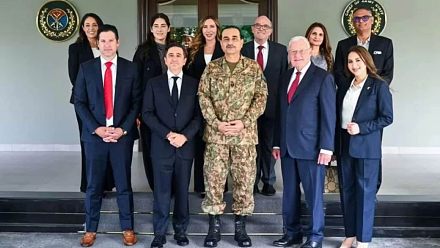
Signed following a September 16, 2026, meeting in Rawalpindi between Powerus executives and Pakistan Army Chief Field Marshal Asim Munir, it includes an initial procurement order for unmanned aerial systems, with long-term goals of establishing a joint technology partnership and localized manufacturing operations in Pakistan.
Powerus utilises counter-drone interceptor systems — the “Guardian” family — developed using Ukrainian tech and battlefield intellectual property via a venture with G1 Exploration, say reports.
HOW IS IT LINKED TO TRUMP?
Powerus completed a merger on October 1, 2026, with the Nasdaq-listed shell company Aureus Greenway Holdings to trade publicly under the ticker PUSA.
Donald Trump Jr. and Eric Trump are notable investors in Aureus through an investment fund called American Ventures. They hold an indirect 9.9% beneficial ownership stake in the combined drone corporation.
CONFLICT OF INTEREST?
The defense deal between the Pakistan Army and Powerus Corporation centers on an intricate web of commercial, diplomatic, and military overlaps. Analysts highlight several layers of friction making this deal uniquely controversial:
The most striking complication is that Powerus has entered the defense pipelines of two nuclear-armed military rivals that fought a drone-heavy conflict as recently as May 2025:
The India Deal (June 2026): Powerus granted Mumbai-based Paras Defence and Space Technologies an exclusive intellectual property (IP) license to manufacture and sell its Guardian-1 counter-drone interceptor.
The Pakistan Deal (September 2026): Just months later, Powerus executives met with Pakistan Army Chief Field Marshal Asim Munir to secure a procurement order and long-term manufacturing MoU for their unmanned aerial systems.
This leaves a single, year-old American defense startup supplying vital, interconnected drone and anti-drone technology to both sides of a volatile border.
FRICTION IN PAKISTAN
The deal brings intense domestic and international ethical scrutiny regarding conflicts of interest. On October 1, 2026, Powerus completed a reverse merger with the Nasdaq-listed shell company Aureus Greenway Holdings (trading under the ticker PUSA). Donald Trump Jr. and Eric Trump hold an indirect 9.9% beneficial ownership stake in this combined entity via their fund, American Ventures.
Geopolitical watchdogs argue that Islamabad is strategically leveraging family business interests to buy political goodwill, bypassing traditional state-to-state diplomatic channels to build an open line of communication directly to the Trump administration.
Powerus was co-founded by Ziv Marom, a veteran and former officer of the Israel Defense Forces (IDF). This has triggered severe domestic friction inside Pakistan. Pakistan holds a strict state policy of non-recognition toward Israel. Hardline domestic circles and political analysts in Islamabad have openly questioned why the Pakistani military is buying hardware from a firm embedded with Israeli military IP, especially when Pakistan already maintains a robust domestic drone ecosystem backed by China and Turkiye.
SOUTH ASIA’S WARFARE
From a supply-chain standpoint, the deal represents a sudden shift in South Asian electronic warfare:
Powerus drones rely heavily on battlefield-tested intellectual property acquired from Ukrainian manufacturers operating against Russian forces.
Historically, China supplied roughly 80% of Pakistan’s armed imports between 2021 and 2025. By embedding high-tier American and Ukrainian autonomous electronics,
Pakistan aims to close its technical gaps in AI integration and electronics, ensuring its foreign supply lines are insulated from singular Chinese oversight.
Analysts note the unprecedented chain of transferring Ukrainian drone advancements through a US defense company into the Pakistani military ecosystem.
STRATEGIC CONCERNS FOR INDIA?
Powerus previously granted Indian defense firm Paras Defence and Space Technologies an exclusive license to manufacture its Guardian 1 counter-drone systems in India. With Pakistan acquiring systems from the same foundational tech family, New Delhi faces the risk that Pakistan could study, exploit, or counter the exact drone defense mechanisms deployed by Indian forces, say experts.
The Trump brothers hold an indirect 9.9% beneficial stake in Powerus (trading as PUSA via Aureus Greenway Holdings). By binding the financial interests of the US first family to Pakistani military procurement, Islamabad gains a unique lobbying pipeline. Analysts suggest this could soften Washington’s stance on Pakistan or complicate India’s efforts to diplomatically isolate Islamabad on cross-border security issues.
Powerus systems are built using battle-tested intellectual property derived from Ukraine’s active drone warfare against Russia. Pakistan’s conventional drone fleet relies heavily on Chinese and Turkish hardware. Access to Western-backed, AI-integrated autonomous electronics represents a significant jump in their electronic warfare and border-surveillance capabilities, according to analysts.
SAFETY MEASURES IN PLACE
While the deal raises alarms, strategic observers note factors that may limit the immediate threat to India:
Powerus co-founder Ziv Marom is a former Israel Defense Forces (IDF) officer. Given Pakistan’s strict stance of non-recognition toward Israel, internal political unease within Islamabad could slow down or restrict deep technology sharing and joint manufacturing.
Even with high-level political links, US defense exports remain strictly regulated under International Traffic in Arms Regulations (ITAR). The US government is unlikely to allow the transfer of top-tier, sensitive source codes that could permanently damage its strategic partnership with India.