'Adda, Slow Films Don't Define Us': Sanjeev Sanyal On Bengal's 'Lost Mojo', Economic Decline | Exclusive
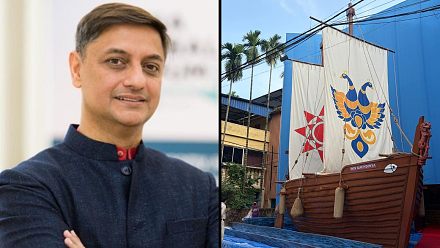
Economist, author and member of the Prime Minister’s Economic Advisory Council, Sanjeev Sanyal, was in Kolkata on the occasion of Durga Puja, where he attended the inauguration of a puja pandal featuring a replica of INS
By Kamalika Sengupta··139K reads
'Adda, Slow Films Don't Define Us': Sanjeev Sanyal On Bengal's 'Lost Mojo', Economic Decline | Exclusive
Economist, author and member of the Prime Minister’s Economic Advisory Council, Sanjeev Sanyal, was in Kolkata on the occasion of Durga Puja, where he attended the inauguration of a puja pandal featuring a replica of INSV Kaundinya, the reconstructed ancient Indian stitched ship that was built in Goa and sailed to Oman as part of an initiative to demonstrate India’s traditional maritime capabilities.
In an exclusive interview with CNN-News18, Sanyal spoke about the International Monetary Fund (IMF)’s growth forecast for India, Bengal’s economic decline and the need to reclaim the state’s entrepreneurial identity. He also challenged the use of the term Gen Z to describe young people involved in abusive online discourse.
The IMF has projected 7% growth for India. How do you assess this forecast in the current global economic climate?
The global situation is really bad. At least two wars are going on; one in the Middle East and the other involving Russia and Ukraine. Oil prices are high, and we have an ongoing tariff war. In this situation, 7 per cent growth is exceptionally good. Under normal circumstances, 7 per cent is a good growth rate. Given the current global situation, it is outstanding.
The past few years have not been easy. Maintaining this pace is important. We have to keep inflation under control and maintain the growth rate at around 7 per cent. A lot of effort has gone into cleaning up the banking system. We must preserve those gains and ensure that the economy remains stable even as external conditions change.
You have spoken about rebuilding Sonar Bangla. What, in your view, does Bengal need to do to regain its economic position?
We will build Sonar Bangla, and the Union government will extend every possible support to Bengal.
The mindset has changed. Until just a few years ago, the situation was very different. Today, projects are being inaugurated in Haldia. A transformation in attitude is essential, and that process has begun.
Change will take time. There is no magic button that can transform everything overnight. But the journey has started. First, we need to believe in ourselves. Even with a double-engine government, Bengal must demonstrate that its people are entrepreneurial and willing to take risks. Government support is important, but people must also be prepared to start businesses, innovate and invest.
Modern India is, in many ways, a creation to which Bengal has made an enormous contribution. We cannot imagine modern India without Swami Vivekananda, Subhas Chandra Bose and Ishwar Chandra Vidyasagar. Our national song and national anthem were written by Bengalis. We gave the country Vande Mataram, yet Bengal lost its mojo. I believe that mojo is returning now.
Why do you think Bengal lost its entrepreneurial spirit?
Bengalis have always been entrepreneurs—from Chand Saudagar to Mohini Mills and Sulekha. We are not disconnected from business, nor are we lazy.
What Bengal has experienced over the past 50 years is the result of a deeply entrenched mindset. Changing it will take time.
We were not allowed to know enough about the history of our own businesspeople. Instead, we were repeatedly told that Bengalis were lazy and not good at business. That is simply wrong.
Our history is full of trade, commerce and innovation. For thousands of years, Tamralipta was one of the major ports of India. Chandraketugarh was another important port, and there were several others. Europeans came here to trade. Even our surnames reflect our commercial history. The Bengali surname ‘Saha’ is associated with the trading community, with connections to the broader Shah mercantile tradition. Somehow, the idea was sold to us that we were bad at business. That is absurd when our own history tells a completely different story.
My own family history is an example. My maternal grandfather’s family had an industrial connection with Mohini Mills in Kushtia, which later became part of East Pakistan. The mill was a significant part of Bengal’s industrial history.
Within a few generations, however, the idea took hold that our cultural identity should revolve around ‘adda’ and watching slow art films. I am sorry, but that is not what defines us. Bengal’s identity also includes enterprise, industry, trade and innovation.
Do you see Bengal’s changing economic outlook as part of a wider cultural and intellectual shift?
Fifty years of a particular ideology, under two different regimes, have obviously had an impact. What we are seeing now is a cultural shift and an intellectual change.
This is particularly significant for me because I am Bengali and I come from Bengal. Growing up here, I witnessed what I would describe as the deliberate destruction of Kolkata as an economic and cultural hub.
I am pleased to see a shift in the way people think. This presents a huge opportunity to bring back Bengal’s lost glory.
Our understanding of our own culture and ideology was hijacked by the Left and the ultra-Left. If we examine our history, we find trade, innovation and entrepreneurship at its core. Bengal needs to rediscover that legacy and move beyond the narrative that it is somehow incompatible with business.
How do you assess the impact of the Left’s long tenure on Bengal?
Jyoti Basu is, in a way, responsible for the development of Bengaluru and not Bengal as when IT companies were coming to India, the Left opposed them, saying computers would take away jobs here. There were trade union movements against the companies which eventually meant they made Bengaluru their hub. Kolkata, as I have seen, didn’t die; it was murdered. I have seen politics of “Cholche Na, Cholbe Na” and brain drain taking place. We need to bring all those people back.
We need to examine Bengal’s political and economic history honestly and understand how the state reached its present position.
This year’s Durga Puja theme is INSV Kaundinya. What makes this project significant?
This year’s Durga Puja is special. The theme is based on INSV Kaundinya, a reconstruction of an ancient Indian stitched ship.
The idea behind the ship was mine and I travelled in the ship from Porbandar to Oman this year as a goodwill mission. When I discussed about the journey with Prime Minister Narendra Modi, he told me “Karo par doob mat jana [Go ahead but don’t drown]”.
We wanted to demonstrate that ancient Indian stitched ships were capable of undertaking transoceanic voyages. The project seeks to showcase India’s traditional maritime knowledge and the capabilities of its shipbuilders. It is significant because it brings an aspect of our history to a wider audience.
This Durga Puja pandal has chosen to celebrate that legacy by recreating the vessel. For me, the project has a personal connection because I am Bengali and come from Bengal. It is an opportunity to reconnect with our history, our culture and our achievements.
Should Bengal revisit the names of places and institutions to reflect its historical and cultural legacy?
We should rename various places. We need to look at our historical legacy and recognise people who contributed to Bengal’s economic and cultural development, including figures such as Dwarkanath Tagore. Revisiting place names can be part of a wider effort to reconnect with our history and recognise the people who helped shape Bengal.
There has been considerable public debate around Gen Z and the language used by some young people in online and political discourse. What is your response?
I object to calling them Gen Z because I am from Gen X. We are the parents of Gen Z, and we brought them up well. People who are using such bad language are not Gen Z. Let me speak up for my children.
The youngsters who won medals at the Asian Games are Gen Z. Those protecting our borders in Siachen are Gen Z. Many of the people pretending to be Gen Z are not even Gen Z; they are not even millennials.
These are people from my generation trying to present themselves as young. Those who are doing all this should not automatically be identified with Gen Z.
We should recognise the achievements of young Indians rather than define an entire generation by the behaviour of some people using abusive language.
What message would you give Bengal as it seeks to regain its economic and cultural prominence?
Bengal must first believe in itself. Its history is one of trade, industry, innovation, intellectual achievement and entrepreneurship. We need to recover that confidence, encourage people to take risks and create an environment in which businesses can grow.
The opportunity is there. The change in mindset has begun, but restoring Bengal’s lost economic and cultural prominence will require sustained effort.