25 Congress MLAs To Join BJP? Why Karnataka's Defection Politics Is A Two-Way Street
25 Congress MLAs, including Cabinet ministers, are allegedly ready to jump ship and join the BJP. That is the claim Karnataka BJP president B.Y. Vijayendra has made — a claim that Karnataka has heard in various forms ove
By Rohini Swamy··31K reads
25 Congress MLAs To Join BJP? Why Karnataka's Defection Politics Is A Two-Way Street
25 Congress MLAs, including Cabinet ministers, are allegedly ready to jump ship and join the BJP. That is the claim Karnataka BJP president B.Y. Vijayendra has made — a claim that Karnataka has heard in various forms over the years.
One only has to go back to 2019, when the Kumaraswamy government was toppled after a wave of defections. The BJP, which benefited from that rebellion, would itself see senior leaders walk out ahead of the 2023 polls and face questions over cross-voting within its own ranks.
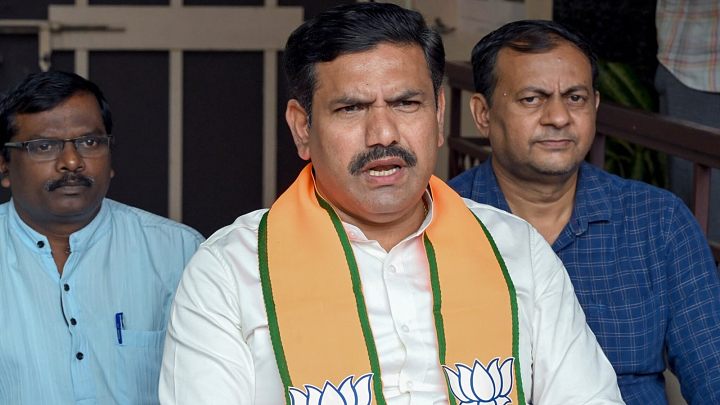
Vijayendra’s claim that 25 Congress legislators would join the BJP if Assembly elections were held now comes amid the controversy over an alleged sting operation within the Congress and the continuing tussle over power and positions in the ruling party. He has accused Congress leaders of resorting to questionable tactics to secure ministerial berths and the Chief Minister’s post, describing the controversy as “political adultery”.
Karnataka’s political history since 2019 is not simply a story of leaders switching parties. It is a story of parties repeatedly discovering that the loyalty they seek from their own legislators is often the same loyalty they exploit when dealing with their rivals.
The Congress-JD(S) government fell after the 2019 rebellion. The BJP benefited from that crisis, only to lose senior leaders ahead of the 2023 elections. Some of the Congress defectors who helped the BJP form a government later became sources of friction within the party. The MLC elections have now raised questions about the BJP-JD(S) camp’s ability to keep its legislators together.
Against this backdrop, Vijayendra’s claim about 25 Congress MLAs is a political assertion that demands scrutiny. If even a fraction of the alleged movement materialises, it could become a significant development in Karnataka politics. If it does not, the claim will remain part of the familiar contest of allegations and counter-allegations that precedes electoral battles.
The Karnataka BJP president has not named the legislators or offered evidence to substantiate the claim. Yet, the number is politically significant. It is large enough to suggest a serious rupture within the ruling party, even as it leaves the Congress with a direct challenge: identify the alleged defectors and establish whether this is a genuine political shift or an attempt to manufacture one.
For Karnataka, however, the irony is difficult to miss. The BJP knows what a mass defection can do to a government. It came to power in 2019 after a wave of resignations brought down the Congress-JD(S) coalition government led by H.D. Kumaraswamy. Four years later, it watched senior leaders walk out of its own ranks and join the Congress.
And now, even as Vijayendra speaks of Congress legislators being ready to switch sides, the BJP and its ally JD(S) are dealing with questions about cross-voting and the reliability of their own legislators.
In Karnataka, the politics of defections has never been a one-way street. It has been a recurring instrument of political survival, ambition and power — with parties alternately playing poacher and being poached.
Let’s dial back a bit and go back to 2019. Seventeen legislators from the Congress and JD(S) rebelled against the coalition government, triggering a crisis that ultimately brought down the 14-month-old Kumaraswamy government. Sixteen of the rebels were subsequently inducted into the BJP in November that year.
The Congress rebels included senior leaders such as Ramesh Jarkiholi, B.C. Patil, S.T. Somashekar, Byrathi Basavaraj, K. Sudhakar, M.T.B. Nagaraj, Anand Singh, N. Munirathna, Shrimant Patil, Mahesh Kumathalli, Pratapgouda Patil and Shivaram Hebbar. The JD(S) rebels included A.H. Vishwanath, K. Gopalaiah and K.C. Narayana Gowda. R. Shankar, elected on a Karnataka Pragnyavantha Janata Paksha ticket, was also part of the wider rebellion.
The consequences were immediate. The resignations reduced the coalition’s numbers, the government fell, and B.S. Yediyurappa returned as Chief Minister. Yediyurappa, who had left the BJP to form his own party, the Karnataka Janata Paksha (KJP), in 2012, had merged it with the BJP in January 2014. Several of the defectors contested by-elections on BJP tickets and later entered the government.
The BJP had not merely gained a handful of legislators. It had acquired the numbers needed to transform the government, while the Congress and JD(S) were left to deal with the consequences of a rebellion from within.
The term ‘Operation Kamala’ came to be used for this form of political engineering in Karnataka. The question was no longer simply whether legislators were unhappy with their parties. It was whether their discontent could be converted into a change in government.
But the 2019 episode also carried a warning for the BJP. A legislator who leaves one party for political advantage does not necessarily become permanently loyal to the party that receives him. The same calculations that trigger an exit can resurface when power shifts, tickets are denied or ambitions go unfulfilled.
Ahead of the 2023 Assembly elections, the BJP found itself on the receiving end of a series of high-profile departures. And these were not legislators without political standing. They included a former Chief Minister and a former Deputy Chief Minister.
Laxman Savadi, who had served as Deputy Chief Minister, joined the Congress after being denied a BJP ticket from Athani. Jagadish Shettar, a former Chief Minister and one of the BJP’s most recognisable faces in north Karnataka, also quit after being denied a ticket from Hubballi-Dharwad Central.
Their exits exposed a familiar problem for political parties: a leadership can insist on organisational discipline, but ticket distribution is often where that discipline is tested. For leaders who believe their political standing entitles them to a place in the electoral contest, denial can become the trigger for a dramatic exit.
The Congress was quick to welcome the two leaders, seeing an opportunity to make inroads into constituencies where the BJP had built a substantial political presence. But the move also demonstrated that the movement of leaders between parties is not necessarily driven by ideological conversion. In several cases, the immediate trigger is a dispute over tickets, positions or influence.
Shettar’s subsequent return to the BJP in January 2024 made the point even more sharply. Less than a year after leaving the party, he was back in its fold. M.P. Kumaraswamy’s trajectory was similarly circuitous: he moved from the BJP to the JD(S) in 2023 and joined the Congress in 2024.
The political lesson was uncomfortable for all three parties. A defector can be a prized acquisition when arriving from a rival camp, a source of embarrassment when leaving, and a potential liability when expectations are not met.
The most telling twist in Karnataka’s defection story has come from some of the very leaders whose departure from the Congress helped the BJP return to power.
S.T. Somashekar and Shivaram Hebbar, both among the Congress rebels who joined the BJP in 2019, subsequently fell out with the party leadership. Somashekar cross-voted in the 2024 Rajya Sabha elections, while Hebbar abstained. Both were later accused by the BJP of anti-party activity and were expelled in May 2025.
Their political journey captures the instability that can follow a defection. The BJP had welcomed them when their exit from the Congress helped change the government. Years later, their conduct became a source of friction within the party they had joined.
More recently, the MLC elections have also offered an example of how fragile party loyalties can be. The BJP and JD(S) were left worried after the results raised allegations of cross-voting by legislators from within their camp. But with the elections conducted by secret ballot, the identities of individual cross-voters could not be established publicly. The numbers, however, did not add up for the BJP and the JD(S).
The Legislative Council elections in June 2026 offered another reminder that political arithmetic can look very different on paper and inside the ballot box.
The Congress won five of the seven seats, while the BJP secured two. The JD(S), which contested one seat through Govindaraju, failed to win. The outcome raised questions about cross-voting within the BJP-JD(S) camp, with the Congress securing more votes than its expected strength.
The Congress received 151 votes against an expected strength of around 140. Govindaraju polled just 14 first-preference votes, despite the JD(S) having 18 MLAs in the Assembly. BJP candidates Raghu Kautilya and Lingaraj Patil also fell short of the numbers the opposition camp had expected.
The BJP subsequently ordered an internal inquiry, with a committee headed by senior MLC C.T. Ravi examining the cross-voting allegations. The committee submitted its report, but the findings and the identities of suspected cross-voters were not made public.
The results did not establish that the legislators involved had defected to the Congress. Cross-voting and defection are not the same thing. But the numbers raised an uncomfortable question for the BJP-JD(S) alliance: if the two parties cannot reliably hold their legislators together in a Council election, how secure is their political coordination?
That question becomes particularly relevant when Vijayendra claims that 25 Congress legislators are ready to join the BJP. While the BJP is projecting discontent within the ruling party, the Council results have exposed the difficulty of ensuring that legislators follow their own party’s preferred line.