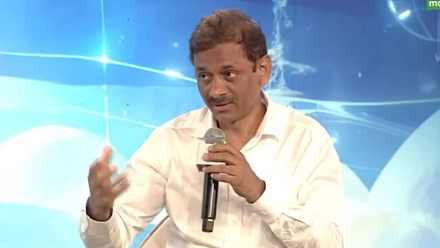
Why IDFC FIRST Bank's MD & CEO V Vaidyanathan Believes There Has Never Been A Better Time To Start Up In India
The infrastructure is here, ambition is rising and founders are starting younger. But turning an idea into an enduring company remains the harder leap.
By Studio18 Desk··48K reads
Why IDFC FIRST Bank's MD & CEO V Vaidyanathan Believes There Has Never Been A Better Time To Start Up In India
The infrastructure is here, ambition is rising and founders are starting younger. But turning an idea into an enduring company remains the harder leap.
There may never have been a better time to start a business in India.
That is the view of V. Vaidyanathan, MD & CEO of IDFC FIRST Bank. Hailing from a bank that has gone out of its way to support startups, he often spots nuances others miss. And he’s of the opinion that the infrastructure surrounding Indian entrepreneurs has fundamentally changed.
In a conversation with Moneycontrol’s Chandra R. Srikanth as part of Leap to Unicorn Season 4, Mr. Vaidyanathan traced that change from the digital rails that enabled India’s first startup boom to a new generation building rockets, drones and AI-led businesses; from college students bootstrapping their first ideas to the persistent hunt for capital; and ultimately, to what it takes to turn a promising startup into a company built to last.
The ecosystem caught up with the ambition
Ten years ago, starting up in India meant building around what the ecosystem lacked. Today, founders can draw on digital infrastructure, AI, venture capital, private equity, mentors and increasingly, successful entrepreneurs backing the generation behind them. “The whole startup ecosystem is coming alive,” Mr. Vaidyanathan said. “If you’re doing a startup today, compared to say 10 years ago, you are plugging into different parts of this ecosystem and bringing it alive. It wasn’t there years ago. So we shouldn’t take it for granted.”
His conclusion is emphatic: “It is the best time to start up. It is really the best time. It’s the best time ever India has seen.” Not the easiest. The best.
Because while many of the barriers to beginning have fallen, the hard work of building an enduring business hasn’t disappeared. If anything, the changing ecosystem is allowing founders to confront that challenge earlier.
A generation that isn’t waiting to start
Mr. Vaidyanathan saw that first-hand during a recent interaction with students at his alma mater, BIT Ranchi. “At least 20 of them told their entrepreneurial stories in college,” he said. One was finding co-founders on campus. Another, working on AI, had found a co-founder studying in Bengaluru. Others were putting together ₹1-2 lakh and bootstrapping their way into business.
“It is a thing,” he said. “Where did we see this before?” What has changed isn’t simply that entrepreneurship has become more attractive. The distance between having an idea and trying it has collapsed.
Cloud infrastructure can be rented. Payments are ubiquitous. AI can compress work that once needed teams. Co-founders don’t even have to be in the same city. For a generation that has grown up inside this infrastructure, starting a company can begin with considerably less permission, capital and ceremony.
And that freedom is changing not only when founders start, but what they dare to build.
First came the rails. Now come the rockets.
India’s first major digital startup wave followed the spread of the internet and, later, the extraordinary adoption of digital payments. New rails created new behaviour, and new behaviour created businesses around mobility, food delivery, commerce and financial services.
Now, Mr. Vaidyanathan sees founders moving beyond services built on those rails. “The next set that is coming… is not necessarily services running on the rails,” he said. “It can even be physical goods. Someone making a rocket, it is not something you send on payment rails. It has to go up there.”
It is a neat marker of how far the ecosystem has travelled. The infrastructure that once was the innovation is increasingly becoming the base layer on which much more ambitious innovation can be attempted.
Leap To Unicorn is evolving alongside that shift. In Season 4, the founder success initiative by IDFC FIRST Bank in association with Moneycontrol and CNBC-TV18 introduces dedicated tracks across Fintech, Deeptech & AI, ESG and D2C. Each will have its own application and evaluation framework, bootcamp sessions, mentor network, founder-investor interactions and selection journey.
Yet one ingredient remains much harder to democratise.
You can bootstrap the beginning. Not necessarily the journey.
The students Mr. Vaidyanathan met could pool ₹1-2 lakh and get an idea moving. Getting the capital to keep moving is another matter. India’s funding ecosystem has undoubtedly deepened. Angel investors, venture funds, private equity and government-backed initiatives have all expanded the pool. But Mr. Vaidyanathan believes capital still isn’t reaching enough startups.
He sees an opportunity in wealth India has already created. “A lot of domestic capital pool is now coming up,” he said. “It’s not only coming from overseas. Domestic is coming up, like savings, family offices, all that is money, and that money can be channelised into startups.”
And founders are attempting harder things. Rockets, robotics, manufacturing and other deep-tech businesses don’t always fit the compressed timelines associated with software-led growth. They may need larger bets, longer development cycles and capital patient enough to wait for technology to become a business.
But access to money is only one half of the fundraising equation. The other is building something worth backing.
Your customers make a better pitch than you do
Mr. Vaidyanathan learnt that lesson from the other side of the table.
While raising capital for IDFC FIRST Bank, he watched prospective investors look beyond the pitch. They examined its products and technology, but crucially, they also went out and spoke to customers. “Nothing speaks when other people speak about you, about your product, your services,” he said. “That chatter catches the ears of the potential investors.”
For founders, it is a useful inversion of the usual fundraising conversation. The strongest pitch may be the one happening when you aren’t in the room. “You can speak whatever you want about yourself. Put any number of advertisements. It’s not as effective as customers speaking about you,” he said.
As the company grows, another constituency begins watching too. Employees, partners, investors and markets start reading the organisation itself: how decisions are made, how money is handled and whether the institution can be trusted beyond its founder. “Governance is a big thing,” Mr. Vaidyanathan said. “As they scale up a little… the reputation carries along.”
Capital can accelerate a company. It cannot manufacture credibility for one.
Great at code. Not always at cash.
The gap between building a product and building a company appears in more mundane places too.
IDFC FIRST Bank now works with around 38,000 startups, according to Mr. Vaidyanathan, including companies at very early stages. One pattern has become hard to miss.
“Various people are phenomenal engineers. They know how to code this, code that or whatever. They don’t know anything about money,” he said. “They leave some ₹15-20 lakh in savings accounts… somebody has given the money at ₹1 crore, ₹2 crore seed funding, and it’s lying in a current account for like six months. Why are you wasting money like this?”
That is why the bank’s startup proposition extends beyond simply opening an account. It includes payment infrastructure, APIs, analytics and financial solutions designed around the way young companies operate. But some of the most valuable infrastructure isn’t financial at all.
“When you’re a five-people, 20-people organisation, you can’t get a Mohandas Pai to come and give you a speech. He won’t have time,” Mr. Vaidyanathan said. “But we can put a hundred founding teams together and get somebody of his stature to come and talk to them.”
The same logic applies to investor access. A single early-stage founder may struggle to get into the room. An ecosystem can build the room around them. It is a principle that sits at the heart of Leap To Unicorn: access becomes more powerful when it doesn’t depend entirely on where a founder happens to begin.
What happens when pin code matters less?
For Mr. Vaidyanathan, that question is personal.
Growing up in a small town, he remembers receiving the newspaper two days late. Information itself arrived at a geographic disadvantage. For today’s founders, at least some of that distance has disappeared.
The same AI tools can be opened in Bengaluru or a Tier 3 town. Cloud credits don’t care about pin codes. Co-founders can meet across cities. Logistics networks can carry products farther. Knowledge, infrastructure and markets that once clustered tightly around India’s biggest cities are becoming easier to reach from outside them.
Which is why, in Season 4, Mr. Vaidyanathan wants to see more founders from Tier 2, Tier 3 and Tier 4 India step forward. Not because ambition suddenly arrived in smaller cities. Because more of the infrastructure needed to act on it finally has.
The next leap may be harder to predict
Every generation of Indian founders has built with a different starting kit.
An earlier one built as the internet spread. The next rode smartphones and digital payments. Today’s youngest entrepreneurs inherit all of that, and add cloud infrastructure, AI, mature logistics, deeper pools of expertise and a startup culture that no longer needs explaining at the dinner table.
That changes the range of what can be attempted. It also changes where we should expect the next interesting company to come from.
For a young country chasing the ambition of Viksit Bharat, the timing is significant. India isn’t just producing more entrepreneurs. It is giving more of them, in more places, the tools to build.
And India is a formidable place to learn how. Build for a market this large, diverse, price-sensitive and operationally complex, and you learn to make things work under conditions few markets can replicate. Do it at Indian costs, and the opportunity doesn’t have to stop at the border.
That may be the bigger promise of this startup moment: not simply more companies built in India, but more companies built in India for the world. The rails are here. The founders are younger. The map is getting bigger.