Mumbai 3.0: The Rs 4,000-Crore City Set To Ride On Atal Setu, Navi Mumbai Airport Boost
Mumbai’s growth is running into a basic problem: there is only so much land left. Property prices remain high, roads and public infrastructure face growing pressure, and expanding the city in the way it did in the past i
By Parishmita Saikia··28K reads
Mumbai 3.0: The Rs 4,000-Crore City Set To Ride On Atal Setu, Navi Mumbai Airport Boost
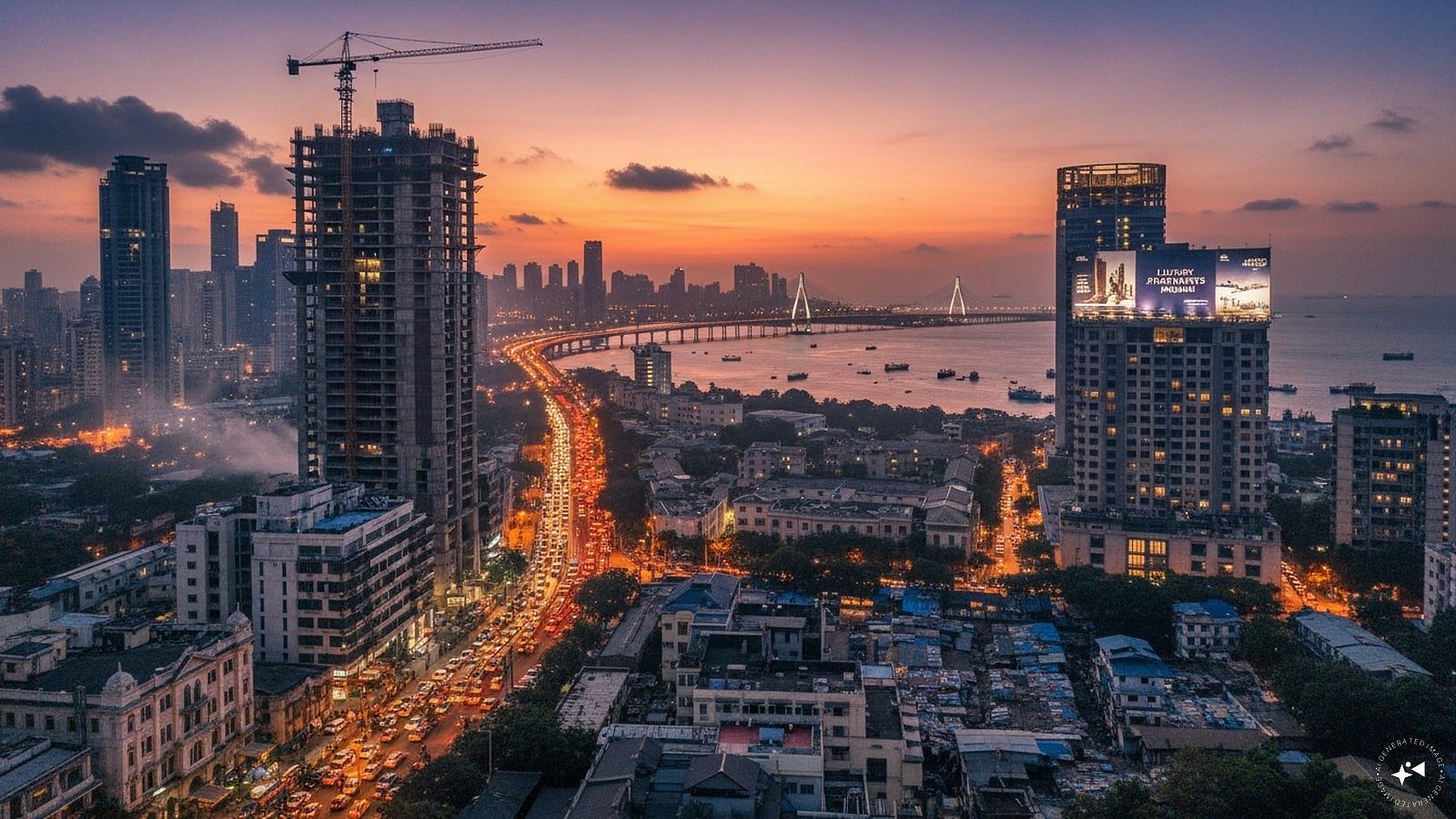
Mumbai’s growth is running into a basic problem: there is only so much land left. Property prices remain high, roads and public infrastructure face growing pressure, and expanding the city in the way it did in the past is becoming increasingly difficult. Now, Maharashtra is looking beyond Navi Mumbai for its next major urban centre. Called Mumbai 3.0, the proposed Karnala-Sai-Chirner (KSC) New Town will cover 323.44 sq km and bring 124 villages across Uran, Panvel and Pen talukas of Raigad district under planned urban development. (AI Generated)
The Mumbai Metropolitan Region Development Authority (MMRDA) has been appointed as the New Town Development Authority for the project. The proposed city is located close to two major infrastructure projects, the Atal Bihari Vajpayee Sewri-Nhava Sheva Atal Setu and the Navi Mumbai International Airport, placing it in a rapidly developing part of the Mumbai Metropolitan Region. (AI Generated)
Why Does Mumbai Need A ‘3.0’? Mumbai has already expanded beyond its original island city. Navi Mumbai was developed as a planned alternative and eventually became one of the region’s major urban centres. But with land becoming increasingly expensive and development pressure continuing to rise, Maharashtra is now looking at another large-scale planned city. The idea behind KSC New Town is not simply to build another residential suburb. The plan envisages a new economic and residential centre, with commercial districts, technology hubs, logistics facilities, data centres, healthcare, education and housing. The broader objective is to create jobs and homes closer together, reducing the need for people to make long daily journeys into Mumbai for work. (AI Generated)
According to the plan, around 104 sq km will be developed through townships and industrial corridors, while other areas will retain green zones, forests and rural settlements. Amar Shah, Director and Co-founder of Golden Abodes, said the development of a new urban centre should not be viewed simply through its proposed boundaries. “When people talk about a ‘Third Mumbai’, the conversation usually jumps straight to the greenfield master plan. (AI Generated)
But if you study how regional urban growth historically unfolds around Mumbai, greenfield boundaries tell only half the story,” he said. Amar Shah said major urban growth generally develops between established economic centres rather than in isolation. He pointed to the Mumbai-Pune, Mumbai-Nashik and Mumbai-Goa corridors as examples of how transport routes can influence the region’s economic expansion. (AI Generated)
How Atal Setu Could Change Mumbai 3.0? One of the biggest advantages for the proposed city is connectivity. The Atal Setu has significantly improved the road connection between Mumbai and the Navi Mumbai-Raigad side of the region. Mumbai 3.0 will also be connected to several major infrastructure projects, including the Navi Mumbai International Airport, Panvel-Karjat railway corridor, Virar-Alibaug multimodal corridor and Mumbai-Pune Expressway. Together, these projects could make the KSC region more accessible for residents, businesses and industries. (AI Generated)
The proposed economic ecosystem is expected to include IT and IT-enabled services, financial services, global capability centres, data centres, healthcare, education and logistics. Vishal N Ratanghayra, Founder and CEO of Platinum Corp., said the project could significantly change the growth pattern of the Mumbai Metropolitan Region. “Mumbai 3.0 has the potential to fundamentally reshape the growth trajectory of the MMR by moving beyond the traditional model of residential expansion and creating a new, integrated economic centre,” he told NDTV. The MMRDA has also secured a proposed $12 billion investment commitment from Brookfield, covering areas including real estate, transit-oriented development, logistics parks, data centres and global capability centres. (AI Generated)
Could Real Estate Get A New Growth Corridor? Large infrastructure projects often create new real estate markets around them, and Mumbai 3.0 could do the same. For property buyers and developers, the combination of new roads, rail links, an international airport and planned commercial development could open up new residential and commercial areas across the region. Abhishek Raj, Promoter of Jenika Ventures, said Mumbai 3.0 could change how the Mumbai Metropolitan Region accommodates its future population. “The development of Mumbai 3.0, or the Karnala-Sai-Chirner New Town, marks a significant shift in the way the Mumbai Metropolitan Region can accommodate future growth,” he said. (AI Generated)
According to Raj, the combination of Atal Setu, Navi Mumbai International Airport and emerging multimodal corridors could create opportunities across residential, commercial and investment markets. “Such large-scale and infrastructure-driven development can offer new micro-markets, create employment opportunities, and generate housing needs, commercial needs and allied services demands,” he said. He also highlighted the project’s proposed green belts and smart-city infrastructure, saying future urban expansion will have to balance economic growth with liveability. Ratanghayra similarly stressed that investment alone would not be enough. He said the new city would need multimodal connectivity, social infrastructure, green spaces and mixed-use neighbourhoods to develop alongside commercial and residential projects. (AI Generated)
The Maharashtra government’s plan is also receiving financial backing from the MMRDA. For 2026-27, the authority has earmarked Rs 4,000 crore for the Karnala-Sai-Chirner New Town as part of its infrastructure-focused budget. Land acquisition is another major part of the project. MMRDA has offered landowners in the 124 villages different compensation options, including monetary compensation, development rights and land pooling. How this process plays out will be crucial because the project covers a large number of existing villages and land parcels. (AI Generated)
When Will Mumbai 3.0 Become A Reality? Mumbai 3.0 will not emerge overnight. Planning and land-related processes are already underway, but developing an urban centre spread across more than 323 sq km will take years. The first phase could begin taking shape towards the end of this decade, while the larger urban ecosystem is expected to take considerably longer to develop. For Amar Shah, the project’s location is particularly important because of the convergence of major transport and industrial corridors. He pointed to the Mumbai-Pune corridor, where development is already expanding from both metropolitan centres, and the Mumbai-Goa highway, or NH-66, which has strategic importance because of its connection to ports and freight movement. (AI Generated)
The belt is also linked to Jawaharlal Nehru Port (JNPT) and other coastal port infrastructure, creating potential for manufacturing, logisticsand export-oriented businesses. Shah said these transport links together form an emerging industrial triangle, connecting the Mumbai-Pune corridor with the Mumbai-Goa highway and the wider metropolitan region. Substantial land parcels in the region have also been acquired or notified by state industrial development agencies for manufacturing and logistics zones linked to national industrial initiatives, he said. (AI Generated)
More Than Just Another Mumbai Suburb? The bigger question is whether Mumbai 3.0 can succeed as a self-sustaining city rather than becoming another commuter suburb. That will depend on whether jobs, housing, transport, schools, healthcare, commercial spaces and public infrastructure develop together. If that happens, KSC New Town could give Mumbai something it increasingly lacks – room to grow without putting all the pressure on the existing city. But building a new city on this scale will take more than roads and real estate. For Mumbai 3.0 to work, the challenge will be creating a place where people do not just live, but also work, study, do business and build their lives. (AI Generated)