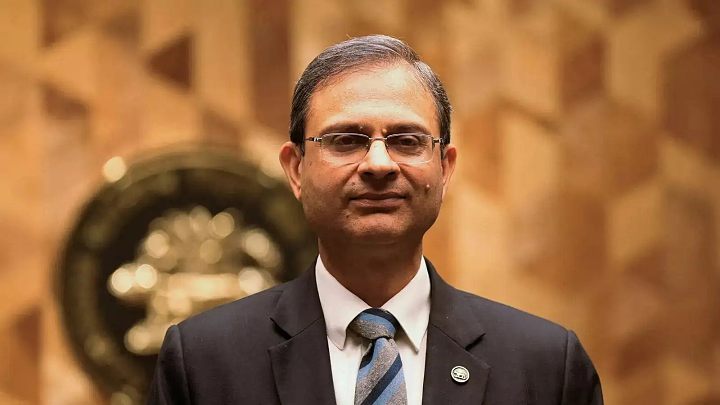
MC Interview: RBI Determined To Do What Is Necessary To Ensure Orderly Rupee Movement, Says RBI Governor Sanjay Malhotra
Reserve Bank of India Governor Sanjay Malhotra told Moneycontrol that the central bank would consider further measures to curb speculative trading in the foreign exchange market if required.
By Business Desk··45K reads
MC Interview: RBI Determined To Do What Is Necessary To Ensure Orderly Rupee Movement, Says RBI Governor Sanjay Malhotra
Reserve Bank of India Governor Sanjay Malhotra told Moneycontrol that the central bank would consider further measures to curb speculative trading in the foreign exchange market if required.
“The RBI is determined to do whatever is necessary to ensure orderly movement in the foreign exchange market,” Malhotra said speaking exclusively to Moneycontrol, adding that the recent measures should not be interpreted as restrictions on capital flows.
He said the measures aimed to ensure forex markets serve genuine hedging needs rather than speculative bets. The central bank had seen around one-third of forex derivative trades being cancelled on the same day, he said.
The governor described the external sector as India’s main macroeconomic challenge, despite robust domestic growth, healthy bank balance sheets and improving corporate earnings. He said the government and the RBI would take further steps, if necessary, to strengthen the country’s balance of payments. Edited excerpts:
You announced a slew of measures over the weekend aimed at curbing speculative forex transactions. What was the immediate trigger for these measures?
The purpose of these measures is primarily to ensure that there is an orderly movement of the forex market. The measures that have been taken: for example, rebooking of cancelled forex derivative contracts have been disallowed. These will also check undue speculative bets. We have brought in a forex reserve requirement because we observed that there is excessive speculative positioning on the buy side. And the other major announcement is basically a re-articulation, mostly procedural, regarding the documentation required. The limits have also been decreased from $100 million to $5 million.
The primary purpose of our forex markets is to meet and hedge underlying foreign exchange requirements. Unlike equities, where participants can take a view on share price movements, forex markets are intended primarily for those with a genuine hedging requirement.
Did you observe excessive speculation, and over what period of time did you see this trend?
Over the past few months, we have observed a very high proportion of trades being cancelled and rebooked on the same day. In some cases, about one-third of trades were closed or cancelled on the day they were entered into. If a participant has a genuine underlying requirement, such as an import payment, they will typically maintain the hedge for the reasonable duration of that exposure. The high proportion of same-day cancellations and rebooking indicated a significant speculative element in the forex derivatives market. We have, therefore, taken these measures to curb such excessive speculation.
We saw a strong appreciation in the rupee on Monday. Do you expect these measures to have a lasting impact on the rupee and stabilise INR at a certain level?
We have repeatedly said that we do not target any particular price level or band for the rupee.
Our effort has always been to ensure orderly movement in the currency and prevent excessive speculation. We observed excessive volatility and one-sided bets that were preventing market forces from determining the rupee’s true value. That is why we have taken these measures.
India’s macroeconomic fundamentals are very strong, and I am confident that the country will emerge stronger from the current episode. The government has been proactive, and the corporate sector has repeatedly demonstrated resilience, using challenging periods as opportunities to strengthen the economy and the external sector.
I believe forex markets are getting unduly pessimistic about the Indian economy’s future, which is actually underpinned by strong economic fundamentals. The free trade agreements we have signed, measures to improve productivity, ease-of-doing-business reforms and schemes such as the production-linked incentive (PLI) programme should support productivity and help reduce imports.
We are also seeing robust inflows on the capital account. Remittances remain strong, services exports continue to perform well, and foreign direct investment (FDI) inflows are healthy. I am confident that FDI will also continue to support India’s balance of payments position.
This is not a capital control measure?
This is in no way a capital control measure. We have excluded all capital account transactions from the foreign exchange reserve ratio requirements as far as customers are concerned. Non-residents can continue to invest in equity, debt and corporate bonds, as well as through external commercial borrowings (ECBs), and can continue to hedge their positions.
Foreign portfolio investors (FPIs) continue to be able to bring money into the country and take it out. Our actions should not be misunderstood as restrictions on these capital flows.
The message we want to convey is that the RBI is determined to do whatever is necessary to ensure orderly movement in the foreign exchange market. These measures are evidence of that commitment.
Does the RBI believe the measures announced so far are sufficient to curb speculative trading in forex derivatives, or could further steps be taken if such activities persist?
Our toolkit is very vast. If further measures are required to curb speculation, we will consider them. We have seen a positive move till now, and we hope it continues. But if more action is needed to curb speculation, the Reserve Bank will not hesitate to take it.
Do you think the MPC will hike interest rates for currency defence?
While this is in the domain of the MPC, I would reiterate the principles which I articulated in the Kautilya Economic Conclave, a few days ago.
The mandate of price stability cannot be achieved without financial stability, as a stable financial system is essential for the effective transmission of monetary policy.
We normally do not use monetary policy to address financial stability risks. We follow the separation principle – monetary policy for price stability and targeted regulatory, supervisory and macroprudential tools for financial stability reasons, but they cannot be separated completely. It is important to keep in mind that monetary policy can have a bearing on financial stability. Therefore, monetary policy has to keep financial stability in mind while taking decisions and can also be used for this purpose.
You recently said that markets can sometimes be irrational and indicated that you believed the rupee was undervalued. Do you stand by that assessment?
The exchange rate is primarily a function of demand and supply. Markets today appear to be overly pessimistic, and that is why I said their assessment could be irrational in the short run.
While being cautious, I would like to emphasise that I am optimistic about India’s medium- and long-term balance of payments (BoP) position. The RBI and the government are determined to ensure that India’s external sector remains resilient.
We will take whatever measures are necessary to achieve this.
You also mentioned that significant work is underway on both the current account and the capital account. Could you elaborate?
Look at the free trade agreements (FTAs) we have signed. The EU is a very large market, and the agreement should become operational soon, while the agreement with the UK is already operational. We are also becoming less energy-intensive and have accelerated our energy transition. The target of 20 percent ethanol blending has been achieved, and the programme is being accelerated further, which will reduce our dependence on crude imports. Work is also underway on reforms to further open up the economy and expand the production-linked incentive (PLI) scheme to improve exports. Measures have also been taken on the taxation front. These measures should help strengthen our current account position.
On the capital account, there has been rationalisation of guidelines related to foreign investment in government securities under the FAR, including opening up longer-tenure bonds of 15, 30 and 40 years.
I am confident that the government and the RBI will work together to determine what needs to be done to further strengthen India’s balance of payments position.
You mentioned measures to rationalise government securities and strengthen capital flows. This raises a broader question about the tax treatment of foreign portfolio investors (FPIs). Is the government considering reviewing the long-standing capital gains tax regime for FPIs, particularly on long-term capital gains?
That’s a policy decision to be taken by the government. It’s in their domain, so I will not be in a position to answer that.
Is there an RBI view on that as an institution?
If I have a view on the matter, I will convey it to the government.
If the RBI had anticipated that global conditions would turn unfavourable so quickly, would it have considered keeping the FCNR-B window open until September 30?
No, I think the dollars that we are now estimated to get roughly about $150 billion, including all three schemes, are substantial, and we have other measures which we have rolled out recently.
We are in a peculiar situation where interest rates are rising even as liquidity remains high. There are also concerns that excess liquidity could encourage easy lending, leading to another asset quality problem. What’s your assessment?
Durable liquidity in the system, including government balances, is around Rs 10 lakh crore. But the liquidity actually available with banks currently is around Rs 3.5 lakh crore.
The amount available to banks, therefore, is limited and will be managed through the measures we have already taken and those we plan to take, apart from natural CIC (currency in circulation) leakages, our interventions, and additional reserve requirements arising from the deposits.
In our assessment, the current liquidity situation is for the short term.
There’s no reason why this liquidity will lead to either a deterioration of credit quality or lead to inflation.
We have aimed to keep the operating target, which is the weighted average call money rate (WACR), aligned with the policy repo rate. So, you will very soon find that it is aligned.
Is that also why you are not too concerned that banks are showing greater appetite for shorter-tenure liquidity absorption operations rather than the 30-day plans?
Exactly. The fact that banks are subscribing less to a 28-day or 29-day variable rate reverse repo (VRRR) operation shows that they do not have that level of liquidity available for the longer period.
Liquidity is not as high as it is being made out to be, primarily because government balances are shown as included in the measure of durable liquidity. While they technically form part of it, in practice, they are not available to the market for use.
Every RBI governor faces a different macroeconomic challenge. There was the 2013 taper tantrum and, more recently, the shock from the Russia-Ukraine war. How would you compare the current situation with those episodes?
Every situation is different; it requires different tools and gives us an opportunity to improve. The Russia-Ukraine war, for example, prompted us to introduce our own set of measures and strengthen our resilience. For COVID-19, that was more of a liquidity challenge.
The current situation is more of an external-sector challenge. So, my confidence comes from, you know, the earlier episodes where every time we have been given a challenging situation, we have come up with our own set of measures, and this time, especially given that our macroeconomic fundamentals are very strong and the resolve is very strong, we shall be able to ensure that we have a stronger external sector.
Your stance has primarily been that US interest rates do not drive Indian monetary policy. However, some influential sections of the market believe India may also need to raise rates as US yields rise. How do you look at this?
I feel it is primarily dependent on domestic growth and inflation. However, both are affected by external developments, so it is not completely insulated from what happens elsewhere.
What is happening around the world, including interest rates, is something that we do keep in mind while deciding monetary policy, because they have an impact not only on our growth and our inflation, but also on our real or neutral rate of interest. Monetary policy must take these changes into account.
How should one view the hardening of the US yield curve, since many foreign markets outside the US, including India, could become less attractive?
I would say that higher yields in the advanced economies is primarily because of two reasons: one is that inflation has been very high over there and so the real rates may not be as high; and two, the public debt over there is very high, as a result of which they are having interest rates higher than us.
Having said that, while the underlying reasons may be different in different countries, they do have an impact, as I mentioned earlier, on interest rates around the world and capital flows. They do have a bearing.
What are the 2-3 top-of-mind issues you want to get in control of at the earliest, because they bother you at the moment?
The domestic growth is doing very well on all fronts. Banks are well capitalised, profitable, and growing, so they are doing well. There are initial signs of corporates investing- they are profitable. Earnings growth is improving right now. Household balance sheets are also pretty resilient and strong. Though there is higher leverage by households, the balance sheets are pretty strong. So overall, the Indian macro and financial institutions are robust; frameworks have improved over the years.
We need to keep a close watch on the evolving geopolitical headwinds and their impact on our economy; therefore, the main challenge is the external sector, and that is something that we all need to work on.
Does this mean that you can’t bother much about what’s not in your control, which is the external factor? Would that be fair to assume?
We continuously look at all risks and challenges that can come our way, and we continue to work towards them. It’s a process, and we continue to improve upon them. Today, much of our time goes into making India grow at a faster pace, making India grow not only sustainably but equitably, and also ensuring our external sector resilience.
The last few years have seen different challenges in banks – some of which are due to leadership issues. How does RBI ensure that the institution is given priority over the individual?
The overall leadership in the banks is generally good. To ensure transition, we have a framework where we expect the banks to have at least two full-time directors on the board so that there is a robust second line of leadership that is developing. We have seen that happening where people have moved from one bank where they have grown, they have matured, and they have moved on to leadership positions in other banks.
How much more can governance improve across banks?
We have a very effective, comprehensive system of governance with a board of directors and then various committees which ensures that there is good compliance, audit, risk management, etc. While there is always scope for improvement and we continuously strive for that, on the whole, there is decent leadership in both the public and private sectors. I would rather look at the growth story of the banks; balance sheets and credit, on the whole, have grown tremendously. Profitability has improved; their asset quality has improved.
The banks are, therefore, resilient. And at a system level, the governance, including the regulatory and supervisory apparatus that we have, is very strong and appropriate for ensuring adherence and taking the banking system to the next level.
Are we seeing a repeat of the taper tantrum?
I do not think so. It is a challenge because of various external-sector headwinds, again, not domestic. But that only means that we need to fortify ourselves because these challenges can come again.
And so, what is it that we can do as a country in order to strengthen our balance of payments? How do we reduce the CAD, and how do we become more in surplus on the capital account? I think there are a number of measures the government has taken. Many of them will show results. And if required, more measures will be taken by the RBI and the government.
The current situation of FPI Flows isn’t comforting. Net FDI could be much better than it is now. What are your thoughts on foreign flows, and can financial services companies continue to be magnets for FDI in India?
Indian financial system is very strong. The Indian economy is strong and has been growing strongly. Whatever flows you witnessed in the financial sector is the result of these two. Banks will continue to grow and become bigger and keep serving the needs of the economy. Indian banks’ growth story is here to stay. So, they offer strong incentives to attract foreign capital.
Gross FDI is obviously going up. Net FDI can go up in two ways. One is that the gross FDI itself goes up. Or the other is that repatriations and/or ODI come down. Gross FDI has been increasing. On repatriations, valuations have come down recently, and so repatriations should not increase.
What is the message that you would like to send to the market?
The overall message is that we are very optimistic not only because of our domestic macroeconomic story, our inherent resilience and strength, but also our resolve that we will come out stronger through each episode, through each challenge. We have already taken some measures to this effect. The government has also taken some measures. And if required, together, we will take more measures. But we will certainly ensure that markets are orderly, that there is no excessive volatility, and that there is no excessive speculation; we will do whatever is required to ensure this. We have enough tools in our kit to deploy, and you will not find RBI wanting when it comes to ensuring orderly conditions in the market.