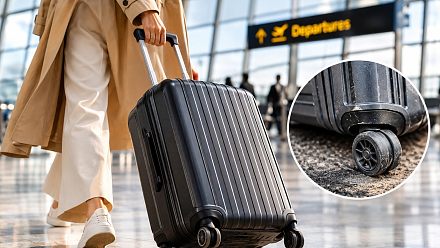
Wheel Broke At The Airport? Suitcases Built For Bad Roads And Rough Handling
From cracked shells and jammed wheels to uneven pavements and overenthusiastic baggage handlers, the right suitcase should be designed for the realities of travel — not just the airport lounge.
By Consumer Trends Desk··9K reads
Wheel Broke At The Airport? Suitcases Built For Bad Roads And Rough Handling
From cracked shells and jammed wheels to uneven pavements and overenthusiastic baggage handlers, the right suitcase should be designed for the realities of travel — not just the airport lounge.
There are few travel mishaps quite as undignified as a broken suitcase wheel. One minute, you are gliding towards the departure gate; the next, you are dragging a lopsided case behind you, attempting to balance your handbag, passport and last shred of patience. Your holiday has barely begun, and your luggage is already demanding attention.
The problem is that a suitcase’s life rarely resembles the polished campaign imagery that first made us fall in love with it. It is wheeled across cracked pavements, pulled over cobblestones, lifted into car boots, squeezed into overhead lockers and, if checked in, entrusted to a baggage-handling system that is not always gentle. Even the most meticulously planned itinerary can involve an unforgiving kerb or a long, uneven walk from the car park to the terminal.
Which raises an important question: when buying luggage, should we be looking beyond the colour, silhouette and designer logo? Absolutely.
A suitcase should be more than a pretty shell
Luxury luggage has become something of a fashion statement. The right case can be as recognisable as a handbag, with signature grooves, discreet branding, handsome hardware and a colour that looks particularly good against an airport’s otherwise uninspiring interiors.
But the most beautiful suitcase is of little use if its wheels buckle under pressure or its handle starts wobbling halfway through a journey.
The smarter approach is to consider how a case is engineered. Look at the quality of its wheel assembly, the rigidity and flexibility of its shell, the strength of its corners, the reliability of its handle and the availability of replacement parts. These details may not be as immediately seductive as a new-season colourway, but they are what make a suitcase worth investing in.
And, importantly, a higher price does not automatically guarantee greater durability. A well-made suitcase should justify its premium through its construction, thoughtful design and after-sales support.
The wheels make all the difference
If rough roads, broken pavements and airport floors are regular features of your journeys, start with the wheels.
Four-wheel spinner suitcases are wonderfully manoeuvrable on smooth floors, allowing you to move through terminals without having to drag a heavy case behind you. However, small spinner wheels can struggle with deep cracks, loose gravel, kerbs and uneven outdoor surfaces. Exposed wheel housings can also be vulnerable to impact.
Look for wheels with a sturdy mounting system, smooth rotation and a design that allows the manufacturer to replace them if necessary. Some premium cases feature suspension systems that help absorb vibration, while others use carefully engineered multi-wheel assemblies for stability and easier steering.
There is a practical distinction worth remembering: a suitcase that rolls beautifully through Heathrow is not necessarily the suitcase that will cope best with a bumpy hotel approach or an uneven pavement in an unfamiliar city.
For genuinely rough terrain, larger wheels can be advantageous, although the overall wheel construction and attachment are just as important. If your travels frequently involve gravel tracks, rural roads or cobblestones, a robust two-wheel case may also be worth considering.
Hard shell or soft shell? Choose your battles
Hard-shell luggage has an obvious appeal. It creates a structured exterior, protects the contents from everyday knocks and keeps the overall shape intact. Polycarbonate is particularly worth considering because it combines relatively low weight with a degree of flexibility, allowing the shell to flex under pressure rather than behave like a completely rigid plate.
Aluminium luggage occupies a more luxurious end of the market. It has a distinctive, architectural appearance and a solid feel, but it can dent and scratch, and it is generally heavier than comparable polycarbonate luggage. For travellers who prioritise weight above all else, that trade-off matters.
Soft-sided luggage, meanwhile, can offer useful external pockets, easier access and a little give when packing. Its resilience depends on the quality of the fabric, stitching, zips and frame, so it should not be dismissed simply because it lacks a rigid shell.
The real objective is not to find a case that is indestructible — no suitcase is. It is to choose materials and construction that suit the way you travel.
Reinforced corners are an underrated luxury
Corners are among the areas most exposed to knocks when luggage is lifted, stacked or moved through tight spaces. A case with thoughtfully protected corners and a well-designed frame can offer additional reassurance, particularly for frequent flyers who routinely check in their bags.
Pay attention to the details around the handle mounts, zips, locks and wheel housings, too. These are functional pressure points, and a beautiful exterior cannot compensate for weak construction beneath it.
Compression straps, dividers and a considered interior matter as well. Keeping belongings organised can prevent items from shifting excessively inside the case, although internal organisation alone will not protect luggage from severe external impacts.
What about those airport baggage handlers?
It is tempting to buy a suitcase in the hope that a premium price will make it immune to rough handling. Unfortunately, even expensive luggage can suffer damage during transit, and no material or wheel design can guarantee that a case will emerge unscathed from every journey.
What a considered purchase can do is reduce avoidable compromises. A dependable wheel assembly, sturdy handle, well-protected corners and a shell suited to your needs can all help. Equally important is choosing a brand with accessible repair services, replacement components and clearly explained warranty terms.
Before purchasing, read the warranty carefully. Some warranties cover manufacturing defects but exclude cosmetic damage, misuse or damage caused during airline handling. A lifetime warranty, where offered, should never be assumed to cover every possible repair.
The luxury luggage worth investing in
The best suitcase is not necessarily the most expensive one in the departure lounge. It is the one that suits your travel habits, carries your belongings comfortably and remains practical after years of journeys.
For the frequent flyer, that might mean an aluminium case with a beautifully engineered wheel system. For someone who regularly navigates uneven streets, a lighter polycarbonate case with replaceable wheels and a sturdy handle may prove more useful. And for longer trips, a spacious check-in case with reinforced corners and dependable after-sales support may be the more sensible investment.
Ultimately, luxury is not simply about arriving with a recognisable suitcase. It is about arriving without having spent the final kilometre dragging one broken wheel behind you.
Because the most elegant travel accessory is the one that lets you get on with the journey.
The luxury luggage edit: worth a closer look
For this edit, prioritise premium construction, practical wheel design and repair support over appearance alone. The models below are worth investigating, but do check the exact specification and warranty of the size you choose.
1. Samsonite Black Label Richmond II
Best for rougher journeys
Premium range · Approx. ₹28,000–₹35,000 depending on size
A polished, design-led case with a durable polycarbonate shell, reinforced corners and an Aero-Trac II suspension wheel system designed to soften bumps and improve manoeuvrability. A strong choice for frequent travellers who want luxury without sacrificing practicality.
2. Delsey Paris Freestyle
A French luggage brand that brings a more understated, European aesthetic to the edit. Its Freestyle range is worth exploring for travellers seeking a smart-looking case for frequent journeys. Confirm the exact model’s shell material, wheel construction and warranty before buying.
Shop on Amazon India
3. VIP Classic 8 Wheels Trolley Bag
An alternative for travellers who prefer a familiar Indian luggage brand. The eight-wheel configuration is designed for easy manoeuvring, making it a practical contender for busy terminals.
4. TUMI 19 Degree
With its sculptural contours and understated branding, TUMI is an appealing choice for business travellers who want their luggage to look as considered as the rest of their wardrobe. Compare the aluminium and polycarbonate versions carefully: the material, weight and construction differ.
5. Delsey Paris Châtelet Air 2.0
For the traveller who prefers a more Parisian aesthetic, this collection pairs elegant detailing with a hard-shell design and multi-directional wheels. It makes a compelling style-conscious alternative, though wheel specifications and availability should be checked for the exact version.
Shopping note: Prices, sizes, sellers and authenticity assurances can vary. Before buying, verify the seller, exact model, wheel construction, warranty and availability of replacement parts. Premium pricing alone is not proof of greater durability.