What’s The Weirdest Question Your Gynaecologist Has Ever Asked You? Women Share Their Most Awkward Clinic Moments
Period pain needs no introduction. That monthly monster arrives with its familiar baggage of cramps, exhaustion and, for some women, an agony that can make getting through the day feel like a task in itself. I’ve always
By Labani Mahanandy··9K reads
What’s The Weirdest Question Your Gynaecologist Has Ever Asked You? Women Share Their Most Awkward Clinic Moments
Period pain needs no introduction. That monthly monster arrives with its familiar baggage of cramps, exhaustion and, for some women, an agony that can make getting through the day feel like a task in itself. I’ve always had it a little worse than I’d have liked, but last month, the pain decided to take things several notches further.
The medicines weren’t helping. The hot-water bottle had seemingly exhausted its purpose. Nothing was making the pain subside. If anything, the situation was getting worse. So I called in sick and, in a rather shambolic condition, somehow managed to make my way to the doctor.
You know the hustle. A hospital bursting at the seams, patients thronging the corridors and everyone waiting rather impatiently for their turn. After what felt like an eternity, I finally managed to get into the doctor’s room.
Teary-eyed and exhausted, I waited as she went through my reports.
And then came the solution.
“Baccha kar le beta, sab theek ho jayega.”
I did what, I suspect, many women do when hit with the ultimate awkward moment: I let out a weird, nervous laugh.
That, apparently, was her cue.
What followed was a lecture about how today’s generation cares about everything else but having babies at the “right” time. I sat there, already distressed, wondering how a consultation about unbearable period pain had somehow turned into a conversation about my reproductive timeline.
Still, I gathered my already-frayed self and made one last attempt to ask for help with the kind of depression I was slipping into, on the verge of completely breaking down.
“Don’t worry beta. We will make your baby happen.”
I left the room baffled. Gobsmacked, actually.
And that’s when I started wondering: there is no way I am a unique case.
So I reached out to women from different walks of life and asked them about the strangest, most awkward and downright baffling questions they had been asked in a gynaecologist’s clinic.
The stories that came back had my jaw dropping a little further with every conversation.
When Your Sex Life Becomes Part Of The Consultation
Madhulika Dash, 48, food columnist and founder of Kalinga Stories, a food-forward collective, has lived with vaginismus, a condition in which the vaginal muscles involuntarily tighten, making penetration painful or difficult, along with dyspareunia.
For Dash, the experience began nearly two decades ago when she was with her then boyfriend. Sex was excruciatingly painful, and after struggling with the condition, she eventually visited a gynaecologist looking for answers.
Instead, she got a question she certainly hadn’t expected.
“How do you touch yourself?”
What followed was a rather long conversation about masturbation, techniques and sexual intimacy. The questions kept piling up, including whether she had tried period sex.
The conversation was certainly intimate. But for Dash, it was also part of trying to understand a condition that was making sex painful.
She thought she had probably had her share of awkward clinic conversations.
Little did she know there was another one waiting for her.
At 45, she found herself sitting across from another gynaecologist when the conversation took yet another unexpected turn.
“Do you want to have kids?”
“Do you want to get married?”
“Do you at least have a boyfriend?”
Her answer to all three was a firm no.
And then came the question that left her stunned.
“You know you are way above the normal baby-bearing age, right? So why not take your ovaries out. We have a good discount running.”
Dash laughed.
Hard.
Perhaps because sometimes you don’t quite know whether to laugh, cry or simply walk out.
When A Pregnancy Scare Comes With A Side Of Judgement
Manali, a video producer, has another story, one that could leave any woman of reproductive age pretty shaken.
A few years ago, she experienced the one scare most women hope never becomes part of their personal history: a pregnancy scare.
She was stuck in her hometown during the pandemic and somehow managed to make her way to a gynaecologist far enough from home to feel she could speak openly. She had missed her period and went in looking for answers.
The doctor initially took the usual route of asking about PCOD. But somewhere in the conversation, a frightened Manali admitted that she had also taken a pill.
That was enough to completely change the tone of the consultation.
“She got angry like she was my mother,” Manali recalls.
And the ordeal only got worse.
The visibly angry doctor threw the prescription onto the desk and asked her to take a pregnancy test.
The humiliation was enough for Manali to know she couldn’t go back to the same doctor. So she found another.
Thankfully, this time, she encountered a kind doctor who helped her through what was already a difficult and frightening situation. She prescribed a transvaginal ultrasound.
But the relief was short-lived.
The sonologist who was supposed to perform the scan asked her a question that would become another uncomfortable chapter in the experience.
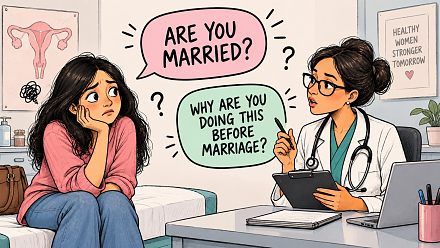
“Are you married?”
When Manali answered no, she says the sonologist refused to perform the ultrasound.
Even after Manali explained that another doctor had recommended it, she was asked to bring someone from her family along with photocopies of both their Aadhaar cards.
And that wasn’t all.
She was also asked to give a written declaration stating that she was unmarried and wanted to undergo the particular ultrasound.
Then came the unsolicited questions.
“Why are you doing this before marriage?”
“Will he surely marry you?”
And more questions along the same lines.
For Manali, the experience was deeply uncomfortable, not simply because of the questions themselves, but because a medical appointment had somehow turned into an interrogation about her relationship and choices.
She still shudders when she recounts the experience.
And perhaps that’s what makes these encounters so uncomfortable. A visit to a gynaecologist is already an intensely personal experience. You’re talking about periods, sex, contraception, pregnancy, fertility, pain and parts of your body you may not even be comfortable discussing with people close to you.
So, are these questions actually inappropriate? Or are we simply uncomfortable because they are personal?
The answer, according to gynaecologists, lies somewhere in between.
When The Question Is Medical, Not Personal
There are plenty of situations where a gynaecologist genuinely needs to know about a woman’s sexual activity, contraception, pregnancy possibility or reproductive plans. The information can be important for diagnosis, deciding on tests or understanding symptoms.
But marital status, doctors say, is not a substitute for any of that.
Is Marital Status Really A Medical Question?
Dr Snehal Kohale, Gynaecologist and Fertility-IVF Expert, Ova Fertility and Women Care, Tieten Medicity Kasarvadavali, Thane, says marital status should not be used as a substitute for a patient’s actual health history.
“Marital status is not a medical diagnosis, and it should never be treated as a substitute for understanding a patient’s actual health history. What matters clinically is the patient’s symptoms, reproductive goals and, when relevant, her sexual, menstrual, contraception or pregnancy history.”
She adds that there may be situations where relationship or sexual history is medically important, but being married does not automatically tell a doctor whether someone is sexually active or wants a pregnancy. Her preferred approach is therefore to ask specific clinical questions, such as whether a patient is sexually active or whether there is any possibility of pregnancy, when that information is relevant to her care.
Dr Pankila Mittal, Senior Consultant – Obstetrics and Gynaecology, Cloudnine Group of Hospitals, New Delhi, Punjabi Bagh, agrees that marital status should not become a proxy for sexual activity.
“Marital status is not always medically relevant and should not be treated as a proxy for sexual activity. What matters clinically is the patient’s sexual history, reproductive goals and symptoms.”
She points out that assuming an unmarried woman is not sexually active or that a married woman is, is inappropriate. Instead, doctors should ask only what is relevant to the patient’s care, without making assumptions.
But what happens when a doctor genuinely does need to ask about something as personal as sexual activity?
Dr Rohan Palshetkar, IVF Specialist, Endoscopic Surgeon, Obstetrician & Gynaecologist, says the answer lies less in avoiding the question and more in changing how it is asked.
“The key is how you ask, not just what you ask.”
He explains that sexual history can be medically important when assessing infections, contraception, fertility, pain during intercourse and several other concerns. But before asking, doctors can explain why the information is relevant.
“For example: ‘I ask this routinely because it can help me understand the cause of your symptoms. Are you currently sexually active?’”
“That one sentence can completely change the tone of the conversation. It tells the patient that this is a medical question, not a personal interrogation.”
And perhaps that is the distinction these stories bring into sharp focus.
A gynaecologist’s room is one of the few places where a woman may be expected to speak openly about some of the most intimate parts of her life. The questions can be personal. They can be awkward. They can sometimes even make you want to disappear into the examination chair.
But they don’t have to feel judgemental.
Dr Kohale suggests something as simple as asking permission before moving into sensitive territory: “Is it okay if I ask you a few personal questions?” She says small changes like explaining why a question is being asked can give the patient a greater sense of control.
And Dr Palshetkar perhaps sums up the entire conversation best.
“As doctors, we sometimes forget that a question which is routine for us may be incredibly difficult for a patient to answer.”
“For us, it may be question number 20 of the day. For the patient, it may be the first time she has ever said those words out loud.”
That difference is important.
Because perhaps there really shouldn’t be any “weird” questions in a gynaecology consultation. There are only questions that need a little more context, a little more sensitivity and, sometimes, a much better way of asking them.
For the woman sitting on the other side of the desk, that small difference can mean everything.