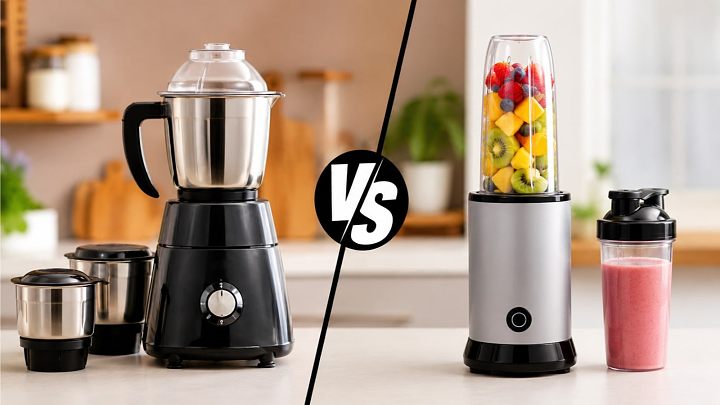
Wet Grinder Vs Mixer Grinder: Choosing The Right Appliance To Make Perfect Batter?
Wet grinders use slow-moving stones to create smooth, well-textured batter, while mixer grinders are faster and more versatile. Here’s how both compare on texture, heat, convenience and everyday use.
By Consumer Trends Desk··25K reads
Wet Grinder Vs Mixer Grinder: Choosing The Right Appliance To Make Perfect Batter?
Wet grinders use slow-moving stones to create smooth, well-textured batter, while mixer grinders are faster and more versatile. Here’s how both compare on texture, heat, convenience and everyday use.
For many Indian households, preparing dosa and idli batter at home still comes down to one important question: should you invest in a dedicated wet grinder or simply use the mixer grinder already sitting in your kitchen?
A mixer grinder is quick, compact and useful for everything from chutneys and masalas to smoothies and pastes. It can also prepare dosa or idli batter, making it an attractive option for households that do not want another large appliance.
Wet grinders, however, are designed specifically for wet grinding. Their grinding stones work at a slower speed and are built to handle soaked rice and urad dal while producing a batter with a different texture.
That doesn’t automatically make a mixer grinder a poor choice. For small quantities, occasional dosa making or kitchens where counter space is limited, a powerful mixer grinder can be perfectly practical. But when the priority is consistently smooth batter with good fermentation potential, a wet grinder has some clear advantages.
For this comparison, we looked at three wet grinders and three mixer grinders and compared the two categories on batter texture, grinding temperature, capacity, speed, convenience, cleaning and versatility.
Which should you buy?
Buy a wet grinder if:
You regularly make idli and dosa batter at home.
You prepare batter in larger quantities for the family.
You want a smooth and consistent batter texture.
You make South Indian breakfast dishes frequently.
You want grinding with less heat build-up.
You don’t mind keeping a larger appliance in the kitchen.
You want an appliance dedicated primarily to wet grinding.
Buy a mixer grinder if:
You make batter only occasionally.
You generally prepare small quantities.
You want one appliance for several kitchen tasks.
You have limited counter or storage space.
You regularly grind chutneys, spices and pastes along with batter.
You prioritise faster preparation over traditional wet-grinding texture.
You don’t want to buy a separate wet grinder.
Top picks
Type
Product
Was
Now
Discount
Best for
Wet grinder
Prestige PWG 09 Wet Grinder with Digital Timer
Rs 9,825
Rs 6,880
30% off
Regular family batter grinding
Wet grinder
Butterfly Smart 2 Litres Table-Top Wet Grinder
Rs 5,156
Rs 4,639
10% off
Everyday idli and dosa batter
Wet grinder
Preethi Astra Expert 2L Table Top Wet Grinder with Food Processor
Prestige Endura Pro 1000W Multi Functional Mixer Grinder
Rs 11,933
Rs 11,933
31% off
Heavy-duty multipurpose grinding
Mixer grinder
INALSA Food Processor for Kitchen with Mixer Grinder Juicer, 1200W
Rs 19,995
Rs 14,599
27% off
Heavy-duty multipurpose food processing
How does a wet grinder work?
A wet grinder uses grinding stones instead of rapidly spinning blades. Soaked rice and dal are placed inside the drum with a controlled amount of water, and the stones gradually crush and grind the ingredients into batter.
The Prestige PWG 09, Butterfly Smart and Preethi Astra Expert are designed for wet grinding, with dedicated drums and grinding systems suited to dosa and idli batter. The Butterfly Smart shown here has a 2-litre capacity and 150W motor, while the Preethi Astra Expert has a 2-litre stainless steel wet-grinding setup and a food processor attachment.
The slower process takes more time than a mixer grinder, but it can produce the kind of smooth, aerated batter many home cooks prefer. A dedicated wet grinder also makes it easier to prepare larger quantities without repeatedly stopping to manage small batches.
Where wet grinders perform best
Wet grinders are particularly useful for families that prepare dosa or idli batter regularly. A 2-litre model can handle a substantial quantity of soaked ingredients, making it more convenient when batter is prepared for several meals.
The grinding stones are another advantage. Rather than cutting ingredients rapidly with blades, they gradually grind the soaked rice and dal, which helps produce a characteristic batter consistency.
Models such as the Prestige PWG 09, Butterfly Smart and Preethi Astra Expert are designed around wet grinding. The Butterfly Smart, for instance, has a 2-litre capacity, while the Preethi Astra Expert combines a 2-litre wet grinder with a food processor attachment.
Where wet grinders struggle
The main drawback is size and weight. A wet grinder takes up considerably more kitchen space than a regular mixer grinder and is not something most users will want to move around after every use.
Grinding is also slower. If you suddenly need a small quantity of batter, using a large wet grinder may feel unnecessary compared with quickly processing the ingredients in a mixer jar.
Cleaning the stones and drum also requires a little more effort. Water and batter can remain around the grinding assembly, so thorough cleaning after use is important.
How does a mixer grinder work?
A mixer grinder uses rapidly rotating blades to chop, crush and blend ingredients. For batter, soaked rice and dal are placed inside a suitable jar with water and processed until the desired consistency is reached.
A 750W mixer grinder such as the Philips Turbo Juicer Mixer Grinder shown here is designed for multipurpose grinding and comes with three stainless steel jars. The Prestige Endura Pro adds a 1000W motor and food-processing attachments, while the INALSA Food Processor with Mixer Grinder Juicer, 1200W provides a more budget-focused multipurpose option.
Mixer grinders are also considerably more versatile. The same appliance can prepare chutney, spice powder, curry paste, smoothies and other everyday kitchen ingredients, making it useful even when you are not preparing batter.
Where mixer grinders perform best
A mixer grinder makes sense when batter is only one of many tasks you expect the appliance to perform. Instead of buying a separate machine, you can use the same motor and jars for several types of food preparation.
It is also convenient for smaller households. If you need batter for just a few dosas or idlis, processing a small quantity in a mixer grinder can be quicker than setting up a large wet grinder.
Preethi’s Zodiac range, for example, combines a 750W motor with multiple jars and food-processing functions, making it a much more versatile appliance than a dedicated wet grinder.
Where mixer grinders struggle
The biggest limitation is the high-speed grinding action. Rapidly rotating blades can generate more heat, particularly when the appliance is operated continuously or overloaded.
This matters because batter preparation is not simply about making ingredients fine. Temperature, consistency, water quantity and subsequent fermentation all influence the final result.
A mixer grinder can therefore produce good batter, but getting the same texture and temperature profile associated with a traditional wet grinder may require more attention to batch size, grinding time and pauses between cycles.
Wet grinder vs mixer grinder: Which is actually better for batter?
If the comparison is purely about dosa and idli batter quality, the wet grinder has the advantage.
Its grinding stones and slower operation are better suited to the traditional process of grinding soaked rice and urad dal. The larger drum capacity also makes it easier to prepare batter in quantities suitable for a family.
A mixer grinder wins on speed and versatility. It can produce usable batter much faster, particularly when you are making a small quantity, but the high-speed blades can introduce more heat and may produce a slightly different texture.
That doesn’t mean every dosa or idli made with mixer-grinder batter will be inferior. A well-controlled mixer grinder can produce excellent results when the ingredients, water ratio, batch size and grinding time are handled correctly.
The choice therefore depends on frequency. If dosa and idli batter is a weekly staple in your home, a wet grinder is worth considering. If you make it occasionally and already own a capable mixer grinder, buying another appliance may not provide enough additional value.
Which is better for Indian cooking?
For households that regularly make idli, dosa, vada or other recipes requiring substantial wet grinding, the wet grinder remains the more specialised choice.
It is particularly useful when you soak ingredients in advance and prepare enough batter for several meals. The larger drum and stone-based grinding system make it more comfortable for this workload.
Mixer grinders are better suited to kitchens where versatility matters more. They can handle wet grinding while also taking care of chutneys, masalas, purees, shakes and other everyday preparations.
For a small family or someone who prepares dosa and idli only occasionally, a 750W mixer grinder can therefore be a practical compromise. For frequent South Indian cooking, the dedicated wet grinder offers more consistency and capacity.
So, which should you choose?
If batter quality is your main concern, the wet grinder is the stronger choice because its stone-based grinding method, larger capacity and slower operation are better suited to regular idli and dosa batter preparation.
If speed and versatility matter more, a mixer grinder is difficult to beat. It can prepare smaller quantities of batter while also handling chutneys, spices, purees and other everyday kitchen tasks.
For a family that prepares dosa or idli several times a week, investing in a wet grinder makes practical sense. For a smaller household that makes batter occasionally, a good 750W mixer grinder may be all you need.
The key point is that a mixer grinder is not automatically worse for batter. It is simply optimised for speed and versatility, while a wet grinder is designed around the specific requirements of wet grinding.
FAQs
Is wet grinder batter better than mixer grinder batter?
For traditional idli and dosa batter, a wet grinder generally has the edge because its stone grinding system can produce a smooth texture with relatively low heat generation. A mixer grinder can still produce good batter when used correctly.
Can a mixer grinder make dosa batter?
Yes. A suitable mixer grinder can grind soaked rice and urad dal into dosa batter. Smaller batches and pauses between grinding cycles can help manage heat build-up.
Which is better for idli batter, wet grinder or mixer grinder?
A wet grinder is generally better suited to regular idli batter preparation, particularly for larger quantities. Its slower grinding process can produce the consistency many home cooks prefer.
Does a wet grinder make batter faster?
No. Mixer grinders generally work faster because their blades rotate at much higher speeds. The advantage of a wet grinder is the grinding method and resulting batter characteristics rather than speed.
Does mixer-grinder batter ferment properly?
It can ferment properly. Fermentation depends on several factors, including the ingredients, batter consistency, temperature and fermentation conditions. Keeping the batter from becoming excessively warm during grinding can be helpful.
Is a wet grinder worth buying for a small family?
It depends on how often you make batter. If idli and dosa are regular parts of your meals, a wet grinder can be worthwhile. If you make them only occasionally, a good mixer grinder may offer better overall value because it performs many other kitchen tasks.
Disclaimer: The product descriptions mentioned in the article are solely based on the primary and secondary research conducted by our experts. To keep you ahead of the curve with these latest products, News18 utilises affiliate links. This means if you decide to shop through our recommendations, we may earn a small referral commission at no extra cost to you. Please be advised that News18 is not responsible for any claims under the Consumer Protection Act, 2019, or other applicable laws regarding the final performance, quality, or safety of these products.