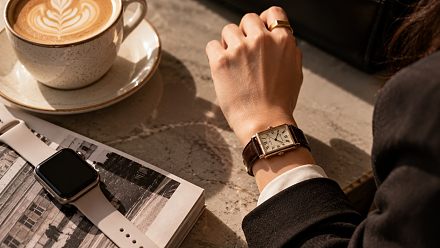
Smartwatches Won The Wrist. So Why Are Young Buyers Looking At Analogue Again?
In a world of notifications, health scores and screens that follow us everywhere, the traditional wristwatch is finding a new audience. For a generation raised on technology, its appeal may lie precisely in what it doesn
By Consumer Trends Desk··14K reads
Smartwatches Won The Wrist. So Why Are Young Buyers Looking At Analogue Again?
In a world of notifications, health scores and screens that follow us everywhere, the traditional wristwatch is finding a new audience. For a generation raised on technology, its appeal may lie precisely in what it doesn’t do.
For years, the wrist belonged to technology. The smartwatch counted our steps, tracked our sleep, monitored our heart rate and made sure we never missed a notification. The traditional watch, once an everyday essential, seemed to have been reduced to something sentimental: a gift for a milestone birthday, perhaps, or an accessory inherited from a parent.
And yet, the analogue watch is finding its way back into the wardrobes of younger buyers.
The interesting part is that this isn’t necessarily a rejection of technology. It is a reconsideration of what a watch is supposed to be. In a world where almost every device competes for our attention, a watch with a simple dial and moving hands offers a different proposition. It tells the time, looks good doing it, and asks very little in return.
For a generation accustomed to measuring almost everything, that simplicity has its own appeal.
The appeal of not being connected
The smartwatch made the wrist useful in a new way. It turned an accessory into a miniature dashboard, delivering information about our bodies, schedules and digital lives with remarkable efficiency.
But usefulness has a cost. Every notification creates another reason to look at a screen. A glance at the time can become a detour through messages, emails and reminders. The device that was supposed to make life easier can also make it harder to switch off.
An analogue watch offers a quieter experience. There are no messages to clear, no apps to update and, in the case of a traditional quartz watch, no nightly charging ritual. You look at the time and carry on.
That distinction may seem small, but it speaks to a larger cultural mood: the desire to be more deliberate about the technology we allow into our lives. The growing interest in offline experiences and analogue hobbies among younger consumers has been explored in recent trend research, although the motivations vary across markets and age groups.
Of course, not every young watch buyer is trying to disconnect. Some simply prefer the way a traditional watch looks. Others want a piece of jewellery, a collectible or an accessory that feels personal. The appeal is not one-size-fits-all.
A watch is becoming part of the outfit again
There is also a straightforward fashion argument for the analogue watch: it finishes a look.
A slim rectangular case beneath a shirt cuff, a steel bracelet with a white dial, a vintage-inspired leather strap worn with a relaxed jacket, these details can change the character of an outfit without demanding attention.
Unlike a smartwatch, whose appearance is often shaped by a digital display and interchangeable interface, an analogue watch has a more fixed identity. The dial, proportions, hands, markers, case and strap are all part of its design. Choosing one becomes an exercise in personal taste.
The shift towards slimmer, dressier watches among younger buyers has also been highlighted in Chrono24’s analysis of the secondary market.
That helps explain why older designs are finding new admirers. A watch doesn’t have to be oversized or covered in complications to make an impression. Sometimes a small dial, an unusual case shape or a well-chosen strap is enough.
And because analogue watches work with almost any wardrobe, they can move between occasions with ease. The same watch might accompany a T-shirt and jeans during the day, then sit neatly beneath a blazer in the evening.
The pleasure of owning something with a story
For some buyers, the attraction goes beyond aesthetics. A traditional watch can carry a sense of continuity that is difficult to manufacture.
It might be a parent’s old timepiece, a watch discovered in a vintage shop, or a first significant purchase made with one’s own money. It can mark a moment in someone’s life without needing to record it digitally.
This emotional connection is particularly interesting in the context of younger collectors. In its March 2026 coverage of a new generation of watch enthusiasts, Vogue India explored how family heirlooms, vintage designs and an interest in craftsmanship are drawing younger buyers towards traditional timepieces.
Then there is the appeal of understanding how something works. A mechanical watch, for instance, relies on a carefully engineered movement rather than a digital screen. Its appeal lies partly in the tiny components, the finishing and the accumulated knowledge behind its construction.
Not every analogue watch is mechanical, of course. Quartz watches use a battery-powered movement and can be an accessible, low-maintenance way into the category. But whether the interest is in engineering, heritage or design, the object offers something tangible to appreciate.
From one watch to a watch wardrobe
The old idea of a watch as a single, all-purpose purchase is giving way, for some enthusiasts, to a more individual approach.
A simple everyday watch might be joined by a dressier piece for evenings, a vintage find for weekends or a more colourful design for days when an outfit needs something extra. Rather than looking for one device that does everything, the wearer chooses an accessory to suit the occasion.
This is not necessarily a mass-market shift, nor does every young buyer want a collection. It is better understood as part of the wider movement towards treating accessories as an expression of personal style.
The watch becomes less about owning the most technically capable object and more about finding something that feels right. Dial size, case shape, strap material and proportion can matter as much as the name on the face.
It also opens the category to a wider range of budgets. A considered quartz watch can deliver the look without the price of a luxury mechanical model. Vintage and pre-owned pieces offer another route, provided buyers check authenticity, condition and servicing requirements carefully.
So, is the smartwatch losing its place?
Not quite. Smartwatches continue to serve a clear purpose for people who value fitness tracking, navigation, digital payments and connected features. For runners, cyclists and people monitoring their activity, these functions can be genuinely useful.
The analogue watch simply offers a different set of benefits. It doesn’t need to replace a smartwatch to become desirable again.
Some people will wear both, choosing a connected device for workouts and a traditional watch for the rest of the day. Others will prefer the convenience of a smartwatch at all times. And some will discover that the most useful thing a watch can do is tell the time without asking for anything more.
Perhaps that is the real shift. The wrist is no longer simply a place for the most advanced technology available. It is a place for personal choice.
The analogue watch doesn’t have to win the technological race. It only has to make a compelling case for being worn.
And in a world that rarely stops asking for our attention, there is something rather appealing about an object that simply keeps time.
Analogue watches worth looking at now
Whether you are considering your first traditional watch or adding another to your collection, the options range from understated everyday designs to vintage-inspired pieces. These are a few models worth exploring across different budgets.
1. Fossil Townsman ME3110
A more dressed-up choice, with an automatic movement and an open-work dial that makes the mechanics part of the design. It gives the story a stronger fashion-watch angle.
2. Seiko SUR399P1
A more understated, watch-enthusiast choice: clean lines, a classic dial and a stainless-steel bracelet. It feels timeless rather than trend-led, which fits the article’s argument beautifully.
3. Titan Men Automatic Vintage Dial Analog Watch
For a vintage-inspired statement
An option for readers drawn to traditional watch styling and a more distinctive dial.
4. Seiko 5 Sports Automatic Watch
For those curious about mechanical watches
The Seiko 5 Sports line is worth exploring if the appeal extends beyond appearance to the mechanics and heritage of watchmaking. Check the seller, warranty and import costs before buying.