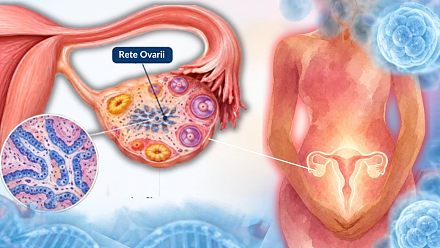
Rete Ovarii: The ‘Useless’ Female Organ That Has The Internet Talking About Misogyny In Medical Research
There is a particular kind of frustration that women across social media are feeling, it comes with learning that something inside the female body has been known to science for more than a century, yet researchers are st
By Tanya Dutt··25K reads
Rete Ovarii: The ‘Useless’ Female Organ That Has The Internet Talking About Misogyny In Medical Research
There is a particular kind of frustration that women across social media are feeling, it comes with learning that something inside the female body has been known to science for more than a century, yet researchers are still figuring out what it actually does.
That is the conversation unfolding online around the ‘rete ovarii’, a tiny network of tubes attached to the ovary that medical textbooks quietly stopped mentioning. For over a century it was treated as evolutionary leftovers, a structure forgotten because it was ‘useless’ and with no real job.
Now new research says that assumption was wrong, and social media has turned the rediscovery into a full-blown conversation about how women’s bodies have been studied (or not studied) for generations; about medical misogyny, with women questioning why certain aspects of female anatomy have received comparatively little attention.
The discussion gained traction after comedian Michelle Wolf shared a viral TikTok reacting to the research, turning an obscure anatomical term into a talking point about gender bias in science.
And that is what has women online frustrated, how can something connected to the female reproductive system be dismissed as ‘useless’ for so long?
What is The Rete Ovarii?
The rete ovarii (from the Latin for “network”) is a small, horseshoe-shaped structure of interconnected tubes and channels sitting right next to the ovary. Think of it as an anatomy plot twist. Gray’s Anatomy, the classic medical reference book first published in London in 1858, once featured illustrations of the rete ovarii. Over time, however, the tiny structure disappeared from newer textbooks and was largely dismissed as a functionless leftover in the adult ovary.
Men have a similar structure called the rete testis, which has a clear, well-documented role in transporting sperm. The female version never received the same attention or respect.
Image credit:D. Anbarci et al/eLife 2025
What’s With Scientists Calling A Forgotten Female Organ ‘Useless’?
A study published in eLife in 2024, titled Rediscovering the rete ovarii, a secreting auxiliary structure to the ovary, examined the structure in mice using advanced microscopy and other laboratory techniques.
Researchers identified three distinct regions of the rete ovarii: the intraovarian rete, the extraovarian rete and the connecting rete. They also found that its cells could transport material and release proteins, while the structure showed close associations with blood vessels, immune cells and nerve projections. Some of the proteins identified were potentially relevant to ovarian development and maintenance.
In simple terms, the rete ovarii appeared to be more biologically active than the label “functionless remnant” suggested.
Image credit:D. Anbarci et al/eLife 2025
In short, it looks less like dead scaffolding and more like a support system that may help the ovary stay healthy and respond to signals from the rest of the body.
Medical Research Negligence Or Medical Misogyny
That’s exactly the angle lighting up TikTok and Instagram. Comedian Michelle Wolf captured the mood in a widely shared video, pointing out that the male equivalent stayed in the textbooks while the female version was erased. “We research women’s health just about as thoroughly as a man looks for ketchup in the fridge,” she said.
Now researchers have claimed they had struggled to establish Rete Ovarii’s function, and scientific understanding often changes as new techniques become available.
But then again, the complete anatomy of the clitoris wasn’t fully mapped until the early 2000s. The appendix was long dismissed as useless until its immune role became clearer.
Image credit:D. Anbarci et al/eLife 2025
So now women and critics alike argue that the rete ovarii’s disappearance fits a broader pattern: when researchers (historically mostly men) couldn’t immediately see a purpose, female structures were more readily written off as irrelevant.
But Could the Rete Ovarii Have a Bigger Role To Play?
The proteins and cellular activity identified in the mouse study suggest that the rete ovarii may contribute to the local environment around the ovary. Researchers have proposed that it could play a role in ovarian development, tissue maintenance or communication with surrounding structures.
There is no proven link to PCOS, unexplained infertility, premature ovarian insufficiency or menopause. But researchers say the findings open new questions about how the ovary is maintained and regulated. If the rete ovarii is actively communicating with and supporting ovarian tissue, it could eventually help explain mechanisms that current models still miss.
It is too early to say that the rete ovarii directly affects fertility, explains reproductive disorders or could lead to new treatments. Nor does its rediscovery mean that current fertility care is missing a confirmed, essential part of ovarian function (because no one knows anything about how the organ function really).
View this post on Instagram
A post shared by Ayesha Raje Goyal (@ayeshargoyal)
Some would ask why does the rediscovery matter so much to women beyond the science? Well because it shows how easily knowledge can be lost when a structure is declared “useless.” It also shows what happens when modern tools finally get pointed at something long ignored. The rete ovarii was never erased from women’s bodies — only from the books and the research agenda.
Questions about female reproductive anatomy, menstrual health, menopause and conditions such as endometriosis continue to draw attention to areas where better evidence is needed. Like research on endometriosis focused for on how it affected men than how the immensely painful and life threatening disorder could be cured (yes, there is evidence).
View this post on Instagram
A post shared by Laura Dowling (@fabulouspharmacist)
That is why rete ovarii has resonated far beyond laboratories and anatomy textbooks with women asking why the function of a structure attached to the ovary remained uncertain for so long, and what other unanswered questions deserve more attention.
The issue is not necessarily that every overlooked structure was deliberately dismissed because it belonged to a female body. It is whether research priorities, funding and historical assumptions have sometimes left important questions unanswered (mostly for women).