Mixer Grinder Vs Wet Grinder: Which Should You Buy For Indian Cooking?
Indian cooking can ask a lot from a kitchen appliance. On an ordinary day, you may need to grind masalas, make chutney, blend a curry paste and prepare a shake. On another, you could be grinding soaked rice and urad dal
By Consumer Trends Desk··11K reads
Mixer Grinder Vs Wet Grinder: Which Should You Buy For Indian Cooking?
Indian cooking can ask a lot from a kitchen appliance. On an ordinary day, you may need to grind masalas, make chutney, blend a curry paste and prepare a shake. On another, you could be grinding soaked rice and urad dal for a large batch of idli or dosa batter.
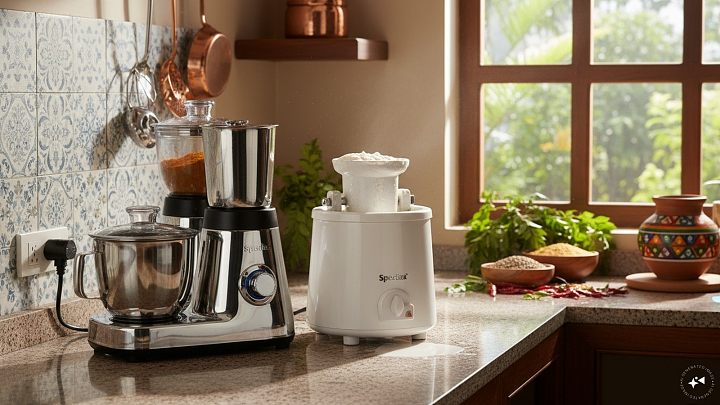
That is why mixer grinders and wet grinders often end up being compared, even though they work quite differently. A mixer grinder uses high-speed blades and multiple jars to handle a wide range of everyday tasks. A wet grinder uses stones and a larger drum to slowly grind soaked ingredients into batter.
The right choice, therefore, isn’t simply about which machine is more powerful. It depends on what you cook most often and how much batter you actually make.
Which should you buy?
Buy a mixer grinder if:
You want one appliance for everyday Indian cooking.
You regularly grind spices, chutneys, masalas and curry pastes.
You make batter only occasionally or in smaller quantities.
You have limited kitchen or counter space.
You want an appliance that can also blend and, depending on the model, juice.
Buy a wet grinder if:
Idli, dosa, vada or other batter-based foods are made frequently at home.
You regularly prepare batter in large quantities.
You want the smooth consistency produced by stone grinding.
You don’t mind dedicating more counter or storage space to one appliance.
For most Indian households buying only one machine, a mixer grinder is the more practical choice because it handles far more everyday jobs. A wet grinder starts making much more sense when batter preparation is a regular part of your cooking rather than an occasional task.
Top picks
Best mixer grinder overall: Philips HL7756 750W Mixer Grinder
Best budget mixer grinder: Bajaj Rex 500W Mixer Grinder
Best versatile mixer grinder: Prestige Iris 750W Mixer Grinder
Best wet grinder overall: Panasonic MK-SW260 2L Wet Grinder
Best value wet grinder: Usha Colossal DLX 2L Wet Grinder
Best wet grinder with chopper: Butterfly 150W Wet Grinder
Quick comparison
Feature
Mixer grinder
Wet grinder
Primary purpose
Everyday grinding and blending
Wet batter grinding
Grinding method
High-speed blades
Grinding stones
Dry spices
Excellent
Not intended for this
Chutneys
Excellent
Possible, but less convenient
Idli/dosa batter
Good for smaller batches
Excellent
Large batter quantities
Limited
Excellent
Smooth batter consistency
Good
Excellent
Blending/shakes
Yes
No
Number of uses
High
More specialised
Counter space
less
More
Cleaning
Usually quicker
More involved
Best for
Everyday Indian cooking
Frequent batter preparation
How does a mixer grinder work?
A mixer grinder uses a high-speed electric motor to rotate sharp blades inside a jar. Different jar sizes allow you to process anything from a small quantity of chutney to larger batches of curry paste or blended ingredients.
That speed is what makes the mixer grinder so convenient. You can grind roasted spices, make coriander chutney or turn onions, tomatoes and ginger into a masala paste in minutes.
Where mixer grinders perform best
Mixer grinders are at their best when your cooking changes from meal to meal.
They are particularly useful for Indian kitchens because the same machine can handle dry masalas, wet masalas, chutneys, pastes and blending. Models with additional jars can also handle juices and shakes.
If you have limited kitchen space and want one machine that will be used almost every day, this versatility is difficult to beat.
Where mixer grinders struggle
Batter is where their limitations become more obvious.
A mixer grinder can certainly make dosa and idli batter, especially in smaller quantities. But processing a large batch usually means working in several rounds, and prolonged grinding can heat the ingredients.
For a family making large amounts of batter every week, that process can become tedious.
How does a wet grinder work?
A wet grinder takes a very different approach. Instead of rapidly cutting ingredients with metal blades, it uses grinding stones inside a drum to crush soaked rice, lentils and other ingredients gradually.
The process is slower, but that’s precisely why wet grinders remain popular for traditional batter preparation. They are designed to process larger quantities while producing the smooth texture needed for dishes such as idli and dosa.
Where wet grinders perform best
Wet grinders come into their own when you’re preparing batter regularly and in quantity.
A 2-litre machine can process a substantial batch without forcing you to divide ingredients repeatedly between small mixer jars. Stone grinding also makes them particularly well suited to achieving smooth, consistent batter.
For a South Indian household making idli, dosa, vada or similar foods several times a week, the convenience can outweigh the extra space the appliance occupies.
Where wet grinders struggle
The problem is versatility.
You aren’t going to pull out a large wet grinder every morning simply to make a small coriander chutney or grind a teaspoon of spices. Nor can it replace your blender for shakes and many other everyday jobs.
So unlike a mixer grinder, which can become your primary kitchen appliance, a wet grinder usually complements other appliances rather than replacing them.
Which is better for dosa and idli batter?
This is the one area where the wet grinder has a clear advantage.
A mixer grinder works perfectly well if you make batter occasionally or prepare relatively small quantities. For a couple or a small family making dosa once every few weeks, buying an entirely separate appliance may be unnecessary.
But if idli and dosa appear on your breakfast table several times a week, the wet grinder becomes much easier to justify. It handles larger quantities and is purpose-built for the job.
Which is more versatile?
The mixer grinder wins easily.
Making chutneys in the morning, grinding masalas for lunch, preparing a curry paste for dinner and blending a shake all fall naturally within its remit.
A wet grinder is much more specialised. Some models add attachments such as atta kneaders, coconut scrapers or choppers, but their core purpose remains wet grinding.
Cleaning and kitchen space
A mixer grinder is generally easier to accommodate in a smaller kitchen. The motor base takes relatively little counter space, while the jars can usually be stored separately in a cabinet.
Wet grinders are larger and heavier because of their drum and grinding mechanism. Cleaning the drum and grinding stones can also take more effort than rinsing a mixer jar.
That doesn’t necessarily make a wet grinder inconvenient. But before buying one, it is worth deciding where it will live. An appliance that has to be dragged out of a difficult storage space every time you want dosa batter may not get used as often as you expect.
Which actually offers better value?
For most households, the mixer grinder.
You can buy a capable mixer grinder for around Rs 2,000 to Rs 4,000 and use it for a wide range of cooking jobs every day. Even if you occasionally make dosa batter, the same machine can usually manage it.
A wet grinder offers better value to a narrower group of users. If you’re regularly making substantial quantities of batter, the time and effort it saves can easily justify the additional appliance. But if you make dosa once a month, it is difficult to justify spending several thousand rupees and giving up the counter space.
Which works better for different kitchens?
Small families, couples and anyone who cooks a broad mix of Indian dishes will generally get more use from a mixer grinder.
A wet grinder is more compelling for larger families and households where dosa, idli and other batter-based foods are dietary staples. Some serious home cooks may ultimately want both: a mixer grinder for daily preparation and a wet grinder specifically for batter.
Common usage scenarios
Situation
Better Choice
Everyday Indian cooking
Mixer grinder
Dry masalas
Mixer grinder
Small quantities of chutney
Mixer grinder
Curry pastes
Mixer grinder
Smoothies and shakes
Mixer grinder
Occasional dosa batter
Mixer grinder
Large batches of dosa batter
Wet grinder
Frequent idli preparation
Wet grinder
Regular vada batter
Wet grinder
Large South Indian household
Wet grinder
Small kitchen
Mixer grinder
Want only one appliance
Mixer grinder
Frequently Asked Questions
1. Can a mixer grinder make dosa and idli batter?
Yes. A good mixer grinder can prepare idli and dosa batter, particularly in smaller batches. A wet grinder becomes more convenient when you regularly prepare larger quantities.
2. Do I need a wet grinder if I already own a mixer grinder?
Not necessarily. If batter is only an occasional part of your cooking, your mixer grinder may be enough. A wet grinder becomes worthwhile when you make batter frequently.
3. Why is a wet grinder better for batter?
It is purpose-built to grind soaked ingredients using stones rather than high-speed blades and can handle larger quantities more conveniently.
4. Can a wet grinder replace a mixer grinder?
For most kitchens, no. A wet grinder is specialised for wet grinding, whereas a mixer grinder handles far more everyday preparation tasks.
5. Which should I buy first?
If you’re setting up a kitchen and can buy only one, start with a mixer grinder. Add a wet grinder later if you find yourself regularly preparing large quantities of idli, dosa or similar batter.
Disclaimer: The product descriptions mentioned in the article are solely based on the primary and secondary research conducted by our experts. To keep you ahead of the curve with these latest products, News18 utilises affiliate links. This means if you decide to shop through our recommendations, we may earn a small referral commission at no extra cost to you. Please be advised that News18 is not responsible for any claims under the Consumer Protection Act, 2019, or other applicable laws regarding the final performance, quality, or safety of these products.