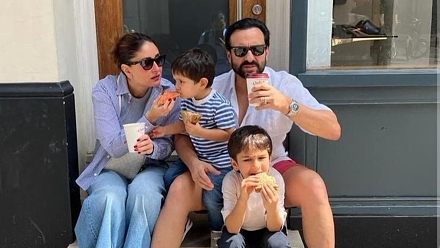
Kareena Kapoor’s “No Hacks” Take on Parenting: 7 Lessons Every Modern Parent Can Learn
Parenting today comes with an endless stream of advice. There are hacks for getting children to sleep, tricks for making them eat vegetables, strategies for reducing screen time and seemingly foolproof formulas for raisi
By Swati Chaturvedi··5K reads
Kareena Kapoor’s “No Hacks” Take on Parenting: 7 Lessons Every Modern Parent Can Learn
Parenting today comes with an endless stream of advice. There are hacks for getting children to sleep, tricks for making them eat vegetables, strategies for reducing screen time and seemingly foolproof formulas for raising confident, well-adjusted children.
Then comes the reality of raising an actual child: they don’t always cooperate. Kareena Kapoor Khan recently tapped into that reality when she reshared a meme about parenting that bluntly declared there are “no hacks” and that, sometimes, “everything is hard”. She captioned it simply, “Monday Motivation.” The post struck a familiar chord because it did something much of social media parenting advice rarely does: it admitted that parenting can be exhausting, unpredictable and resistant to shortcuts.
And this isn’t the first time Kareena has spoken about motherhood without presenting herself as someone who has figured it all out. In an earlier interview, when asked about her parenting superpower, she joked that it was not knowing what she was doing because “everything is new” and every child is different.
That may actually be the more useful message for modern parents. Parenting does not need another perfect formula. It may need less pressure to find one.
Here are seven lessons parents can take from Kareena’s refreshingly imperfect approach.
1. Stop searching for the one parenting hack that will fix everything
The internet can make parenting look like a problem-solving exercise.
A child won’t sleep? Try this routine.
A child won’t eat? Use this trick.
A child is having a tantrum? Say these five words.
Some strategies can certainly help. But children aren’t machines, and what works beautifully for one child may completely fail with another.
Kareena’s “no hacks” observation is valuable precisely because it takes away the expectation that every difficult parenting moment needs an instant solution.
The American Academy of Pediatrics similarly emphasises consistency, age-appropriate expectations and positive discipline rather than quick punitive responses.
The lesson: Use parenting advice as a tool, not as a test you have to pass.
2. Accept that different children may need different parenting
One of Kareena’s most revealing comments about motherhood has been that every child is different.
She has spoken about how raising her two sons, Taimur and Jeh, has taught her that there is no universal approach. What works for one child may not necessarily work for another.
This is an important reminder for parents who compare siblings.
One child may need more reassurance. Another may want independence. One may talk constantly about their feelings, while another needs time before opening up.
Treating children as individuals doesn’t mean having completely different rules for everyone. It means recognising that fairness doesn’t always mean identical treatment.
The lesson: Don’t compare your child’s personality, pace or behaviour with their sibling’s or with another child online.
3. Parents don’t have to look perfect
Perhaps the biggest pressure created by social media parenting content is the feeling that everyone else has figured it out.
The organised lunchboxes. The peaceful bedtime routines. The perfectly worded responses to tantrums. The carefully planned activities.
Real family life rarely looks like that every day.
Kareena has previously spoken candidly about being inexperienced as a new mother, including admitting that she initially didn’t even know how to change a diaper properly. Her willingness to talk about those early uncertainties challenges the idea that becoming a parent automatically means knowing what to do.
Parents learn as they go.
And sometimes, they get things wrong and then try again.
The lesson: Making a mistake doesn’t make you a bad parent. Refusing to learn from it is the bigger problem.
4. Confidence matters more than constantly getting things “right”
Kareena has also spoken about building confidence in children by noticing their efforts and celebrating small achievements. In a 2026 interview, she discussed the importance of telling children when they’ve done well and allowing confidence to develop from those everyday moments.
That doesn’t mean praising everything a child does.
It means paying attention.
A child who finishes a difficult task, tries something new, handles disappointment or shows kindness doesn’t necessarily need a grand reward. Sometimes, simply recognising the effort tells them: I see you.
The goal isn’t to create children who believe they’re perfect. It is to help them develop the confidence to try, fail, learn and try again.
The lesson: Praise effort, persistence and growth, not just outcomes.
5. Let children experience both winning and losing
Modern childhood can become surprisingly performance-driven.
Marks, trophies, competitions, sports, school admissions and social comparisons can make parents feel that every setback needs to be prevented.
But Kareena has spoken about allowing children to own both success and failure. She has also discussed supporting her children’s interests rather than deciding their futures for them.
That distinction matters.
A parent can be supportive without constantly stepping in to make everything easier.
Children need opportunities to discover that losing a match is survivable, getting an answer wrong is survivable and not being the best at something doesn’t diminish their worth.
The lesson: Protect children from harm, but don’t try to protect them from every disappointment.
6. Emotional openness is part of raising confident children
One of the more important shifts in modern parenting is moving away from the idea that children, particularly boys should suppress difficult emotions.
Kareena has spoken about wanting her sons to be comfortable expressing emotions, including crying, rather than learning that vulnerability is incompatible with strength.
That approach is consistent with the broader principle of helping children identify and regulate emotions rather than simply demanding that they stop expressing them.
Emotional openness doesn’t mean allowing every behaviour.
A child can be told, “It’s okay to be angry,” while also being told, “It’s not okay to hit someone.”
The emotion is accepted. The harmful behaviour still has a boundary.
The AAP recommends discipline that teaches children appropriate behaviour rather than relying on physical punishment, humiliation or shame.
The lesson: Teach children that every emotion is allowed, but not every action is.
7. Sometimes humour is healthier than parental guilt
There is a particular kind of exhaustion that comes from believing that every difficult moment is evidence of bad parenting.
Your child had a tantrum.
You lost your patience.
Dinner didn’t go according to plan.
The screen-time argument happened again.
And suddenly you’re wondering whether you’re doing everything wrong.
Kareena’s willingness to laugh at the chaos offers another perspective: sometimes parenting is simply hard.
Humour doesn’t mean ignoring problems. It can mean refusing to turn every imperfect moment into a personal failure.
Even established parenting guidance recognises that parenting is demanding work and that realistic, manageable changes are more useful than expecting parents to transform everything at once.
The lesson: A difficult day is a difficult day. It doesn’t automatically mean you’re a difficult parent.
The bigger lesson behind Kareena’s “no hacks” parenting message
There is an irony to parenting in the social-media age. Parents have access to more information than ever before and can consequently feel more inadequate than ever before.
There is always another expert to follow, another routine to try and another parent whose child seems to be sleeping better, eating better, studying better or behaving better.
But children are not algorithms.
They grow at different speeds. They have different temperaments. Families have different circumstances. And parents themselves have different personalities, resources and limits.
That doesn’t mean parenting advice is useless. Consistent routines can help children feel secure, and positive discipline, clear boundaries and age-appropriate expectations are supported by established paediatric guidance.
The point is that good parenting is not the same thing as perfect parenting.
Kareena’s most relatable parenting lesson may therefore be the simplest one: stop expecting a hack to make parenting easy.
Sometimes the goal isn’t to find the perfect response. Sometimes it is to stay patient enough to try again tomorrow.