Jyeshtha Gauri Pujan 2026: Date, Muhurat, Puja Vidhi And Significance
Jyeshtha Gauri Pujan is one of Maharashtra’s most cherished household festivals, celebrated during Ganeshotsav to welcome Goddess Gauri, regarded in different traditions as a form of Parvati or Mahalakshmi. The three-day
By Nibandh Vinod··15K reads
Jyeshtha Gauri Pujan 2026: Date, Muhurat, Puja Vidhi And Significance
Jyeshtha Gauri Pujan is one of Maharashtra’s most cherished household festivals, celebrated during Ganeshotsav to welcome Goddess Gauri, regarded in different traditions as a form of Parvati or Mahalakshmi. The three-day observance begins with Gauri Avahan, continues with the main Puja and Naivedya, and concludes with Visarjan.
This year, Gauri Avahan falls on September 17, Jyeshtha Gauri Puja on September 18, and Visarjan on September 19. Families decorate their homes, prepare traditional offerings, perform Aarti and seek blessings for prosperity, harmony, good health and family well-being. The festival also highlights Maharashtrian food, folk customs, women’s participation and warmth of community.
Jyeshtha Gauri Pujan 2026: When is it?
Devotees pray for prosperity, family harmony, good health, marital well-being and abundance.
Jyeshtha Gauri Pujan will be celebrated on Friday, September 18, 2026. It is the main worship day of the three-day Jyeshtha Gauri festival celebrated in Maharashtra and among Marathi communities.
The three-day observance will be:
Jyeshtha Gauri Avahan: Thursday, September 17, 2026
Jyeshtha Gauri Puja: Friday, September 18, 2026
Jyeshtha Gauri Visarjan: Saturday, September 19, 2026
Jyeshtha Gauri Pujan 2026 Muhurat
Jyeshtha Gauri Pujan is celebrated during the Ganeshotsav period in Maharashtra.
Gauri Avahan (Arrival): September 17, 2026, Thursday (before 7:52 PM)
Gauri Pujan (Main Worship): September 18, 2026, Friday (Auspicious throughout the day, with Naivedya offered around midday)
Gauri Visarjan (Farewell): September 19, 2026, Saturday (Between sunrise and sunset)
Jyeshtha Gauri 2026 Nakshatra
The Jyeshtha Gauri observance is traditionally associated with a three-day nakshatra sequence:
Gauri Avahan: Anuradha Nakshatra
Main Gauri Puja: Jyeshtha Nakshatra
Gauri Visarjan: Mula Nakshatra
Why is Jyeshtha Gauri Pujan celebrated?
Jyeshtha Gauri is worshipped as Goddess Gauri, with traditions variously identifying her with Goddess Parvati or Mahalakshmi. The festival is closely associated with Ganeshotsav in Maharashtra.
For many Maharashtrian families, Gauri is welcomed into the home like a daughter returning to her maternal home. The arrival, worship and farewell of the Goddess form the emotional core of the three-day celebration.
Devotees pray for prosperity, family harmony, good health, marital well-being and abundance. In several traditions, women take a leading role in decorating the home, preparing the Naivedya, performing the rituals and organising Haldi-Kumkum gatherings.
The exact form of worship differs among communities and families. In some parts of Maharashtra, two Gauri forms — Jyeshtha and Kanishta — are worshipped, while some communities worship a single Gauri form.
Jyeshtha Gauri Avahan 2026: September 17
The first day is known as Gauri Avahan, or the ceremonial arrival of Goddess Gauri.
Homes are cleaned and decorated before the Goddess is welcomed. Rangoli, flowers, diyas and traditional decorations are used to create the puja space.
In some families, footprints representing the arrival of Gauri are drawn from the entrance towards the place of worship. The Goddess is then ceremonially brought into the home and installed.
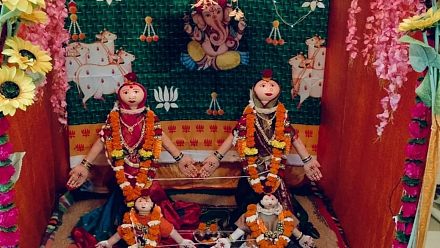
The idol, mask or symbolic representation of Gauri varies according to regional and family traditions. In some Maharashtrian communities, traditional metal masks are dressed in sarees and jewellery.
After installation, devotees perform Aarti and offer flowers, fruits and other customary items.
According to Drik Panchang, Gauri Avahan falls on Thursday, September 17, one day before the main Puja.
Jyeshtha Gauri Puja Vidhi 2026
The main Puja is performed on September 18. While rituals differ between households, a traditional sequence generally includes the following:
Clean the puja area: Clean the house and especially the area where Gauri will be worshipped. Decorate the space with rangoli, flowers and lamps.
Prepare the Gauri installation: Place the Gauri idol, mask or symbolic representation on a clean and decorated platform. Depending on family tradition, one or two forms of Gauri may be installed.
Place the Kalash: A Kalash decorated with mango leaves and a coconut is commonly used in Hindu worship. It represents auspiciousness, abundance and the presence of divine energy.
Invoke Goddess Gauri: Begin the Puja with a Sankalpa and invoke Goddess Gauri with flowers, akshata, kumkum and other traditional offerings.
Offer Shodashopachara or customary Puja items: Families may perform detailed worship according to their family priest’s instructions, offering items such as water, sandalwood, flowers, turmeric, kumkum, incense, lamp and Naivedya.
Prepare the Naivedya: Traditional Maharashtrian households prepare an elaborate meal for Gauri. The exact dishes differ by region and family custom.
In many households, a meal featuring several vegetable preparations is prepared. Some traditions attach special importance to 16 varieties of vegetables or dishes, although the menu is not identical across Maharashtra.
Perform Aarti: After the offerings, devotees perform Gauri Aarti and seek the Goddess’s blessings for the family.
Haldi-Kumkum: Haldi-Kumkum gatherings are an important social and cultural aspect of Gauri celebrations in many Maharashtrian households. Women invite relatives, neighbours and friends and exchange turmeric and kumkum as symbols of auspiciousness.
What Naivedya is offered to Jyeshtha Gauri?
The Naivedya varies according to household and region. Traditional offerings may include:
Modak
Kheer
Puran Poli
Rice preparations
Seasonal vegetables
Fruits
Coconut
Sweets
Traditional Maharashtrian dishes
Some families prepare an elaborate meal with multiple vegetable dishes, while rural communities may use locally available seasonal or wild vegetables. The exact menu should therefore be described as a family and regional tradition rather than a mandatory list.
Jyeshtha Gauri Visarjan 2026
The third day, Saturday, September 19, 2026, is observed as Jyeshtha Gauri Visarjan.
The farewell ritual marks the end of the Goddess’s ceremonial stay at the devotee’s home. Families perform a final Aarti, offer Naivedya and bid farewell to Gauri while praying for her return the following year.
The meaning of Visarjan also varies by tradition. It does not necessarily mean that every representation of Gauri is immersed in water. Some communities ceremonially remove the Gauri representation and preserve the traditional mask or other symbolic form for the following year’s festival.
Drik Panchang describes the three-day sequence as Avahan, Puja and Visarjan and notes that Gauri Visarjan represents the ceremonial farewell of the Goddess.
Jyeshtha Gauri and Gauri Ganpati: What is the connection?
Jyeshtha Gauri Pujan is celebrated during the Ganeshotsav period in Maharashtra. Goddess Gauri is closely associated with Lord Ganesha in popular Maharashtrian tradition.
The relationship is understood differently across communities. In many households, Gauri is revered as the mother of Ganesha and a form of Parvati, while traditions involving Jyeshtha and Kanishta Gauri describe the two forms as accompanying Ganesha during the festival.
Jyeshtha Gauri Pujan 2026: Regional traditions
Jyeshtha Gauri worship is not completely uniform across Maharashtra. Rituals can differ between Konkan, Mumbai, western Maharashtra, Vidarbha and other regions.
In some coastal communities, Gauri may be represented by a traditional metal mask that is dressed in a saree and jewellery.
Among some Koli families, the Goddess is associated particularly with protection, livelihood and prosperity.
In other parts of Maharashtra, two Gauri forms are worshipped. The manner in which the idols are installed, dressed and bid farewell can also vary from one family to another.
These variations are important because there is no single universal Gauri Puja format followed by every Maharashtrian household.