'Gave Up Coffee And White Rice': How 40-Year-Old CA Lost 19 Kg In 5 Months Despite Chronic Inflammation
Giving up coffee and white rice is never going to be easy for anyone especially when it has been a staple food for over 35 years. Neither is getting up for a walk after meals when exercise itself had become difficult.
By Tanya Dutt··28K reads
'Gave Up Coffee And White Rice': How 40-Year-Old CA Lost 19 Kg In 5 Months Despite Chronic Inflammation
Giving up coffee and white rice is never going to be easy for anyone especially when it has been a staple food for over 35 years. Neither is getting up for a walk after meals when exercise itself had become difficult.
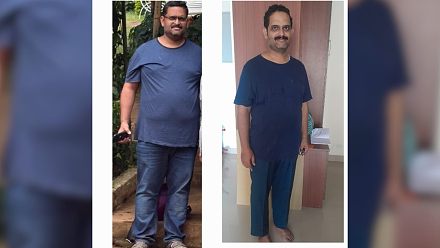
For Ganapathy Subramanian, a 40-year-old Chartered Accountant working at a large automobile company in Chennai, losing weight wasn’t simply about deciding to eat better or spend more time at the gym. There were years of habits to rethink, a demanding job to work around and, importantly, a body that had already been through its share of setbacks.
At 107 kg and 167 cm, he was also dealing with the consequences of years of lifestyle challenges and a history of surgery that had made working out difficult.
Ganapathy spoke to News18 about the early struggles, he shared, “After 35 years of consuming coffee and white rice, transitioning away from them and adopting to millets was a significant challenge. I was not sure how the body would adapt to this drastic change. Post meal walking seemed to be another battle.”
Representational Image: Canva
Ganapathy had undergone surgery for a 6mm stone in the urinary tract and also had a crushed tibia that required a plate to be inserted. These physical limitations made exercise more challenging. When he began nutritional coaching, he was experiencing chronic inflammation, nutritional deficiency, high cholesterol and an overall feeling of tiredness.
According to his care team, the weight loss has focused on preserving muscle while reducing fat and visceral fat, alongside improvements in his health and energy.
For people with a history of surgery or physical limitations, the usual advice to simply exercise more may not always be practical. Dr. Neha Shah, Obesity & Weight Loss Specialist and Co-Founder of The Good Weight, explains that weight loss plans need to be adapted to an individual’s physical circumstances.
“This comes up a lot more than people think. Someone walks into my clinic post knee-replacement, or they’ve had a spinal fusion, and every single doctor before me has told them the same thing- move more, eat less. Which, sure, fine, except moving more isn’t really on the table for them right now, is it? So what I actually do is shift the entire conversation. We stop treating exercise like it’s the main lever we’re pulling. Because it isn’t, not for this person.”
For Ganapathy, one of the biggest changes was dietary. After decades of following familiar eating habits, changing what was on his plate required him to rethink his relationship with food. Dr Neha shares, “Protein intake becomes huge. Meal timing becomes huge. Sometimes we bring in medication support where it makes sense. I had a patient bariatric surgery, maybe eight months out and her nutrition plan looked nothing, nothing like what I’d write for someone recovering from an ACL tear. Completely different playbooks. There’s no template for this, I’ll be honest. It just takes longer. And it takes patience from me and from them.”
He began eating with more attention. “I started eating mindfully. I ensured my meals had the right nutrients, vitamins, proteins. Portion control came in automatically. Paneer became a part of daily routine. Cravings especially after coming from office disappeared.”
Representational Image: Canva
What Made The Biggest Difference Beyond The Weighing Scale?
As the months progressed, Ganapathy began noticing changes that had little to do with the number displayed on the scale. What shifted first was not the number on the scale. Ganapathy adds, “What surprised me most was not the number on the weighing scale, but how much lighter and more active I felt. Within a few weeks, my clothes became looser around the waist and I found myself less dependent on coffee to get through the day.”
His approach to eating also changed. Rather than focusing only on restriction, he began paying closer attention to the nutritional composition and portions of his meals. Social occasions required discipline rather than complete restriction. “I did not want cheat days. Days of struggle were days when we had to go to some function or trip. Those days I ensured the consumption of white rice and sweet was very limited. Focus was more on vegetables and walking.”
Representational Image: Canva
Why Weight Loss For People With Surgical History Is Different and Difficult?
For Dr. Neha Shah, the number on the scale is only one part of assessing whether weight loss is improving health. For people carrying surgical history or physical limitations, the approach needs to change.
“The weight loss number on the scale is probably the least useful number I look at anymore. I mean it. I’ve had patients drop four kilos feel great about it, understandably and their visceral fat, the bioactive fat wrapped around the liver, around the pancreas, hasn’t budged. That’s the fat actually driving insulin resistance. That’s the one linked to cardiovascular risk.”
For Ganapathy, sustainability also meant figuring out how to handle situations where his usual routine was disrupted. “I did not want cheat days . Days of struggle were days when we had to go to some function or trip. Those days I ensured the consumption of white rice and sweet was very limited. Focus was more on vegetables and walking.”
For someone starting after years of difficult habits or physical limitations, the journey may not always follow the conventional idea of an intense workout routine and restrictive diet. Sometimes, the more sustainable transformation begins by understanding what the body and the person’s life can realistically accommodate.