Gandhi Jayanti 2026: Journey Through Porbandar, Sabarmati, Sevagram & Rajghat, A Look At The Important Paces In Gandhiji's Life
Every October 2, India remembers Mohandas Karamchand Gandhi, the leader whose ideas of satyagraha, non-violence and self-reliance gave rise to the country’s freedom struggle and led to its inevitable independence. But Ga
By Abigail Banerji··12K reads
Gandhi Jayanti 2026: Journey Through Porbandar, Sabarmati, Sevagram & Rajghat, A Look At The Important Paces In Gandhiji's Life
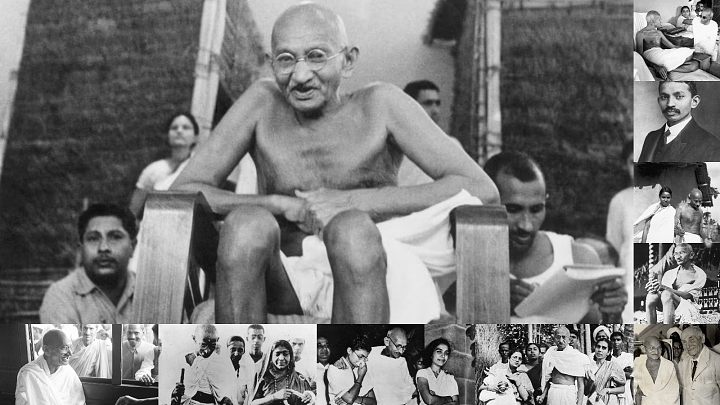
Every October 2, India remembers Mohandas Karamchand Gandhi, the leader whose ideas of satyagraha, non-violence and self-reliance gave rise to the country’s freedom struggle and led to its inevitable independence. But Gandhi ji’s story is not contained in a single city or monument. It can be traced across India through the homes, ashrams and places where he lived, worked, organised movements and eventually came to rest.
If you were to take a leaf from his book and walk in his footsteps, travellers would find themselves on an interesting journey through the annals of modern Indian history. It is without a doubt that Gandhi ji touched many people’s lives and was a strong force that blew through many parts of India.
Mahatma Gandhi speaks into a microphone during an event in Pune, capturing one of his public addresses from the freedom struggle. (Getty Images)
However, the cities of Porbandar, Sabarmati, Sevagram and Rajghat offer a different way to understand Gandhi ji’s life. Each destination represents a distinct chapter — his beginnings, the development of his political philosophy, his years of constructive work and the final chapter of his life.
Porbandar, Gujarat
The journey begins on Gujarat’s western coast, in Porbandar, where Gandhi was born on October 2, 1869.
The most important Gandhi landmark here is Kirti Mandir, which incorporates the ancestral home where Gandhi was born. The Gandhi Heritage Portal identifies the house as his ancestral home and birthplace, while the memorial that stands alongside it was built later. The cornerstone of Kirti Mandir was laid in 1947, and the memorial was dedicated to the nation by Sardar Vallabhbhai Patel in 1950.
The modest rooms offer a striking contrast to the scale of Gandhi’s later public life. The building includes the room associated with his birth, along with living spaces, a kitchen and other rooms that were part of the ancestral house.
For a traveller, Porbandar is therefore less about monuments on a grand scale and more looking at the humble beginning of this great freedom fighter.
Sabarmati, Gujarat
From Gujarat’s coast, Gandhi’s journey leads to Ahmedabad and the Sabarmati Ashram.
After returning from South Africa, Gandhi established his first ashram in India at Kochrab in 1915. It was moved to the banks of the Sabarmati River in 1917. The ashram became his home from 1917 until 1930 and developed into one of the important centres of the Indian freedom struggle.
Mahatma Gandhi is pictured with Sardar Vallabhbhai Patel and Jawaharlal Nehru in a rare photograph of three key figures of India’s freedom movement. (Getty Images)
Today, visitors can explore spaces including Hriday Kunj, where Gandhi and Kasturba lived, as well as Magan Niwas, Vinoba-Mira Kutir, Nandini and Upasana Mandir. The ashram also houses the Gandhi Memorial Museum and archival material relating to Gandhi and his associates.
But Sabarmati’s importance is not simply architectural. It was from here that Gandhi and 78 companions began the Salt March to Dandi on March 12, 1930, challenging the British salt laws. Gandhi left the ashram with a pledge not to return until India had achieved independence. He never returned.
Sevagram, Maharashtra
The next stop lies in Maharashtra, near Wardha. Sevagram was previously known as Segaon and became Gandhi’s home from April 1936 until August 1946.
The move was significant because Gandhi wanted to live in a village and concentrate on constructive work and rural reconstruction. His hut, Bapu Kuti, became the centre of his activities at Sevagram.
Gandhi Smriti, New Delhi (Image: Wikipedia)
The village subsequently became an important meeting point during the final decade of the freedom struggle. The Gandhi Heritage Portal records the presence of prominent figures including Jawaharlal Nehru, Sardar Patel, Subhas Chandra Bose, Sarojini Naidu, Rajendra Prasad and Maulana Azad at Sevagram.
The setting also reflects another side of Gandhi’s work. Sevagram was not simply a political headquarters. It was connected to his ideas around village industries, self-reliance, social reform and constructive work.
In July 1942, the Congress Working Committee met at Sevagram and passed a resolution calling for the withdrawal of British power from India; Gandhi had prepared the draft resolution.
Rajghat, Delhi
Mahatma Gandhi at the Bhangi sweeper’s colony in New Delhi in 1946, during the final years of the freedom struggle. (Getty Images)
Gandhi ji’s journey ends in Delhi, at Rajghat, the memorial that marks his cremation site. Delhi Tourism lists Rajghat among the city’s major memorials associated with India’s national leaders.
There is another nearby site that adds context to the final chapter of Gandhi’s life: Gandhi Smriti at Birla House. Gandhi was staying there during his visits to Delhi and was assassinated on his way to his customary evening prayer on January 30, 1948. The building is now a memorial containing photographs and personal belongings associated with him.
Rajghat, however, is deliberately restrained. The memorial is marked by a simple black marble platform and an eternal flame, creating a quiet ending to a journey that began nearly eight decades earlier in Porbandar.
These destinations might be simple, but they are rightfully so. Gandhi ji was a simple man who shed all worldly pleasures to focus on one goal – the unification and the freedom of our country. These stops are important because they tell a story, the truth and show an unglamorous side that not a single museum exhibit can quite capture.