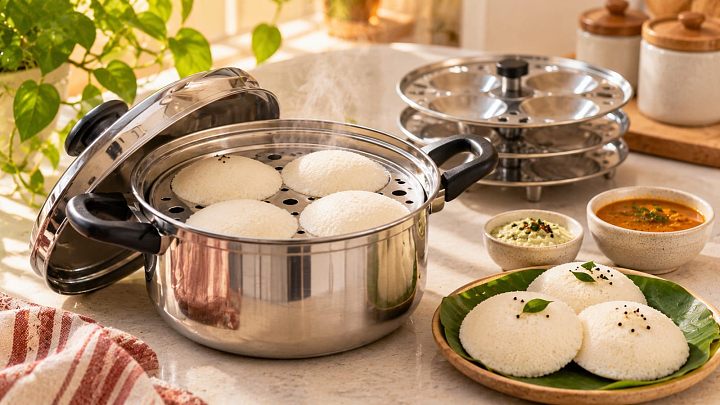
Electric Idli Maker vs Traditional Stovetop Pot: Which Is Convenient, Makes Soft, Fluffy Idlis?
Idli is one of the easiest breakfast staples to prepare at home, but the right cooking equipment can make the process even more convenient. Traditional stovetop idli pots have been a familiar part of Indian kitchens for
By Consumer Trends Desk··26K reads
Electric Idli Maker vs Traditional Stovetop Pot: Which Is Convenient, Makes Soft, Fluffy Idlis?
Idli is one of the easiest breakfast staples to prepare at home, but the right cooking equipment can make the process even more convenient. Traditional stovetop idli pots have been a familiar part of Indian kitchens for years, while electric idli makers offer a more modern approach with built-in heating and steaming.
A traditional idli pot needs a separate gas or induction cooktop to heat the water and generate steam. An electric idli maker, on the other hand, combines the heating element and steaming chamber in one appliance. This can reduce the number of utensils involved and make the process easier for people who prepare idlis frequently.
Both options can produce soft, properly steamed idlis when used correctly. The main difference is how much effort is involved before and during cooking. For some households, the simplicity of a conventional pot is more important, while others may prefer the plug-and-use convenience of an electric appliance.
Verdict: Which one should you choose?
Choose an electric idli maker if:
You prepare idlis regularly.
You want a simple plug-and-use cooking setup.
You prefer not to occupy a gas or induction burner.
You want less supervision while the idlis are steaming.
You have enough storage space for a dedicated appliance.
Choose a traditional stovetop idli pot if:
You make idlis occasionally.
You already have a gas or induction cooktop.
You prefer conventional cookware.
You want an appliance that can also be used for other steaming tasks.
You want to avoid depending on electricity.
An electric idli maker is the more convenient choice for frequent users who want a dedicated appliance with a simple setup. A traditional stovetop pot remains the better option for occasional idli preparation, especially for households that already have suitable cookware.
Top picks
Category
Product
Was
Now
Discount
Best Electric Idli Maker for Everyday Use
Pigeon By Stovekraft 1.5 Liters Multipurpose Kessel
Rs 2475
Rs 1499
39%
Best Electric Idli Maker for Small Families
Amazon Basics Multi-Kettle Steamer
Rs 2799
Rs 1239
56%
Best Budget Electric Idli Maker
Cookwell Multipurpose Cook Kettle
Rs 1999
Rs 1199
40%
Best Traditional Stovetop Idli Maker
Pigeon Stainless Steel Idly Maker
Rs 1545
Rs 909
41%
Best Stovetop Idli Maker for Large Batches
The Indus Valley Stainless Steel Idli Maker
Rs 3849
Rs 2199
43%
Best Value Stovetop Idli Maker
Lifelong Idli Cooker
Rs 1099
Rs 599
45%
Quick comparison
Feature
Electric Idli Maker
Traditional Stovetop Pot
Heating method
Built-in electric heating element
Gas or induction cooktop
Convenience
Excellent
Good
Setup
Simple plug-and-use setup
Requires separate cooktop
Supervision
Minimal
Moderate
Cooking control
Depends on appliance
Manual heat control
Electricity required
Yes
Not with a gas stove
Burner required
No
Yes
Batch capacity
Varies by model
Varies by pot
Ease of cleaning
Good
Generally easier
Portability
Good
Good
Storage
Requires dedicated space
Easier to store with cookware
Versatility
Primarily designed for steaming
Can be used for different steaming tasks
Power-cut usability
No
Yes, with gas cooking
Best for
Frequent idli preparation
Occasional and traditional cooking
Value
Better for frequent users
Better for occasional users
How does an electric idli maker work?
An electric idli maker uses a built-in heating element to heat water and generate steam inside the appliance. The idli batter is placed in removable moulds, which are positioned above the water. Once switched on, the appliance heats the water and allows the steam to cook the batter.
This design removes the need for a separate pot and cooktop. For someone preparing breakfast early in the morning, that can make the overall process feel more straightforward. There is also no need to keep adjusting the gas flame during steaming.
Most electric models are designed around multiple idli moulds, although the actual capacity varies considerably between models. Buyers should therefore check the number of idlis that can be prepared in one batch rather than assuming all electric makers have the same capacity.
Some models also include indicator lights, heat-resistant handles and removable trays. These features can make everyday operation easier, although the exact specifications differ from one product to another.
Where electric idli makers perform best
Frequent breakfast preparation
Quick and convenient steaming
Small and medium-sized households
Kitchens with limited free burners
Users who prefer a dedicated appliance
Where electric idli makers struggle
Dependence on electricity
Additional appliance to store
Limited functionality compared with general cookware
Electrical components require careful cleaning
Capacity may be limited on compact models
The main advantage of an electric idli maker is convenience rather than a fundamentally different cooking method. It automates the heating part of steaming while keeping the process relatively simple.
How does a traditional stovetop idli pot work?
A traditional idli pot uses steam produced by boiling water on a gas or induction cooktop. Water is added to the bottom section of the pot, while idli moulds are positioned above it. As the water heats, steam rises and cooks the batter.
The method is simple and familiar. There is no heating element, power cord or electronic component to deal with. Users only need a suitable cooking surface and enough water to generate steam.
Traditional idli pots are also available in different sizes and configurations. Some can accommodate several moulds, making them useful for larger households. Depending on their construction, the same type of vessel can also be used for other steaming requirements.
The main trade-off is that the cooktop remains occupied while the idlis are being prepared. Users also need to manage the heat manually and ensure that there is sufficient water throughout the cooking process.
Where traditional stovetop idli pots perform best
Occasional idli preparation
Large-batch cooking
Conventional Indian kitchens
Cooking during power cuts
Users who already own a gas or induction cooktop
Other steaming requirements
Where traditional stovetop idli pots struggle
Requires a separate heat source
Needs more manual supervision
Occupies a stove burner
Hot cookware needs careful handling
Setup involves more steps
Despite these limitations, the traditional pot remains a dependable option because of its straightforward design. There are fewer components to maintain, and the cooking method does not depend on electricity when used with a gas stove.
Which is more convenient for everyday cooking?
For everyday convenience, an electric idli maker has the edge because its heating system is built into the appliance. Once the water and batter are added, the appliance can be switched on without setting up a separate steaming pot on the stove.
A traditional pot requires the user to add water, place the moulds inside, heat the vessel and manage the cooking process. None of these steps is particularly complicated, but they add a little more involvement to the routine.
This difference becomes more noticeable for people who make idlis several times a week. If idlis are prepared only once in a while, however, the convenience of an electric model may not be significant enough to justify buying another appliance.
Convenience comparison
Electric Idli Maker: Better for simple, frequent preparation
Traditional Stovetop Pot: Better for straightforward conventional cooking
Which is better for large families?
Capacity depends on the individual model rather than simply whether it is electric or stovetop. Both categories include compact and larger options, so buyers should check the number of moulds and idlis that can be prepared in one batch.
For a large family, a multi-tier or larger-capacity traditional pot can be useful because it allows more idlis to be steamed together. Electric models can also offer multiple moulds, but buyers need to check whether the capacity matches their household requirements.
If several batches are needed, the convenience advantage of an electric model can also become less important if its capacity is relatively small.
Which is easier to clean?
A traditional stovetop idli pot generally has a simpler construction, with fewer components that need special care. The pot and moulds can usually be washed separately after cooking.
Electric idli makers may also have removable moulds and trays, making those parts easy to clean. However, the electrical base and heating element need to be handled carefully and should not be treated like ordinary cookware.
In either case, removing leftover batter soon after cooking makes cleaning easier. Buyers should also check whether the moulds and trays are designed for convenient removal before purchasing.
Which offers better value?
A traditional stovetop idli pot can offer better value for households that make idlis occasionally. If a gas stove or induction cooktop is already available, there is no need for a separate heating system, and the pot can potentially be used for other steaming tasks.
An electric idli maker costs more for the added convenience of integrated heating. For frequent users, that convenience can be worthwhile, particularly if the appliance is used several times a week.
Therefore, value depends largely on usage. A traditional pot makes more sense for occasional cooking, while an electric model can be worth considering when idli preparation is a regular part of the household routine.
Which should you buy for your kitchen?
If convenience, simple operation and frequent idli preparation are your priorities, an electric idli maker is the better choice. Its integrated heating system reduces the amount of cookware needed and means you do not have to use a separate burner for steaming.
If you prepare idlis occasionally or already own a suitable stovetop steaming pot, there is little reason to switch to an electric model purely for convenience. A traditional pot is simple, durable and does not depend on electricity when used on a gas stove.
Ultimately, both methods rely on the same basic steaming principle. The better choice comes down to how often you make idlis and whether you value dedicated convenience over the simplicity and versatility of traditional cookware.
Common cooking scenarios
Situation
Better choice
Daily breakfast preparation
Electric Idli Maker
Occasional idli preparation
Traditional Stovetop Pot
Busy weekday mornings
Electric Idli Maker
Large family breakfast
Traditional Stovetop Pot
Small kitchen with limited burners
Electric Idli Maker
Power-cut cooking
Traditional Stovetop Pot
Users who already own a gas stove
Traditional Stovetop Pot
Minimal cooking supervision
Electric Idli Maker
Cooking idlis along with other stovetop dishes
Electric Idli Maker
Traditional kitchen setup
Traditional Stovetop Pot
Multiple steaming requirements
Traditional Stovetop Pot
Dedicated idli-making appliance
Electric Idli Maker
FAQs
Is an electric idli maker better than a traditional idli pot?
An electric idli maker is more convenient because heating and steaming are combined in one appliance. A traditional pot is better suited to occasional users who prefer conventional cookware.
Does an electric idli maker need a gas stove?
No. An electric idli maker has its own heating element and only requires a suitable electrical power source.
Is a traditional stovetop idli pot still worth buying?
Yes. It remains a practical choice for occasional idli preparation and does not require electricity when used with a gas stove. It can also be useful for other steaming tasks, depending on the design.
Which is easier to clean?
A traditional stovetop pot generally has a simpler construction and can be easier to wash. Electric models with removable moulds and trays can also be easy to clean, but their electrical base needs additional care.
Which is better for a large family?
Capacity varies by model, so buyers should check how many idlis each appliance can prepare in one batch. Larger stovetop models can be particularly useful when preparing bigger quantities.
Can an electric idli maker be used for other foods?
Some electric models may support other steaming applications, but this depends on their design and manufacturer instructions. It is best to check the specified uses before cooking foods other than idlis.
Does an electric idli maker cook idlis faster?
The actual cooking time depends on the appliance, amount of batter and recipe. Its main advantage is that it simplifies the heating and steaming process rather than necessarily making every batch significantly faster.
Which should I buy overall?
Choose an electric idli maker if you prioritise convenience and prepare idlis regularly. Choose a traditional stovetop pot if you want simple, versatile cookware for occasional idli preparation.
Disclaimer: The product descriptions mentioned in the article are solely based on the primary and secondary research conducted by our experts. To keep you ahead of the curve with these latest products, News18 utilises affiliate links. This means if you decide to shop through our recommendations, we may earn a small referral commission at no extra cost to you. Please be advised that News18 is not responsible for any claims under the Consumer Protection Act, 2019, or other applicable laws regarding the final performance, quality, or safety of these products.