Dr. Maritess Gozon Viterbo and the art of listening to horses
Horses don't communicate in our language, but it doesn't mean they have nothing to say.
By Martin Javier··24K reads
Dr. Maritess Gozon Viterbo and the art of listening to horses
Horses don't communicate in our language, but it doesn't mean they have nothing to say.
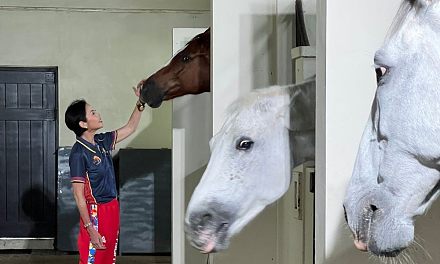
Dr. Maritess Gozon Viterbo believes truly getting to know these majestic creatures takes more than knowing how to command them. It begins with learning how to listen.
"Actually, more of a horse listener," Viterbo said when asked if she considers herself a horse whisperer.
This philosophy guides her work in equine therapy, where she focuses on both the physical and psychological needs of horses.
But how exactly does one "listen" to a horse?
Says Viterbo, it starts with grounding yourself, with presence and mindfulness.
As prey animals, horses have heightened senses and are able to detect even the most subtle changes in their environment, including human body language.
So to establish an initial connection, one must approach calmly and be aware of his or her own behavior, Viterbo said.
Then the attention shifts to behavioral signals.
"Pina-aral sa amin 'yung mga expression nila. Like yung tenga nila, may meaning yan kapa gumagalaw. Yung mata nila, malalaman mo kung stress or hindi. Yung paghinga."
(We were taught how to read their expressions. For example, the way their ears move has meaning. You can also tell from their eyes whether they're stressed or not, even from their breathing.)
The ability to interpret these signals helps foster a relationship built on trust.
That bond becomes especially valuable in competitive equestrian sports, where rigorous training and international competition can take a significant toll on a horse's body.
But despite the physical strain horses endure, their recovery needs can sometime be overlooked.
Viterbo believes recovery goes beyond treating physical injuries. A horse's psychological well-being can affect its performance.
"Since athlete yung human, athlete yung kabayo, nakakalimutan natin na sila kailangan din nila na may mag-te-therapy ng katakana nila, lalo na kappa mabigat yung ginagawa nila. Naninigas yung muscles nila o kung minsan may injury sila. Tinutulungan mo rin sila," she explained.
(Like human athletes, horses are athletes, too. We sometimes forget that they also need physical therapy, especially when they're doing strenuous activities. Their muscles get tight and sometimes they suffer injuries. They need help, too.)
A great example is Lacoste 126, also known as Costi, the veteran dressage horse ridden by Olympian and multi-medaled equestrienne Toni Leviste.
Viterbo describes him as a horse with longstanding health concerns and a temperament that makes him challenging to handle.
"Kakaiba siya na kabaya, kaya mga three years ago pa lang, binisita ko na siya para tignan kung may magagawa ba ako para sa kanya. Tapos, namulat kami, after a few weeks, mamaamo na siya sa akin. Nagpapahawak na siya ng ulo," she recalled.
(He's quite an unusual horse. Three years ago, I visited him to see if there was anything I could do for him. We were surprised because after a few weeks, he became gentle with me. He even started letting me touch his head.)
In 2025, while Leviste was trying to qualify for the Southeast Asian Games, Costi struggled to perform and reach the required score. Viterbo traveled to Belgium to assess him.
What she found was a horse exhibiting considerable tension, which she suspected was affecting his movement.
"Kaya kapag nai-stress na siya mentally, automatic, mag-ti-tighten yung buong katawan niya. So akala mo lame siya kahit na hindi."
(When get mentally stressed, his entire body automatically tightens up. So you might think he's lame even when he's not.)
On July 19, 2025, Leviste and Costi won the Prix St. Georges dressage competition in Flemalle, Belgium, scoring 68.603% and surpassing the 67% qualifying benchmark.
But months later, they faced a similar challenge.
Just 10 days before Costi's scheduled flight to Japan for the 2026 Asian Games, the horse reportedly developed severe lameness, putting his participation in jeopardy.
Even after veterinary consultations, his condition remained a concern. Viterbo was called back to Belgium.
Having worked with Costi before, she suspected psychological tension might once again be contributing to his movement difficulties.
"Tense lang talaga siya. After one day lang ng session, naka-practice pa si Toni na parang normal."
(He was really just tense. After only one session, Toni was able to practice with him almost as if everything was normal.)
Following their session, Costi reportedly improved enough to resume training with Leviste. The pair eventually competed in the Asian Games.
Viterbo's bond with Costi reflects what she has learned through years of working with horses: No two are exactly alike.
"Individual talaga sila. Parang tao. Hindi tato pare-pareho i-treat. Gannon din ang horses. Hindi pwedeng ikahon yung treatment," she said.
(They are individuals, just like people. We don't all receive the same treatment, and it's the same with horses. You can't teat every horse the same way.)
A Childhood Dream Revisited
"I feel like God really set this path for me. Kasi bata pa lang ako, gusting-gusto ko na ng horse. May affinity na ako sa mga horses. Mahilig ako sa animals pero iba talaga yung relationship ko with horses."
(I feel like God really set this path for me. Ever since I was a child, I've always loved horses. I've always had an affinity for them. I love animals in general, but my connection with horses has always been different.)
While other children dreamed of becoming doctors, lawyers, or pilots, Viterbo had an unusual ambition.
"Nun kinder ako, kasi di ba usually kappa first day of class, tinatanong kung among pangarap mo? Usually sasabihin mo doctor, lawyer, pilot or fireman. Ang sinabi ko, maging guide ng kabayo sa Wright Park."
(When I was in kindergarten, you know how on the first day of class, they usually ask what you want to be when you group up? Most kids would say a doctor, lawyer, pilot, or firefighter. What I said was I wanted to be a horse guide at Wright Park.)
She eventually became a physician but in the pandemic, Viterbo would get another chance to pursue her childhood dream.
Drawing on her background in psychology, Viterbo enrolled in a 40-week Australian online program in equine-assisted psychotherapy, a practice involving interactions with horses to support human mental health.
During her studies, she realized that before horses could help people, their own needs had to be addressed. That realization led her to focus on caring for the horses themselves.
She went on to study equine bodywork and therapeutic approaches such as osteopathy, taping, and laser therapy, combining techniques from these disciplines and developing her own approach.
"Tinake ko lahat. Tapos kinuha ko yung best practices of all of them. And ngayon, may sari akong ginagawa na method," Viterbo said.
(I studied all of them and took the best practices from each. Now I have developed my own method.)
It's the same approach she applies in her work with the Philippine equestrian team.
Beyond helping competitive horses, Viterbo hopes to promote greater awareness of horse welfare within the equestrian community.
She believes prioritizing their physical and psychological well-being can strengthen the partnership between horse and rider while improving safety in the sport.
Her advocacy comes from deep appreciation of what horses endure in serve of their rides.
"Ang dami nilang binibigay sa humans kahit na na-i-injure na sila. Todo pa rin sila bigay."
(They give so much to humans, even when they are already injured. They still give everything they've got.)
For Viterbo, the work has brought her closer to the life she once imagined as a child.
"So I graduated as a human doctor but now I mostly work with horses, which is my real dream." — LA GMA News