Breast Cancer Awareness Isn’t Just for Women: What Men Should Know About Changes in Their Chest
Every October, breast cancer awareness campaigns bring pink ribbons, screening reminders and conversations about early detection into public view. But there is an important part of this conversation that often gets overl
By Tanya Dutt··9K reads
Breast Cancer Awareness Isn’t Just for Women: What Men Should Know About Changes in Their Chest
Every October, breast cancer awareness campaigns bring pink ribbons, screening reminders and conversations about early detection into public view. But there is an important part of this conversation that often gets overlooked- men can develop breast cancer too.
According to the World Health Organization, approximately 0.5–1% of all breast cancers occur in men globally. In India, the National Cancer Registry Programme indicates that male breast cancer accounts for roughly 0.5–1.5% of cancers in men, with about 7,000 new cases reported annually; more than half of these are diagnosed at Stage III or IV.
Male breast cancer accounts for fewer than 1% of cases overall, with an average lifetime risk of around 1 in 755. Most diagnoses occur between the ages of 60 and 70. Because the disease is so uncommon, it is often detected later than in women, which contributes to somewhat poorer outcomes overall.
Breast cancer in men is uncommon, roughly one in every hundred cases but that rarity itself becomes a problem. Both patients and clinicians are less likely to suspect it, so diagnosis often comes later, when the disease has already advanced. Outcomes tend to be poorer as a result. Most men are diagnosed in their mid-sixties, though younger men are not exempt.
Dr Anmol Chugh, Plastic Surgeon and Founder of Seena Strong, explains why awareness needs to extend beyond women and what men should know about changes in their chest.
“Breast cancer in men is rare, about one in every hundred cases. That rarity works against them. Doctors don’t expect it and patients certainly don’t, so it tends to be found later than it is in women, often when it has already progressed. That delay is a big part of why outcomes are worse. Most men are diagnosed in their mid-sixties, though younger men aren’t immune,” says Dr Chugh.
Men have breast tissue, including ducts in which cancer can develop. While the condition is much less common in men than women, unfamiliarity with its symptoms can make it harder to recognise a potentially serious change.
Is Every Lump Or Enlargement In A Man’s Chest A Sign Of Cancer?
Many chest changes are caused by benign conditions, including gynecomastia, which refers to the enlargement of glandular breast tissue in men. Hormonal changes, certain medications, ageing and some health conditions can contribute to it. However, the cause of a new or unusual change should be assessed by a healthcare professional rather than assumed.
Dr Chugh explains, “The good news is that most changes to appearance in men’s chests are not cancerous. The most common diagnosis is gynecomastia, an enlargement of breast tissue, which is largely harmless. Hormonal imbalances, certain drugs, weight gain and age can all play a part in its development. It often manifests itself as two soft rubbery discs under the nipples on both sides, and can sometimes cause pain. Its occurrence is fairly common, and I see it on a regular basis, and for most of these men their concern is their image and self-esteem, rather than their health.”
Although gynecomastia is common, a person should not self-diagnose a lump based on how it feels. A clinical examination can help distinguish between different causes and determine whether further investigations are needed.
What Changes In The Chest Should Men Get Checked?
A new lump is one of the most recognised warning signs of male breast cancer. Other symptoms can include nipple inversion, discharge, changes in skin texture and swelling around the underarm. These symptoms do not automatically indicate cancer, but they should not be ignored.
Dr Chugh highlights the changes that deserve prompt medical attention, “What worries me looks different. A firm lump that doesn’t hurt, especially if it’s off to one side or sits away from the nipple, needs to be looked at soon. The same goes for a nipple that turns inward, any discharge that’s bloody or comes on its own, dimpled or puckered skin, redness or scaling that won’t clear up, and swelling under the arm. None of these means cancer for certain. But none of them is something to monitor for a few months and hope for the best.”
Image: Freepik
Who Carries Higher Risk?
Certain genetic conditions, inherited gene mutations and medical histories can increase a man’s risk. Certain men should be especially attentive. Dr Chugh, “Some men carry a higher risk and ought to pay closer attention. A BRCA2 mutation raises the risk considerably, and BRCA1 does so to a smaller degree. Klinefelter syndrome, serious liver disease and earlier radiation to the chest do as well. So does a strong family history of breast or ovarian cancer. Men often overlook that this includes their father’s side of the family, not just their mother’s.”
A family history does not mean a man will necessarily develop breast cancer, just as having no known family history does not rule it out. Men with relevant family histories or known inherited mutations can discuss their risk and whether genetic counselling is appropriate with their healthcare provider.
How Is Breast Cancer Diagnosed In Men?
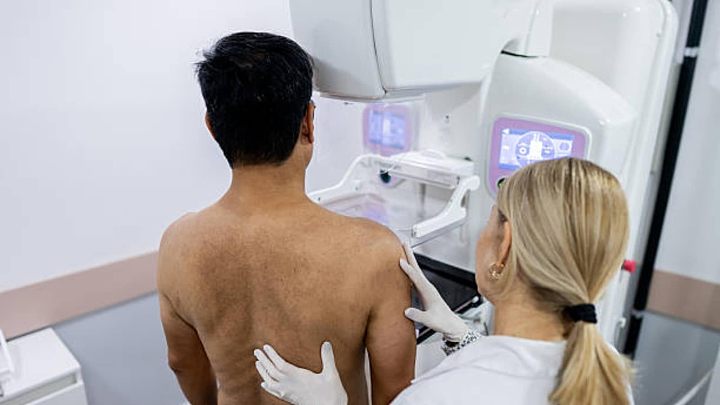
When a man reports a concerning change, a doctor may conduct a physical examination, review his personal and family medical history, and recommend imaging such as a mammogram or ultrasound. If the findings warrant further investigation, a needle biopsy may be performed to examine a tissue sample. The exact tests depend on the individual findings.
Dr Chugh advises, “If you notice something, see your doctor. Get an examination, and probably a mammogram or ultrasound, and a needle biopsy if it turns out to be something. It’s quick, it’s routine, and it’ll give you an actual answer instead of leaving you hanging for weeks.”
He also highlights why tissue analysis matters during procedures undertaken for enlarged breast tissue, “One more thing from my own corner of medicine. Whenever I remove tissue from a man during gynecomastia surgery, it goes to pathology, every time. Once in a while the report turns up something nobody anticipated, which is why I never think of these operations as purely cosmetic. And if a man does need a mastectomy, reconstruction is an option, and it’s worth raising early.”
When Should Men Seek Medical Advice About Chest Changes?
Men should arrange a medical assessment if they notice a new lump, persistent skin changes, nipple inversion, unexplained discharge or swelling around the underarm. These signs can have causes other than cancer, but waiting several months to see whether they disappear is not advisable. There is also no need to feel embarrassed about discussing breast or chest symptoms with a doctor.
Dr Chugh concludes, “Knowing your own body isn’t a skill that belongs to one gender. If something in your chest feels new or different, get it checked. The worst that can come of an unnecessary appointment is a bit of awkwardness. The worst that can come of waiting is far harder to undo.”