Book Review | From Caviar to Khichdi: A New Book Traces Indian PMs’ Food Preferences Alongside Their Political Journey
Unlike royalty, democratic leaders are not born into a common mould. Prime ministers and heads of state emerge from vastly different socio-cultural backgrounds, economic circumstances and educational experiences. Their p
By Pragati Pandey··14K reads
Book Review | From Caviar to Khichdi: A New Book Traces Indian PMs’ Food Preferences Alongside Their Political Journey
Unlike royalty, democratic leaders are not born into a common mould. Prime ministers and heads of state emerge from vastly different socio-cultural backgrounds, economic circumstances and educational experiences. Their political ideologies may differ sharply, as do their personal habits; from the way they dress to what they eat. Interestingly, their culinary preferences often carry the imprint of their upbringing, culture and, at times, even their political worldview.
Bringing together politics and the personal, therefore, makes for a fascinating recipe. And that is precisely what Purabi Shridhar and Sanghita Singh attempt in their new book, titled ‘The Prime Minister’s Table: Delicacies and Diplomacies from the Era of Nehru to Modi’. In this book, the authors explore India’s prime ministers not merely through the corridors of power, but also through the food that found its way onto their tables.
The book is rich in anecdotes, with the culinary preferences of India’s prime ministers woven seamlessly into their stories. One of the most intriguing chapters is devoted to Morarji Desai, fascinating not only for what it reveals about his eating habits but also for the political and personal portrait that emerges.
Desai was the only Indian Prime Minister to have survived a plane crash and, uniquely, the only one to have received the highest civilian honours of both India and Pakistan. A staunch Gandhian in both thought and action, he brought the same remarkable discipline to his personal life. The authors recount that during his visit to the United States in June 1978, Desai granted an interview to an undergraduate student who was undertaking a two-year project on Mahatma Gandhi.
His dietary discipline was equally extraordinary. At the age of sixty, Desai gave up cooked food and subsisted largely on raw fruits and boiled vegetables. Yet, despite these austere habits, his palate had its indulgences. He liked paneer and milk, and among his favourite meals were Jawari Roti with Aloo ki Sabzi. His most prominent weakness, however, was Shrikhand, which he particularly enjoyed; Doodh Pak was another dessert that found favour with him. The contrast is revealing: behind the image of the austere Gandhian was a man who, even within the strict confines of his diet, retained a distinct and surprisingly enjoyable relationship with food.
Another, and perhaps the most elaborate, culinary journey in the book is that of Atal Bihari Vajpayee. Much like his life, marked by a love for poetry, unconventional personal relationships, a deep affection for Hindi cinema, and a politics defined by accommodation rather than confrontation, Vajpayee’s food choices too tell the story of a man who, in the words of his close friend N.M. Ghatate, “loved everything good in life, especially food.”
The authors’ painstaking research, including conversations with several of Vajpayee’s friends and associates, does more than simply offer a glimpse into his culinary preferences. Rather, it creates an entire tableau in which food becomes an integral part of the life and personality of one of modern India’s most consequential political figures.
From his love for fish, Chinese and continental cuisine to Delhi’s chaat and jalebis, Vajpayee’s palate was as expansive and eclectic as his personality. One anecdote in the book perhaps captures this relationship with food best, placing Vajpayee firmly among those who certainly did not eat merely to live, but also lived to eat.
The authors recount that at an RSS training camp in Lucknow’s Chowk area, Vajpayee and a fellow RSS worker, on a lark, entered into a lassi-drinking competition. Both ended up downing 10–12 glasses, laughing throughout the contest, only to find themselves barely able to move after their epic lassi duel. It is an anecdote that is amusing on the surface, but also revealing of how food, fellowship and conversation were intertwined in Vajpayee’s life.
As the authors write, “The Chowk was his place for meetings and brainstorming on political ideologies accompanied by fresh and flavourful food—chaat, rabdi, thandai and malai, served in terracotta bowls”. His culinary indulgences extended to Ramashray, where he particularly enjoyed malai paan, made with malai, mewa, elaichi, mishri and a coating of varq, along with doodhiya halwa, sohan and kishmish ke samose.
These details may appear, at first glance, to be merely delightful gastronomic trivia. But taken together, they reveal a more intimate dimension of Vajpayee; the man behind the statesman: someone who could engage in intense political and ideological conversations over a plate of chaat, savour the pleasures of a good meal, and find companionship in the simple joys of food. In that sense, the authors succeed in making food not merely a subject of the book, but a window into the life, personality and relationships of one of modern India’s most fascinating political figures.
The book also turns to two other Prime Ministers from the same family, father and daughter, whose culinary worlds make for an equally fascinating study. Jawaharlal Nehru, India’s first Prime Minister, came from an exceptionally privileged and anglicised upbringing. His father, Motilal Nehru, was a successful barrister who maintained an English governess and an English cook for his children and household. Inevitably, this cosmopolitan upbringing found its way onto the family table.
The authors bring out these nuances through fascinating family recollections. A relative recalls that Nehru was particularly particular about how his eggs were cooked: “the egg had to be dropped directly into boiling water and not placed in a bowl and then steamed in hot water like how it is done in many Indian homes.” His meals, too, reflected a fascinating coexistence of the Indian and the Continental. As the authors note, “A typical Nehru Kashmiri daawat was an interesting combination of arhar ki dal, dum alu, khatti tarkari and roganjosh.” In Allahabad, where the family lived between Swaraj Bhawan and Anand Bhawan, lunch was usually Indian, while dinner often brought a distinctly Continental spread, sometimes potatoes stuffed with mincemeat and macaroni with cheese.
There is something revealing in this juxtaposition. dum alu could sit comfortably alongside potatoes stuffed with mincemeat and macaroni with cheese on the same family table. It was neither a complete departure from Indian culinary traditions nor an uncritical embrace of the West, but rather a reflection of the hybrid, cosmopolitan world in which Nehru was raised. The dinner table, in its own quiet way, mirrored the cultural tensions and synthesis of a family that stood at the intersection of an Indian tradition and an increasingly westernised elite culture.
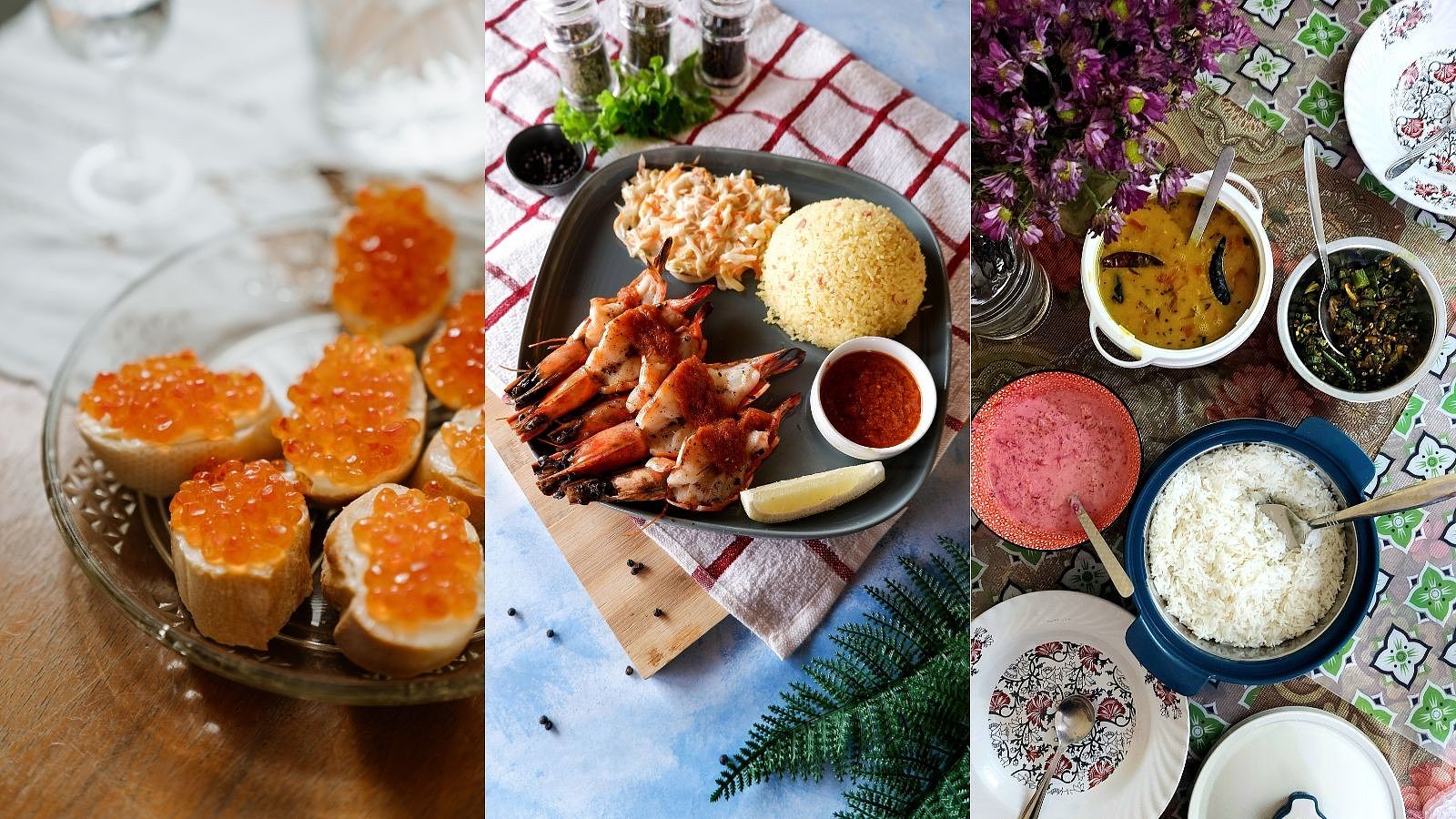
The cosmopolitanism reflected in the Nehru household’s culinary preferences was carried into the next generation, perhaps most strikingly in the case of Indira Gandhi. Among the foods she particularly cherished was caviar, an unlikely item to associate with an Indian Prime Minister’s table, but one that reveals the breadth of her culinary preferences. Former career diplomat S.K. Lambah is quoted in the book recalling that Indira Gandhi herself taught him how to eat caviar.
At the same time, her cosmopolitan palate coexisted with a deep and abiding love for Kashmiri food, reflecting her enduring connection with her ancestral roots. The authors write that former Union Minister Mohsina Kidwai recalls a memorable meal at Indira Gandhi’s residence when she had invited a group of dignitaries from the Middle East. At a table of twelve, Kidwai and former diplomat Yunus Khan were among the guests. What particularly caught Kidwai’s attention was a baingan dish she had never encountered before. She found it so delectable that she asked about it, and Indira Gandhi told her that it was a Kashmiri preparation.
The contrast is striking: caviar on one hand, and an unfamiliar Kashmiri baingan dish on the other.
The book traces the culinary preferences of all of India’s Prime Ministers, whether those who occupied the office briefly, such as I.K. Gujral and Chandra Shekhar, or one of India’s longest-serving Prime Ministers, Narendra Modi, with the same depth and curiosity. In Modi’s case, the food on his plate seems to fit naturally with the modest background and simplicity of his personal life, something that comes through repeatedly in the anecdotes shared by those who have known him closely.
The authors quote a Gujarat-based businessman describing him as someone who is “khilane ke bade shaukeen hai”, someone who takes great pleasure in feeding others. Modi, a strict vegetarian, is fond of Gujarati favourites such as undhiyo and jalebi. What emerges from the chapter is a picture of a Prime Minister whose own approach to food is remarkably simple and restrained. In this respect, he appears almost the antithesis of Atal Bihari Vajpayee, the only other Prime Minister from his party, whose love for food was legendary. If Vajpayee could be said to live to eat, Modi, as the anecdotes in the book suggest, seems to eat simply to live.
While tracing the culinary preferences of all of India’s former Prime Ministers as well as the incumbent one, the book does something else rather well: it keeps the reader’s palate lively by weaving these food preferences into rich anecdotes from their political and personal lives. The result is a book about India’s Prime Ministers where, for a change, the tadka is provided by food rather than politics. And that, perhaps, is what makes ‘The Prime Minister’s Table’ such a delightful read.
Pragati Pandey is a Noida-based freelance writer who writes on books, pop culture, and ideas. Views expressed are personal and do not necessarily reflect those of News18.