US Midterms: Early Voting Surges In Texas, Kansas, Ohio As Trump Faces Voter Discontent
States in contention to determine control of the US Senate are seeing voter turnout surge compared with the previous midterm election, according to an Associated Press analysis of early-voting data released two weeks bef
Oleh Shankhyaneel Sarkar··90K dibaca
US Midterms: Early Voting Surges In Texas, Kansas, Ohio As Trump Faces Voter Discontent
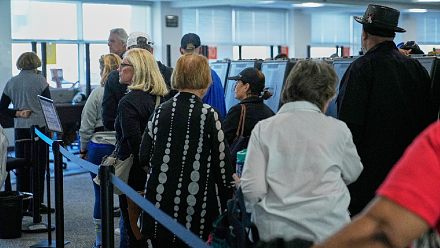
States in contention to determine control of the US Senate are seeing voter turnout surge compared with the previous midterm election, according to an Associated Press analysis of early-voting data released two weeks before Election Day.
Texas has recorded a 74% increase in early voting compared with the same point in 2022, while Kansas has more than doubled its advance vote. Maine, North Carolina and Ohio have also reported increases exceeding 30% in early in-person and mail-in voting.
The increases come as Democrats seek to wrest Republican-held Senate seats in these states. The AP analysis found that Republicans accounted for a smaller share of advance voters in most of the states examined than they did at the corresponding stage of the previous midterm cycle.
The figures offer an early look at voter engagement ahead of the November 3 elections, although higher participation alone does not establish which party stands to benefit. The political backdrop includes discontent over President Donald Trump’s tariffs, persistent cost-of-living pressures and higher petrol and diesel prices linked to the Iran war — issues that have complicated the Republican campaign in several states.
More than 13 million Americans had cast mail-in or early in-person ballots nationwide by Tuesday, compared with approximately 9 million at the same point in the 2022 midterm cycle. However, part of the increase reflects changes in early-voting access and the availability of election data, making direct comparisons between the two cycles more complicated.
Democrats target Republican-held Senate seats
Republicans hold a 53-47 majority in the US Senate, and Democrats are seeking opportunities to narrow or overturn that advantage. The party’s prospects depend in part on competitive races in states that backed Trump in the 2024 presidential election but where Democrats believe economic concerns could help them attract voters.
Kansas has emerged as one such focus. Trump won the state by 16 percentage points in 2024, yet more than 55,000 people had already voted by the comparable point in the current cycle, against roughly 27,000 in 2022.
Republicans have responded by directing additional resources towards incumbent Senator Roger Marshall, who is facing Democrat Adam Hamilton. Earlier this month, Republican groups shifted nearly $12 million into Kansas after reducing spending in the North Carolina Senate contest, another race that had drawn attention as a potential Democratic opportunity.
Trump also held a rally in Kansas on Monday, seeking to reinforce Republican support as the party attempts to retain its congressional majorities.
The state’s early-voting figures are particularly notable in the context of its 2022 elections. Democratic Governor Laura Kelly narrowly won re-election that year, while Republican Senator Jerry Moran secured a decisive victory; illustrating how different contests on the same ballot can produce contrasting outcomes.
Texas records nearly one million early votes
Texas has also seen a substantial increase in advance voting, with nearly one million ballots cast by Tuesday, compared with approximately 550,000 at the same stage of the 2022 midterms. Early in-person voting had begun only on Monday, and the state’s figures do not identify ballots by party registration.
The increase comes amid a competitive Republican Senate contest involving state Attorney General Ken Paxton and Democrat James Talarico. Paxton defeated incumbent Senator John Cornyn in a Republican primary runoff after receiving Trump’s endorsement.
Democrats have sought to make Paxton’s legal and political controversies a central issue. He was impeached by the Texas House in 2023 over allegations of misconduct but was acquitted by the state Senate. He has denied wrongdoing in relation to the allegations.
Talarico is seeking to make history by becoming the first Democrat to win a statewide Texas election in more than three decades. The state is also holding a closely watched gubernatorial contest, with Republican incumbent Greg Abbott facing Democratic state lawmaker Gina Hinojosa.
The scale of early voting suggests substantial participation in a state where both parties have invested heavily in their campaigns. However, because Texas does not report the advance ballots by party registration in the data cited by the AP, the increase does not reveal which party is driving the surge.
Ohio and Maine see significant increases
Ohio has recorded approximately 156,000 more ballots than at the equivalent point in 2022, an increase of around 30%. The state has competitive races for the Senate, House of Representatives and governor, with campaign spending particularly high in the Senate contest.
According to AdImpact, spending on the Ohio Senate race is expected to approach $500 million, reflecting the importance both parties attach to the contest.
The comparison with 2022 comes with a qualification: Ohio has changed its voting rules since the previous midterm election, including eliminating the grace period for receiving mail ballots. Voters must therefore ensure their ballots arrive earlier, a change that can affect when votes are recorded.
Maine has also seen a substantial increase, with advance voting up 39% from the same point in the 2022 midterms. Republican Senator Susan Collins, who is seeking a sixth term, faces Democrat Troy Jackson.
The Maine contest is significant for Democrats because Collins has repeatedly won in a state where Democratic voters are numerous, making the race a potential opportunity for the party to gain a Senate seat.
Early voting remains broadly stable in other states
The increase is not uniform across all competitive states. Michigan and Georgia, where Democrats are defending Senate seats, have recorded high advance-voting totals that are broadly comparable with the same point in 2022.
Both states set midterm voting records four years ago. Michigan’s election was shaped in part by the issue of reproductive rights, while Georgia had a closely contested Senate race.
Iowa has seen a different trend, with early voting down approximately 6% from the corresponding period in 2022. The state has competitive contests for governor, the Senate and three of its four House seats, despite having voted for Trump in each of the previous three presidential elections.
Taken together, the figures show that voter participation is rising sharply in several states central to the Senate battle, but not across the board. The eventual impact will depend on who turns out, how voting patterns differ from previous elections and whether the increased participation translates into votes for either party.